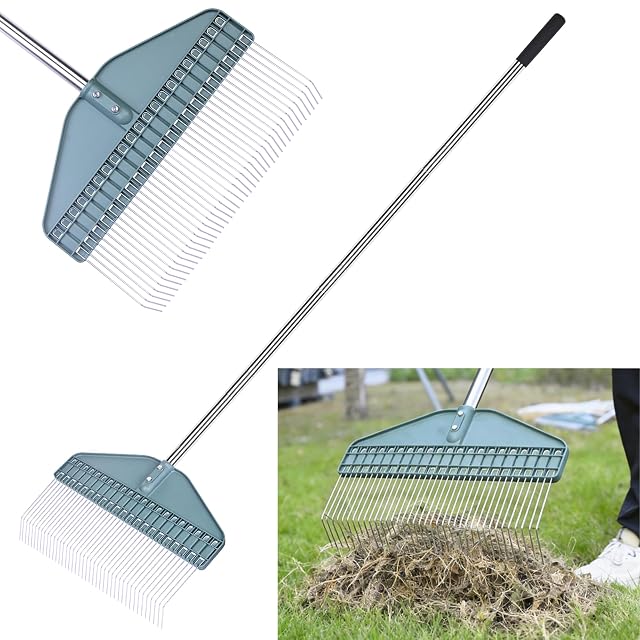
Three handle lengths
165.1 cm. 129.5 cm. 95 cm.
The only height adjustment on this shelf, and on a rake it changes more than any
property of the head.
Because raking is a posture, not a task
Every other consideration on this shelf — width, tine count, material, weight — affects
how fast leaves move.
Handle length decides how far you bend.
And raking leaves is the garden job most often abandoned because of a back rather than
because it is finished: an hour, bent forward, pulling repeatedly, in November, in the
cold.
165 cm lets a tall person work close to upright, with the pull coming from the
shoulders and body rather than from a bent spine.
95 cm is for close work — under a shrub, on a bank, on a terrace, kneeling — and for
a shorter user.
Most rakes are one length, chosen by whoever designed the packaging, and everybody adapts
to it. One rake on this shelf gets at the same problem differently, through a modular
handle range that includes a long back-sparing pattern sold separately.
This one includes three lengths in the tool.
Spring steel, and the trade
“High-quality spring steel tines. Great elasticity, not easily deformed, will not
fatigue or break after repeated use.”
That names the right property. A rake tine is not asked to be strong — it is asked to be
elastic: to bend under load and return, thousands of times a season, cold and wet
and full of grit.
What fails on a cheap rake is a permanent set. A tine that stays bent no longer
reaches the ground at the same angle as its neighbours, so it stops picking anything up.
An old plastic rake has splayed outer tines and has stopped working before anything has
broken.
Spring steel is the material that resists that, and this is one of only two steel rakes
on this shelf — the other is flat galvanised steel.
And what steel gives up: gentleness.
Four rakes here have plastic tines, which flex enough to ride over the sward and
lift loose material without digging in. On a soft wet lawn in autumn, steel pulled
hard lifts grass crowns out with the leaves, and it scratches paving.
So the split on this shelf is a real one:
Dry leaves on a lawn — plastic is the better tool.
Matted wet material, pine needles, straw, acorns — steel is, and this listing names
exactly those.
The self-clearing trick
From the last feature line: “If the rake is clogged with dirt, simply turn it over and
pull it once on the ground. It cleans itself, so leaves and grass slide off the tines
effortlessly.”
That is the single most useful practical note on this shelf, and it works for a
mechanical reason.
A fan rake’s tines are curved, and material collects in the hollow of the curve.
Pulling in the normal direction packs it in tighter, which is why a rake stops working
halfway across a lawn and why everybody ends up pulling wet leaves out by hand.
Turn the head over and the curve is reversed. One pull flexes every tine the other way
and the whole mass releases at once.
It costs nothing, it takes two seconds, and no other listing in this family mentions
it.
The double-bolt fixing
“A double-bolt fixing structure ensures a stable and firm connection.”
Worth noting because the head-to-handle joint is what fails on a complete rake.
Raking is a pull with a twist. Every stroke loads the joint sideways as the head
catches, and a single-bolt or friction fitting works loose: first a rattle, then play,
then the socket splits where the handle has been hammering it.
Two bolts cannot rotate relative to each other, which is the whole point. The same
manufacturer makes the same claim on this site’s aerator shelf, about a dethatching rake
with the same head width — and that is worth a second look.
The rake next door, which is not this rake
The same maker sells a dethatching rake on this site’s aerator shelf: 43.2 cm
head, spring steel tines, adjustable stainless handle to 167.6 cm, double-bolt
head fixing.
Every one of those matches this product.
What differs is what actually separates the two tools: tine spacing and stiffness.
That listing publishes 21 pairs of tines across its 43.2 cm — perhaps twice the
density of a leaf rake — with a half-round hooked profile designed to dig into the
mat of dead grass between the green blades and the soil.
A leaf rake rides over the sward. A dethatcher digs into it. Done at the wrong time
of year, the second one makes a mess of a lawn and the first one achieves nothing.
This listing publishes no tine count, which means the one figure that would tell you
which tool it is has been left out. What the text points at is leaves, straw, pine
needles, acorns and yard debris — so it reads as the leaf rake of the pair.
Anybody buying both should check the tine spacing on arrival, and use them in different
months.
About the price
The dearest rake on this shelf, at more than three times the cheapest complete tool
here.
What it buys, itemised: a handle (five of seven rakes here have none), three
lengths of it, spring steel rather than plastic, a double-bolt joint, and the
fact that it dismantles for storage.
What it does not buy: a published tine count or a published weight — and two
plastic heads on this shelf publish weights of 560 g and 360 g, against a steel head
with a steel handle that will certainly be heavier than either.
On a tool held out at the end of a 1.65 m lever for an hour, that is the figure most
worth having.
Availability
From 35 € to 50 €, that being the spread across the German, French, Italian and Spanish Amazon stores on the day of the survey.
Beyond the euro zone, the American and British Amazon stores price it in their own currencies, which the spread above sets aside.
Taken from Keepa on the day this page was last revised; stock and prices move without notice.
Prices quoted in this text were read on 26 September 2026. The live price is at the top of the page.