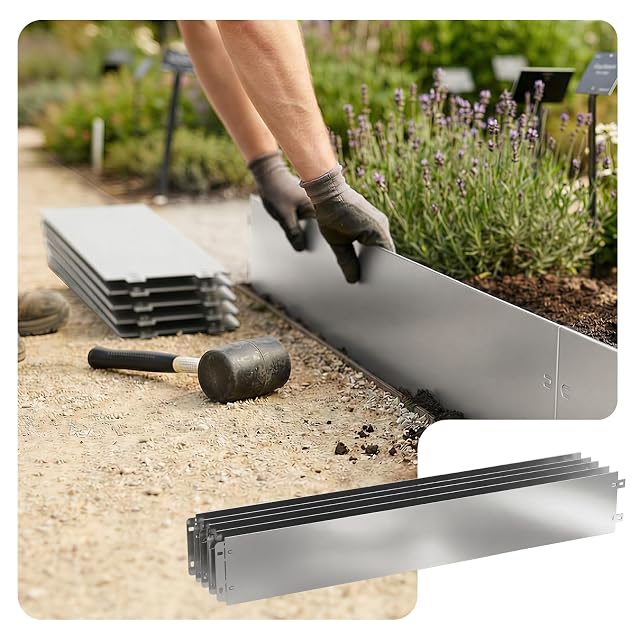
The only galvanised edging here
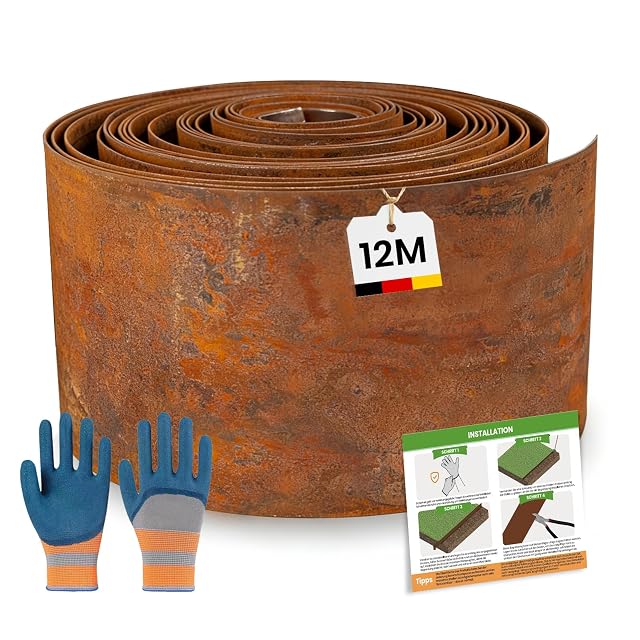
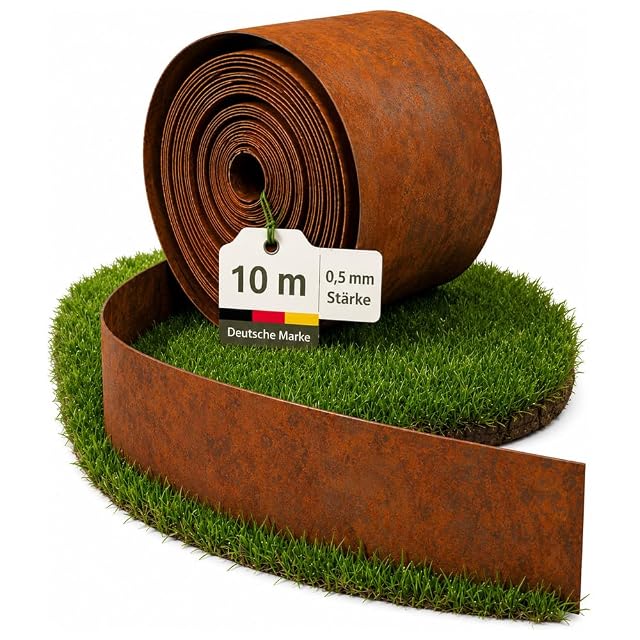
Four products on this shelf are Corten — weathering steel, which is meant to
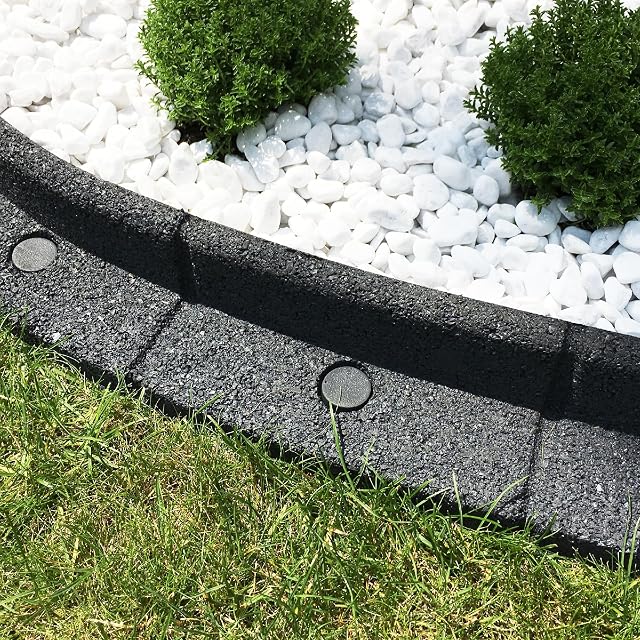
rust. One is plastic. One is recycled rubber.
This is the only galvanised one, and the difference is not quality. It is a
decision about appearance and about what the edging touches.
Galvanised against Corten, properly explained
Galvanised steel is coated in zinc. Zinc corrodes in preference to the steel
underneath it, which is why a scratch in galvanising does not become a rust spot —
the zinc around it protects the exposed metal electrically. It starts bright, dulls
to a matt silver-grey within a season, and stays there.
Corten is a steel alloyed so that its own rust forms a tight, adherent layer
that seals the surface instead of flaking off. It goes deep orange-brown and then
stabilises, and the rust is the protection.
Both last. They look completely different, and there is one practical consequence
that no Corten listing on this shelf mentions:
Corten runs rust while the patina is forming. For the first year or two, rain
carries iron oxide off the surface and onto whatever is below — and on pale paving,
limestone, render or a light gravel path, that stains.
Galvanised steel does not do that. If the edging runs alongside a light-coloured
patio or a rendered wall, this is the one on this shelf that will not mark it.
0.7 mm
The thickest steel published here, against 0.6 mm on the one Corten product
that gives a figure. Three of the five metal edgings publish nothing.
Thickness is the only real specification a metal edging has, and it decides two
things:
Whether it holds a line. Thin sheet follows the ground — every hump and hollow
transfers into the top edge, and a run that should read as a clean line reads as a
wobble. Thicker sheet bridges small irregularities and stays where it is set.
Whether it survives installation. Steel edging is hammered into the ground, and
the listing’s competitors on this shelf mention rubber mallets and hammering teeth.
Thin sheet buckles under a hammer; 0.7 mm takes it.
Point one tenth of a millimetre sounds like nothing. In sheet metal it is about a
sixth more material, and stiffness rises faster than thickness.
The snap system
“No screws needed to connect several metal edgings. Thanks to the simple plug
system, the two ends of the edging snap together.”
That is genuinely quicker than a bolted joint, and on ten panels it is nine joints
saved.
The limitation is worth stating: a plug joint fixes the overlap. A screwed or
overlapped system can be adjusted to make a run come out at the right length; a
snapped one cannot, so the last panel gets cut.
And a cut edge on galvanised steel is bare steel. It will rust, locally, from
the cut — which is invisible if the cut end is buried at a corner, and is worth
putting in the least conspicuous place.
18 cm, and what to do with it
The second tallest on this shelf, behind a 20 cm plastic border. The Corten
products here are 11, 14, 14 and 15 cm.
Height splits into two parts and the split is the decision:
Buried — a root barrier. Couch grass, ground elder and mint travel by rhizomes
in the top 10 to 15 cm of soil, and a continuous sheet through that layer stops
them.
Visible — a design line, and a trip hazard if it is too proud.
Eighteen centimetres lets you bury 13 or 14 and show 4 or 5, which is close to
ideal for a bed edge. It does not let you set it flush, which is what a mowing
edge needs — and that is the other half of this shelf.
Which it is not
A mowing edge.
Two products on this shelf are sold on that function: one names robot mower
compatibility, the other states that mower wheels can run along it and that a
trimmer can be used against it.
An 18 cm sheet standing 4 cm proud does the opposite. The mower cannot reach the
grass against it, so a strip has to be trimmed by hand, and the edging itself is
something a mower deck will hit.
This is a bed border and a good one. The distinction is the most useful thing on the
shelf.
What goes unpublished
No safe top edge. Three products on this shelf address this: two describe a
hemmed or folded top — one specifies a 1 cm fold — and three supply a pair of
mounting gloves.
That matters, because the top edge of a 0.7 mm steel sheet at 4 cm above a lawn is
sharp, at ankle height, in a garden. A folded edge is the engineering answer; gloves
are an admission that there is something to protect against.
This listing offers neither, and heavier gauge does not make an edge less sharp.
About 3.10 € per metre
The cheapest metal on this shelf, where Corten runs 3.83 € to 6.32 € per metre and
recycled rubber about 15.00 €.
The plastic border here is about 1.11 €.
Availability
From 31 € to 35 €, that being the spread across the German, French and Spanish Amazon stores on the day of the survey.
Beyond the euro zone, the American and British Amazon stores price it in their own currencies, which the spread above sets aside.
More than 1.6× the cheapest country at the Italian Amazon store; a gap of that size normally means forwarded stock rather than a seller on the ground, so the spread above leaves it out.
Taken from Keepa on the day this page was last revised; stock and prices move without notice.
Prices quoted in this text were read on 26 September 2026. The live price is at the top of the page.