The two outlets
Two 3/4 inch connections, for taps or hoses.
Three-quarter inch is the thread most garden hose fittings and tap adapters are
built around, which makes this the butt on this shelf that is easiest to connect
to something other than a watering can.
The obvious pairing is a soaker hose or a drip line, and it is a better
pairing than it looks.
Because gravity suits a soaker hose
On this site’s drip irrigation shelf, one manufacturer states a maximum of 1 bar
“in order to achieve even watering”, and explains that its porous hose needs a
low pressure to work properly over time.
A soaker fed from mains at 4 bar weeps hard at the tap end and barely wets the
far end, because a porous hose loses pressure along its length and leaks most
where the pressure is highest.
A butt gives the opposite problem and the right kind of it. A tank 115 cm tall
produces roughly a tenth of a bar at the bottom when full — very gentle, very
even, and falling as the level drops.
That is low even for a soaker. The same manufacturer that publishes the 1 bar
ceiling also points customers wanting to water from an unpressurised container
at a different, pressureless version of its hose — which is the honest answer
here too.
So: two 3/4 inch outlets make this the practical choice for gravity irrigation,
and the hose has to be chosen for gravity rather than for a tap.
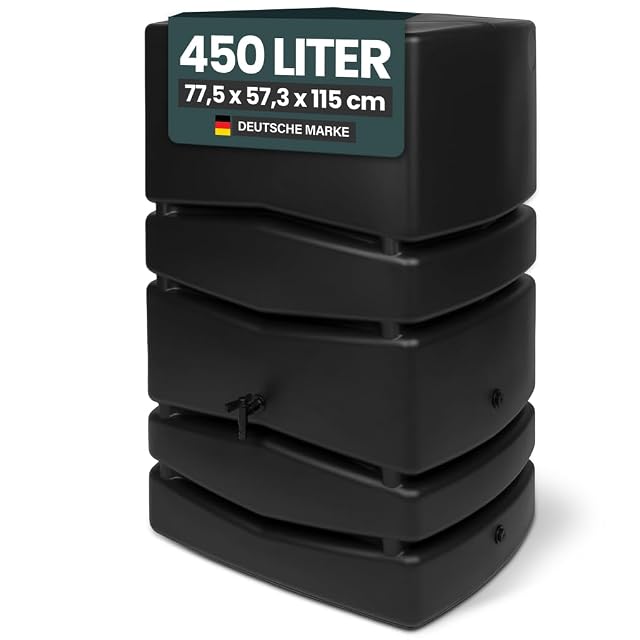
57 × 57 × 115 cm
All three published, which two butts on this shelf do not manage.
That is a footprint of 0.325 m², and 240 litres over it works out at about
739 litres per square metre of ground.
Across the five butts here with published dimensions, that figure runs from 707
to 1,250 litres per square metre — so this is towards the bottom of the
range, despite the listing describing it as relatively slim for its size.
A 57 cm square is compact for 240 litres in absolute terms. It is not dense
compared with the flat-backed wall tanks on this shelf, which get more litres out
of less ground by being deeper front to back and wider than they are thick.
The planting tray
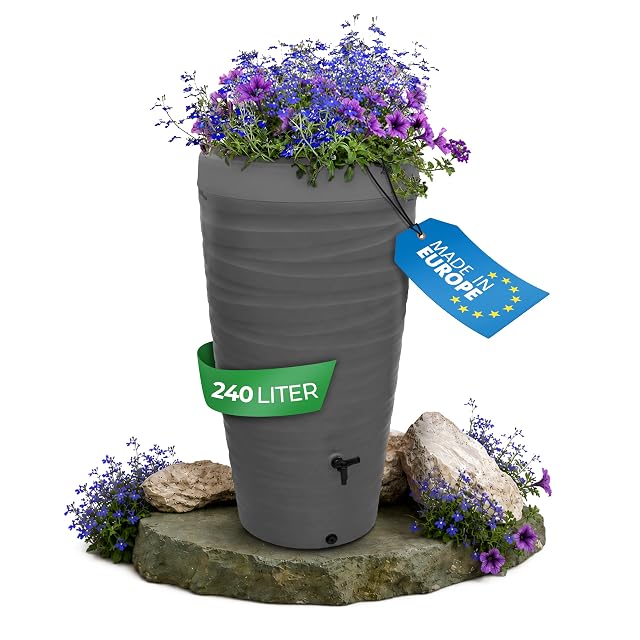
Supplied, and sold on the idea of flowers growing at the water source.
Two butts on this shelf have one, and both share a catch neither listing
mentions: the top of a water butt is a lid whose job is to shed rain into the
tank, so a tray sitting on it is in a rain shadow.
It will not water itself. In July it needs doing daily, by hand, from the butt
below.
The winter instruction, stated
“Always empty the water for overwintering.”
Two of the seven listings on this shelf say this and it applies to all of them.
Water expands as it freezes. A butt left full through a hard frost bulges at the
walls, splits at a seam, or simply snaps the plastic tap off — which is the
commonest outcome, because the tap is the thinnest part and it is full of ice.
The listing also calls the butt frost-safe and UV-resistant, and puts the
draining instruction in the same breath. Both are true: the material
tolerates cold; the water does not.
About 0.54 € per litre
Near the top of a shelf that runs from about 0.25 €.
What it buys: two hose-threaded outlets, a published set of dimensions, a tap, a
planting tray, and a stated frost and UV rating.
What it does not buy is a downpipe collector. Five of the seven butts here
omit one, and it is the part that connects a barrel to a roof — without it the
butt collects whatever falls on its own lid, which is a fraction of a square
metre.
Availability
From 130 € to 149 €, that being the spread across the German, French, Italian and Spanish Amazon stores on the day of the survey.
Listed and unsold: the British Amazon catalogue holds the reference with nobody behind it.
Nothing came back from the American Amazon store at all; the buy button there runs a search rather than opening an empty page.
Taken from Keepa on the day this page was last revised; stock and prices move without notice.
Prices quoted in this text were read on 26 September 2026. The live price is at the top of the page.