The fifth reading, and what it actually is
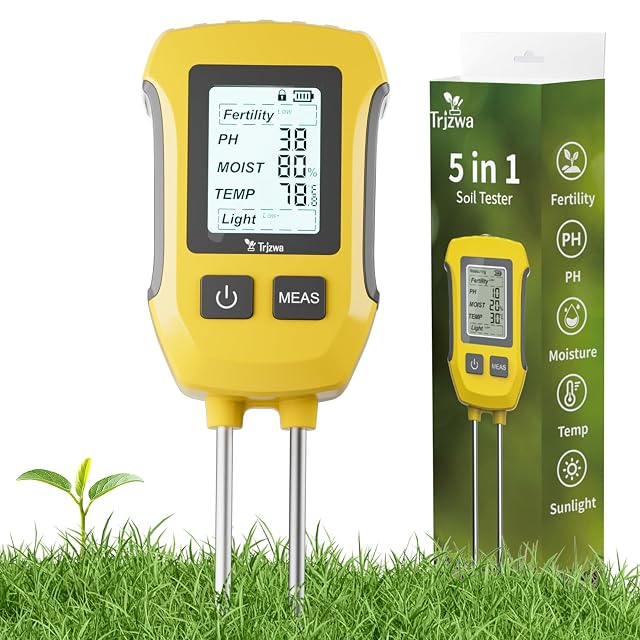
“Fertility” heads the list of five parameters.
A probe cannot measure fertility as nutrients, and this is worth explaining rather
than merely asserting.
What an electrode pair in soil measures is electrical conductivity. Current
passes through the soil water, and how well it passes depends on how many ions
are dissolved in it.
Every soluble salt raises conductivity. Nitrate raises it. Potassium raises it.
Sulphate, calcium, magnesium, chloride and de-icing salt all raise it, by the same
mechanism and indistinguishably.
So the number the meter produces is a measure of total dissolved salts. It
cannot say which salts, it cannot report nitrogen, and it cannot distinguish a
well-fed soil from a soil that had road grit washed onto it.
Which is also why “moisture” and “fertility” are the same signal
This is the part that follows and that no listing on this shelf mentions.
A conductivity reading rises with water and with dissolved salts. Those are
not separable by one probe: wetter soil at the same salt content conducts more, and
saltier soil at the same water content conducts more.
A device reporting both from one probe is reporting two views of one measurement.
Two other meters on this shelf claim a fifth function too. On one of them it is
ambient air humidity, which needs its own sensor and is a genuinely separate
reading. Here and on one other it is fertility.
What the reading is still good for
Not a feeding plan.
Very low conductivity in soil that is clearly not dry does point at a depleted,
heavily leached soil — which is the real condition of a sandy lawn that has been cut
and collected for years. This site’s fertiliser shelf explains why: a grass plant
loses nutrients with every clipping removed.
Very high conductivity points at recent feeding, or at salt.
Beyond that, a real answer requires a laboratory or, for the one variable that
matters most, the chemical test on this shelf — which gives a pH and a lime
requirement from a colour reaction, and is the only output in this family that is
a decision rather than a number.
And for the actual nutrients, this site’s fertiliser shelf shows what a declaration
looks like: two of the seven feeds there publish an NPK, and on those two it becomes
possible to work out that the potassium costs about 11.86 € against 23.18 €
per kilogram — a factor of two that no probe would ever reveal.
The pH, and what the other makers say about it
This listing publishes no caveat about its pH reading. Three others on this shelf
do, and they describe the same method:
A constant reading of 7 means the probe needs cleaning and the measurement
retaking elsewhere.
The soil must be compacted before the pH measurement.
Inconsistent insertion depth in the same soil sample gives inaccurate pH
readings.
Dry or hard soil must be moistened and left ten minutes.
Four user-controlled variables, documented by four independent manufacturers. None
of the six probe meters here publishes a tolerance, a calibration step or a
reference solution for pH.
The two readings that are solid
Temperature. A thermistor measures it properly. It is also the most useful figure
on this shelf for a lawn: this site’s lawn seed shelf publishes germination
thresholds of 8 °C and 10 °C, and seed sown below them waits in cold ground
where birds find it.
Light. A photocell measures it properly. Shade is one of the four reasons moss
gets into a lawn, and knowing how many hours a corner really gets is how you decide
between a shade mix and giving up on grass there.
The genuine improvements in this listing
A remaining-charge indicator. Nothing else on this shelf has one, and on a
device used a few times a season that is more useful than it sounds — a meter with a
failing battery gives low readings rather than no readings.
All five values on one screen. No cycling through interfaces. On a device held at
knee height in a flowerbed, that is a real ergonomic gain.
Eight seconds. One meter here asks for a full minute instead.
A top-mounted sensor, stated to avoid blockage by soil. That addresses the same
failure the “constant 7” warning on another listing describes: a sensor packed with
soil is a sensor not reading the soil.
The 30-second sleep
Aggressive, given the meter takes 8 seconds to read.
Moving from one corner of a bed to another means waking it again. One meter on this
shelf sleeps after five minutes instead, which is the better balance for a tool used
in a garden rather than a pot.
Availability
From 24 € to 29 €, that being the spread across the German, French, Italian and Spanish Amazon stores on the day of the survey.
Listed and unsold: the British Amazon catalogue holds the reference with nobody behind it.
Nothing came back from the American Amazon store at all; the buy button there runs a search rather than opening an empty page.
Taken from Keepa on the day this page was last revised; stock and prices move without notice.
Prices quoted in this text were read on 26 September 2026. The live price is at the top of the page.