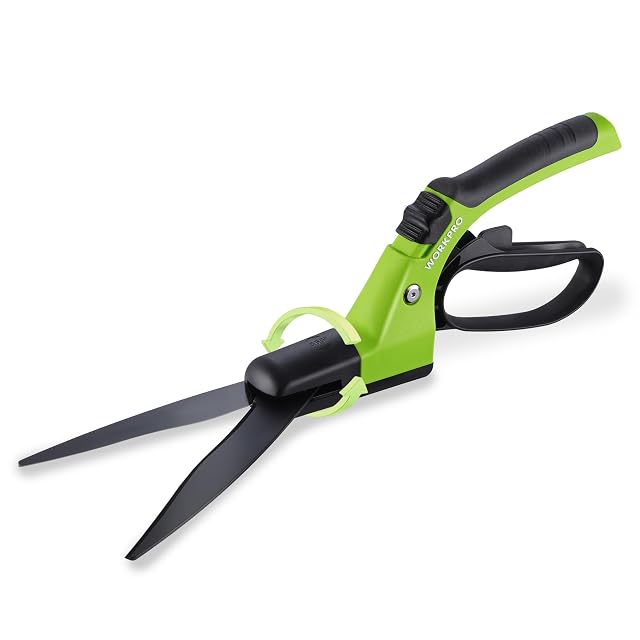
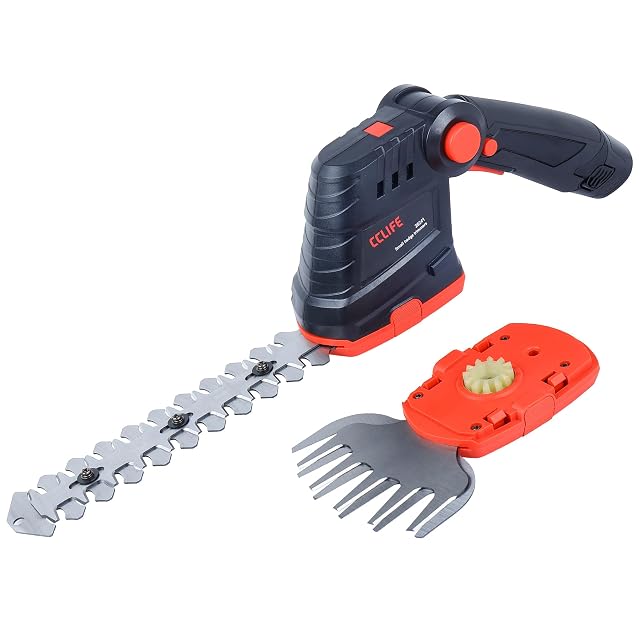
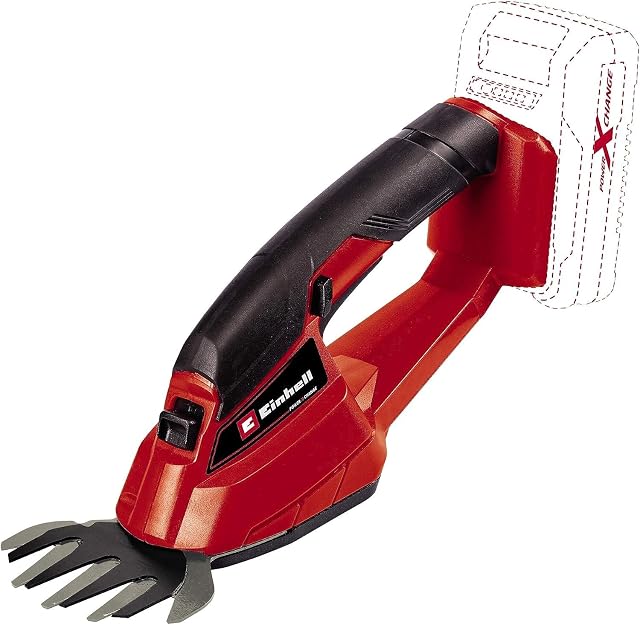
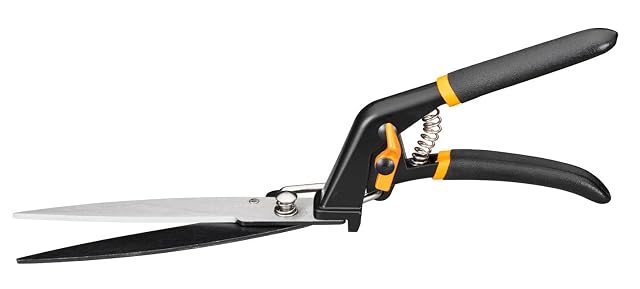
Four of the products here are hand shears. Three are battery shears.
And they publish different things, which is the first thing to notice.
The hand shears publish the length of the tool: 39 cm here, 31 cm on another.
The battery shears publish the width of the cut: 83 mm, 100 mm, 120 mm.
Those are not the same measurement and they cannot be compared. Not one of the four
hand shears on this shelf publishes a blade width, which is the specification that
would tell you how much grass it takes per cut.
Sixteen positions, and what rotation is actually for
360°, locking in 16 positions — 22.5° apart.
That is the finest rotation adjustment on this shelf. One competitor offers 180°, and
two offer none at all.
The reason it matters is geometry rather than convenience.
A fixed grass shear cuts horizontally. You hold it level and it takes a strip of
grass off at the height you hold it. That works in open lawn and nowhere else.
An edge needs a vertical cut. The grass growing over the lip of a path, up against
a wall, around a tree trunk, behind a downpipe — all of that is a cut in a different
plane from the one your wrist naturally makes.
Without rotation you twist your wrist instead, which is uncomfortable and
inaccurate and is why people give up on hand shears.
Sixteen stops means there is always a position within about eleven degrees of whatever
angle the obstacle demands. For working around fixed objects — which is exactly what a
strimmer cannot do without stripping bark — that is the right feature.
The spring, which matters more than it sounds
“The integrated spring opens the blades automatically after each cut.”
Every cut with an unsprung shear is two actions: squeeze, then deliberately open
the hand against the blade friction.
The second one is what tires a hand, because opening uses the weaker muscles. Half an
hour of edging is several hundred cuts, and several hundred forced re-openings.
A sprung shear is one action per cut: you pull, it opens itself. The hand only ever
does the strong movement.
Three of the four hand shears on this shelf are sprung in some form — one publishes a
claim of 20 % less force from improved mechanics, with no baseline stated.
The safety catch
“The safety lock prevents the shears opening accidentally when not in use.”
Small and worth having. Grass shears live in a bucket or a drawer with secateurs and a
trowel, and a sprung shear with no catch is a sprung shear that is always open — blades
apart, at hand height, in the dark.
The loop handle, and the one thing a competitor does better
“The comfortable loop handle sits securely in the hand and increases friction.”
That is the conventional arrangement: the whole hand closes around a loop.
One shear on this shelf uses a different design — a grip operated with the index and
middle fingers rather than the whole fist, specifically to reduce the force needed.
The difference shows up in a long session. A whole-hand squeeze uses more muscle and
gets tired; a two-finger action is less powerful and can be repeated far longer. For
edging a lawn — many small cuts, none of them hard — the second is the better
arrangement.
That shear is also the only one on this shelf with a skid plate, and it is
right-handed only.
The coated blades
“Robust steel blades with a black coating. The coating ensures long-lasting sharpness
and easy cleaning.”
The coating claim worth examining is the cleaning one, because it addresses the
real failure mode of grass shears.
Grass sap is sticky and it sets. Cut grass leaves a green-brown residue on a blade
that dries to a varnish, and a shear left uncleaned after one session is stiff at the
pivot and dragging at the blade faces by the next.
A coated surface releases it more readily. One shear on this shelf specifies a
non-stick coating for the same reason.
What no coating does is keep an edge indefinitely. Wiping the blades dry after every
use and a drop of oil at the pivot is what actually keeps these working, and no
listing on this shelf says so.
What goes unpublished
No cutting width. As above — the shelf’s central gap on the hand tools.
No weight. One battery shear here publishes 0.62 kg, and it is the only weight
in the family. On a tool held out at arm’s length and worked several hundred times,
that figure matters more than most.
No blade material beyond “steel”, and no hardness.
Availability
From 13 € to 20 €, that being the spread across the German, French and Spanish Amazon stores on the day of the survey.
Beyond the euro zone, the American and British Amazon stores price it in their own currencies, which the spread above sets aside.
More than 1.6× the cheapest country at the Italian Amazon store; a gap of that size normally means forwarded stock rather than a seller on the ground, so the spread above leaves it out.
Taken from Keepa on the day this page was last revised; stock and prices move without notice.
Prices quoted in this text were read on 26 September 2026. The live price is at the top of the page.