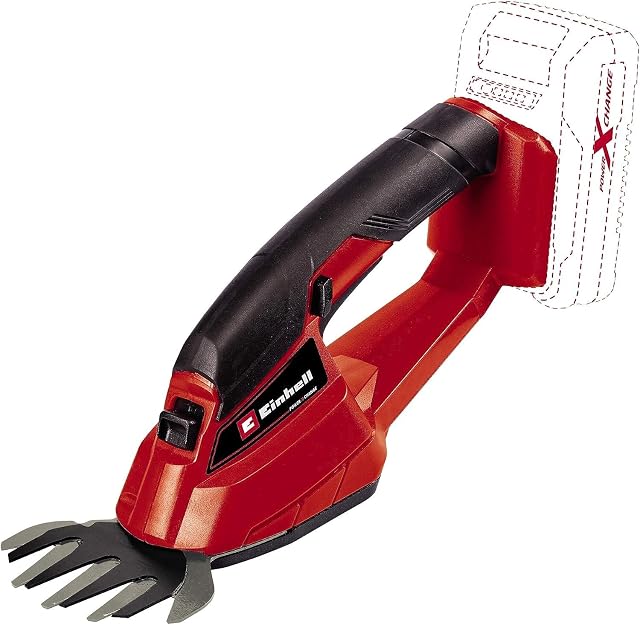
“The cordless grass shears are driven by a robust metal gearbox, which transmits enough
power to the blades even in densely grown grass.”
That is the only gearbox material named on this shelf, and it identifies the part that
actually breaks.
A battery grass shear has a motor that spins fast and weakly and a blade that has
to move slowly and strongly.
Between them sits a gear train that trades the one for the other, and everything the
blade meets is transmitted back through it.
What the blade meets is not gentle. Grass is soft; the tussock at the base of a
fence post is not, and neither is the twig hidden in it, the wire, the stone, or the
moment the blade jams against a kerb.
Each of those is a shock load arriving at the gear teeth.
Plastic gears absorb a few of those and then wear their teeth round, or strip. The
tool still runs — the motor whines and the blade barely moves — and there is nothing to
repair.
Metal gears transmit it. The load goes somewhere else: the blade stops, the motor
stalls, and the overload protection cuts in.
On a tool used along the base of walls, fences and kerbs, that difference is the one
that decides whether it lasts five seasons or one.
100 millimetres
The middle cutting width on this shelf: 83 mm, this 100 mm, and 120 mm.
That is 20 per cent more grass per pass than the lightest competitor here, and on
twenty metres of boundary it is a fifth off the number of passes.
The listing ties it to the right thing: “the low weight of the device and the cutting
width of 100 mm make the cordless grass shears the perfect helper for large gardens and
more demanding work.”
Low weight is claimed and not stated. One battery shear on this shelf publishes
0.62 kg; this publishes nothing, and it is an 18 V tool with a metal gearbox and a
battery pack on the back — all three of which add mass.
On a tool held out at arm’s length and pointed down, that is the figure a buyer most
needs and it is absent.
Eighteen volts, and what higher voltage buys
The highest on this shelf, against 10.8 V and 7.2 V.
More power at the same current. Which in practice means the blade keeps moving in
dense matted grass instead of slowing and stalling — the condition the listing names.
And a bigger battery. An 18 V pack is physically larger and heavier than a 7.2 V
one, and it hangs off the handle of a tool used at arm’s length.
The trade is genuine and it points at two different uses:
7.2 V, 0.62 kg, 60 minutes, 83 mm is a tool for a long light session.
18 V, 100 mm, metal gearbox is a tool for grass that fights back.
No runtime, and why that is correct
The listing publishes no runtime figure, and it could not.
Runtime is capacity divided by draw, and the capacity is not part of this product.
The batteries in this 18 V platform range across several capacities, and the difference
between the smallest and the largest is a factor of four or more.
One competitor on this shelf publishes 60 minutes from an integrated 1500 mAh
pack; another publishes 15 to 20 minutes. Both can do that because the battery is
part of the tool.
A platform tool that published a single runtime would be publishing a figure that was
wrong for most of its own batteries, and this listing does not.
Stated plainly, twice: “battery and charger are not included in the delivery, but are
available separately as a starter set”, and the packs may only be charged with the
matching charger.
If you already own the batteries, this is the cheapest way to own a powered grass
shear with a metal gearbox, because the expensive parts are already in the shed.
If you do not, the price on the shelf is not the price. A pack and a charger for a
platform like this cost more than most of the tools on this shelf, and at that point the
two shears here that arrive complete are both cheaper.
The same trade appears on this site’s spreader shelf, where two of three battery
spreaders are bare tools and one includes its battery and charger.
And the removable-battery advantage nobody here states
One battery shear on this shelf has an integrated cell: sixty minutes, then
charging, and when the cell ages the tool is finished.
A platform tool has a removable pack. A second battery is a ten-second swap rather
than an hour’s wait, and a worn cell is a spare part rather than the end of the tool.
On a tool that might be used for ten years, that is worth more than the runtime figure
it cannot publish.
What goes unpublished
No weight. No runtime. No blade speed — one competitor publishes 1100 rpm.
No cutting thickness — one competitor publishes 8 mm. No rotation.
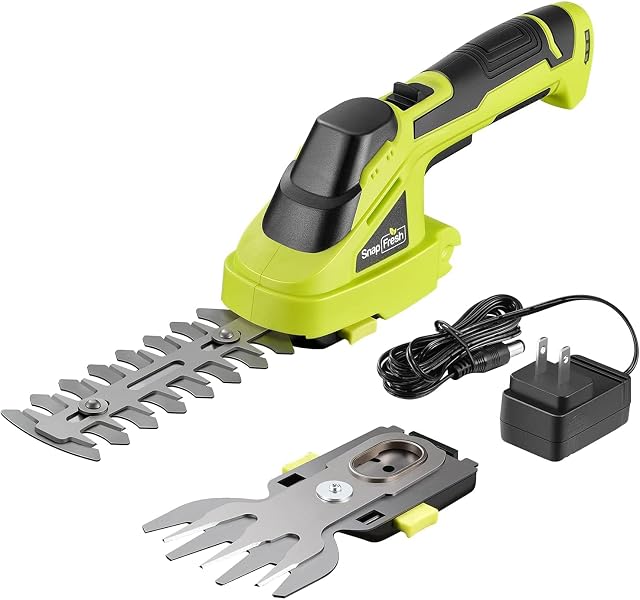
And no hedge blade: two battery shears on this shelf supply a second, longer blade for
woody shoots, changed without tools. This one is supplied with a grass blade only.
Availability
From 36 € to 48 €, that being the spread across the German, French, Italian and Spanish Amazon stores on the day of the survey.
Beyond the euro zone, the British Amazon store prices it in its own currency, which the spread above sets aside.
Listed and unsold: the American Amazon catalogue holds the reference with nobody behind it.
Taken from Keepa on the day this page was last revised; stock and prices move without notice.
Prices quoted in this text were read on 26 September 2026. The live price is at the top of the page.