Rain barrels
Tymar IDSM
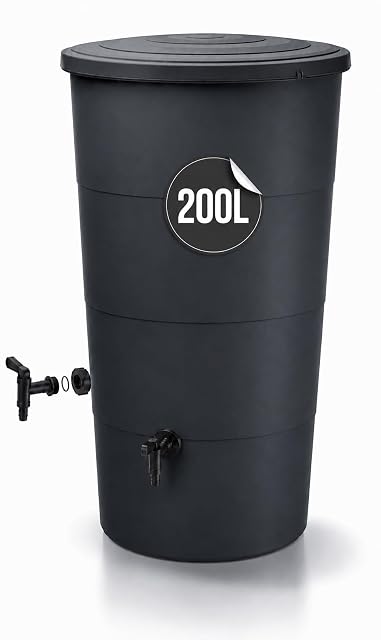
The cheapest litre on this shelf — 200 litres in a 60 cm circle, with a tap you fit at your own height.
The cheapest litre on this shelf
200 litres at the German price recorded here works out at about 0.25 € per
litre.
Across this shelf the range runs from that figure to about 0.56 € — a factor
of more than two.
And it does not sort the shelf, because the cheap litre here comes without a
downpipe collector, without a stand, and with a hole you have to make yourself.
The dearest litre arrives with the downpipe connector in the box.
Ø 600 mm. That is a circle of about 0.28 m².
200 litres over 0.28 m² is roughly 707 litres per square metre of ground.
That figure is worth calculating on every product here, because ground is the
scarce thing beside a house wall. Across the five butts on this shelf that
publish dimensions, litres per square metre run from 707 to 1,250 — and the
densest is a flat-backed wall tank rather than a round one.
A round barrel is the least efficient shape against a wall, because the wall
meets the circle at one point and there is a wedge of wasted ground on either
side. It is also the shape that fits in a corner of a patio where nothing
rectangular will go, and 60 cm is genuinely compact.
The tap you fit yourself
The listing is explicit: a tap is supplied, and you drill a hole at whatever
height you want.
That is unusual, and it is worth thinking about properly before treating it as
a saving.
The argument for it. The right tap height depends entirely on how the butt
is installed — on the ground, on blocks, on a purpose-made stand — and on what
you draw water into. A manufacturer cannot know that.
The argument against it. You get one attempt. A hole 5 cm too low is a butt
you can never get a watering can under; a hole too high is 40 litres you can
never reach. And a hole drilled slightly out of round in a curved wall is a tap
that weeps forever.
Other products on this shelf answer the same question differently: one includes
a four-part stand, one has two outlets at different heights, one has threaded
bosses already moulded at 10 cm and 38 cm.
And the height that a watering can needs
The single most practical thing to know about any water butt.
A full watering can is about 30 to 35 cm tall, and it needs clearance to sit
under the spout and to be lifted out.
A tap at the bottom of a butt standing on the ground gives you a bucket lying on
its side, or a hose.
So either the tap goes a third of the way up — and everything below it is
water you cannot use without a siphon — or the butt goes up, on blocks,
paving slabs or a stand.
On a 200-litre butt, a tap at 35 cm strands something in the order of 60 litres.
Standing it on two courses of blocks costs nothing and keeps all of it.
What goes unpublished
No roof area, which is the figure that tells you whether 200 litres is a
season’s supply or three days’ rain. One product on this shelf publishes one:
up to 50 m².
No weight, empty. No frost guidance, though it is universal on this
shelf: water expands as it freezes, and a butt left full through a hard winter
splits or bulges. Emptying in November is the whole of the maintenance.
No lid description, and no mention of whether it is secured — which matters
if there are children or animals near it.
Availability
From 50 € to 61 €, that being the spread across the German, Italian and Spanish Amazon stores on the day of the survey.
Listed and unsold: the American, British and French Amazon catalogues hold the reference with nobody behind it.
Taken from Keepa on the day this page was last revised; stock and prices move without notice.
Prices quoted in this text were read on 26 September 2026. The live price is at the top of the page.