The only chemical test on this shelf
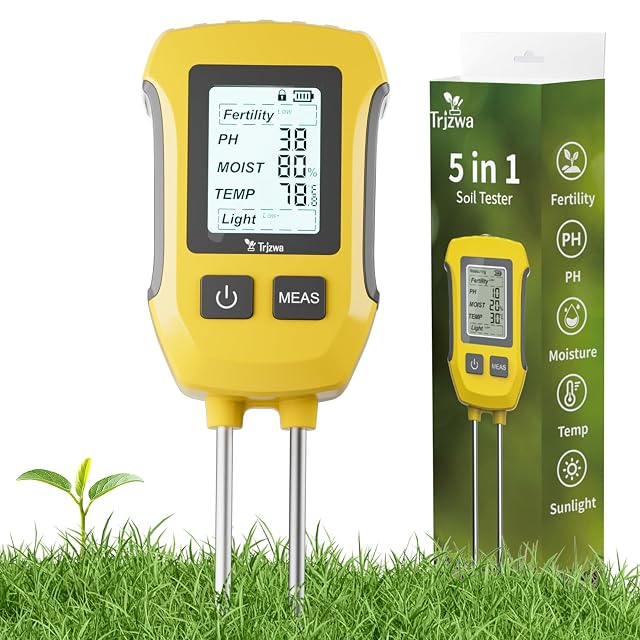
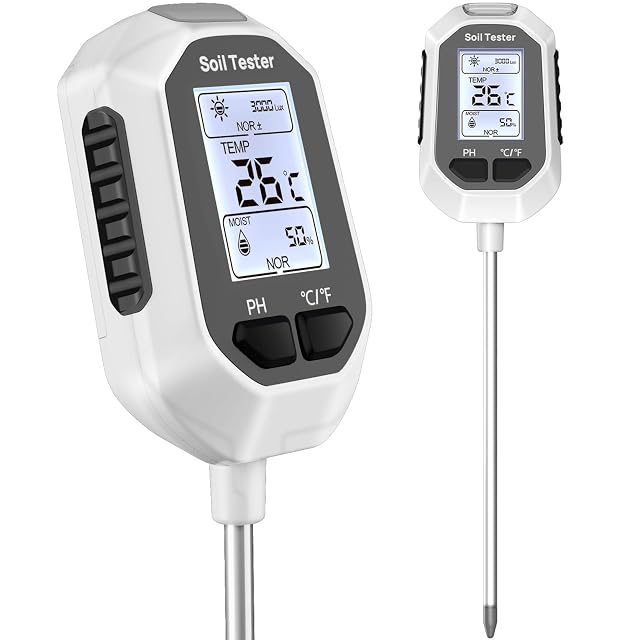
Six products in this family put a pH figure on a screen from a metal probe.
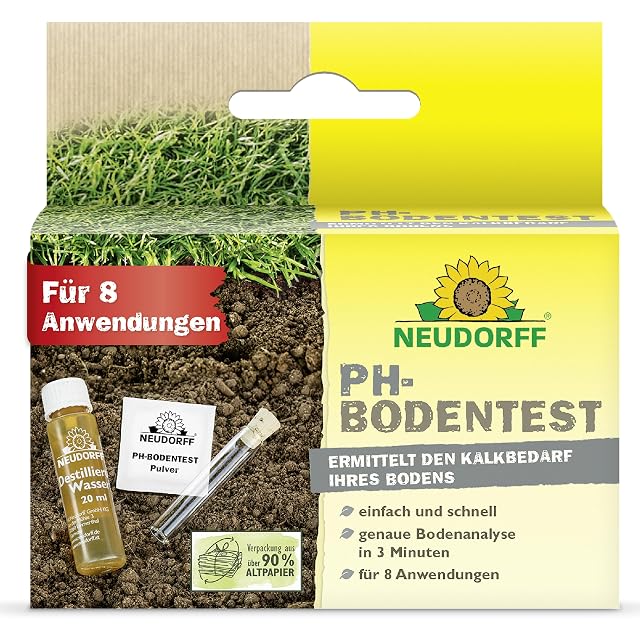
This one does it the way a laboratory does it in miniature: a reagent powder, a
test tube, distilled water, and a colour scale.
Three minutes, eight times, and then the kit is used up.
Why that is the more dependable method
A probe infers pH from an electrical property of the soil touching its surfaces.
Soil is particles, water films and air — so how much of the probe is in contact
with wet soil varies, and the reading varies with it.
The manufacturers of the probe meters on this shelf say so themselves, in their own
listings:
One warns that a constant reading of 7 means the probe needs cleaning and the
measurement needs retaking somewhere else.
The same one says the soil must be compacted before a pH measurement.
Another says that inconsistent insertion depth in the same soil sample gives
inaccurate pH readings.
A third asks for dry or hard soil to be moistened and left ten minutes before
measuring.
Four independent manufacturers, four variables the user has to control: depth,
cleanliness, compaction and moisture.
A chemical test removes all four. The powder reacts with a soil-and-water
suspension — the reaction is with the soil water itself, and it does not care how
hard anybody pushed.
None of the six probe meters on this shelf publishes an accuracy figure for pH: no
± tolerance, no calibration step, no reference solution. This one publishes a
colour scale, which is a calibration you can see.
The distilled water, which is not a detail
Supplied in the kit: a small bottle of it.
This is the commonest way a home pH test goes wrong, and it is why the inclusion
matters.
Tap water has its own pH, and in a hard-water area it is alkaline — it carries
dissolved calcium carbonate, which is chemically the same thing as lime. Making the
suspension with it shifts the result towards alkaline, by an amount that depends on
where you live.
A kit that supplies its own water removes the variable. A kit that does not is a
kit whose result depends on the supply.
The lime table, which is the actual output
This is what separates this test from a number on a screen.
The kit gives a colour, the colour gives a pH, and an enclosed table converts
that into how much lime the soil needs.
That distinction matters more than it sounds.
A reading of “pH 5.4” is information. It tells you the soil is acid. It does not
tell you what to do, because the amount of lime needed to move a soil’s pH depends
on the soil type as much as on the starting point — a sandy soil shifts with a
little lime, and a heavy clay resists, because clay has a far greater capacity to
hold the acidity in reserve.
A table that reads across from colour to quantity is a decision rather than a data
point. No other product on this shelf produces one.
Why lawn pH is worth measuring at all
Because it sits underneath three other shelves on this site.
Moss. Moss is favoured by acidity. A lawn that is mossy on compacted, shaded,
acid soil is mossy partly because of the pH — and this site’s moss killer shelf
carries iron sulphate products that acidify further. One of those listings
describes its own acidification as “optimising” the pH, and whether that is true
depends entirely on which soil you have. This test is how you find out before
buying.
Colour. Above about pH 7 iron and manganese become less available, and grass
goes pale yellow-green rather than dark. That looks like a nitrogen shortage and it
is not, and feeding it will not fix it.
Nutrient availability generally. Grass does best at roughly 6.0 to 6.5.
This site’s lawn soil shelf has exactly one substrate that publishes its own pH,
and it is 6.0 — the bottom of that band.
Feeding, liming and moss treatment are three decisions that all rest on one number,
and six products on this shelf produce that number with a caveat attached.
Eight uses
The honest limitation.
A probe meter is reusable indefinitely. This kit is finished after eight tests, and
then it is a purchase again.
Eight is more than it sounds for a lawn. Soil pH changes slowly — over years, not
weeks — so the sensible pattern is a test every two or three years, and two or three
samples from different parts of the lawn each time to catch variation. That is
several years of testing in one kit.
Where eight would not be enough is a large or varied plot, or a vegetable garden
where different beds want different pH.
The practical tip in the listing
“Form a funnel out of a piece of paper to get the powder into the tube.”
Small, and the sort of thing that only appears in a listing when somebody has
actually done it. Getting a sachet of fine powder into a narrow tube outdoors,
without a funnel and usually in a breeze, is exactly as annoying as it sounds.
Availability
Around 11 €, read at the German Amazon store on the day of the survey.
Nothing came back from the American, British, French, Italian and Spanish Amazon stores at all; the buy button there runs a search rather than opening an empty page.
Taken from Keepa on the day this page was last revised; stock and prices move without notice.
Prices quoted in this text were read on 26 September 2026. The live price is at the top of the page.