The thumb control
The reason to consider this gun, and it is a better argument than the ten
patterns the listing leads with.
Most spray guns are operated by a trigger: three fingers squeezing against
a spring, held for as long as the water runs. It is the standard and it is
tiring, which is why people water in bursts and stop early.
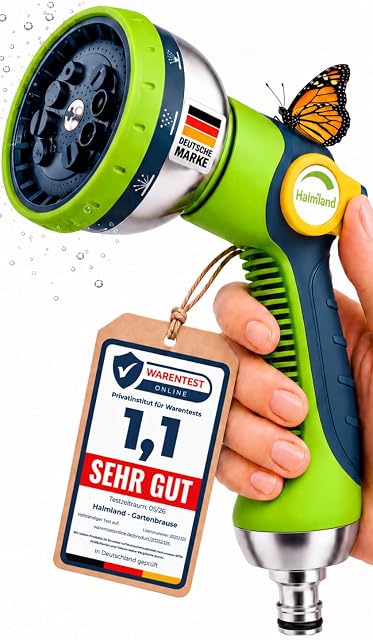
A thumb lever works the other way. The fingers wrap the handle and hold the
gun; the thumb presses the lever. The thumb is the strongest digit on the hand
and it is opposing the grip rather than being part of it.
The practical consequences: it can be held longer, it can be held at a
consistent setting, and the other hand stays free — for a pot, a trowel, or
pulling the hose along.
Stepless, which is the half that matters for seedlings
The control is described as regulating pressure steplessly with one hand.
Those are two separate adjustments and the difference is worth understanding.
The pattern decides the shape: mist, cone, shower, jet.
The flow control decides how much water goes through that shape.
A mist pattern at full flow is still a lot of water arriving at once, and it
will flatten a tray of seedlings. A mist pattern at a quarter flow is a genuine
fine spray that settles rather than lands.
Guns without a flow control have one intensity per pattern. This has a
continuum, and for raised beds and propagation it is the feature that matters.
Ten patterns, and the shelf’s verdict on pattern counts
The most on this shelf.
Sorted by price, the counts across this family run 8, 8, 3, 4, 10, 5 and 1.
There is no relationship. The two cheapest guns here have eight patterns; the
gun at four times their price has five; the dearest product on the shelf has
one.
So ten is a marketing number rather than a specification, and this page treats
it as such. What gets used on any gun is a jet for washing, a shower for
watering, and a mist for anything delicate. The rest of the bezel is turned
past on the way between them.
The material statement, and it is partial.
Aluminium at the connector is a real and specific claim, and it is the right
place to put metal. That joint takes a spanner or a firm hand every time the gun
goes on or off a hose; a plastic collar rounds off and then will not seal.
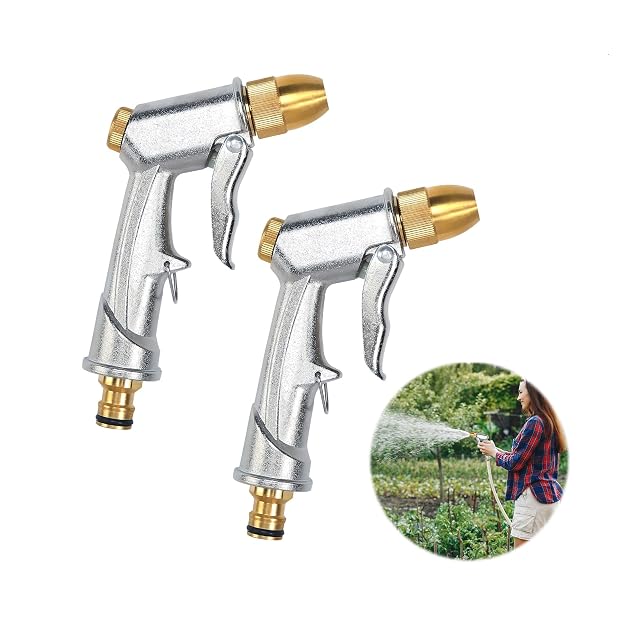
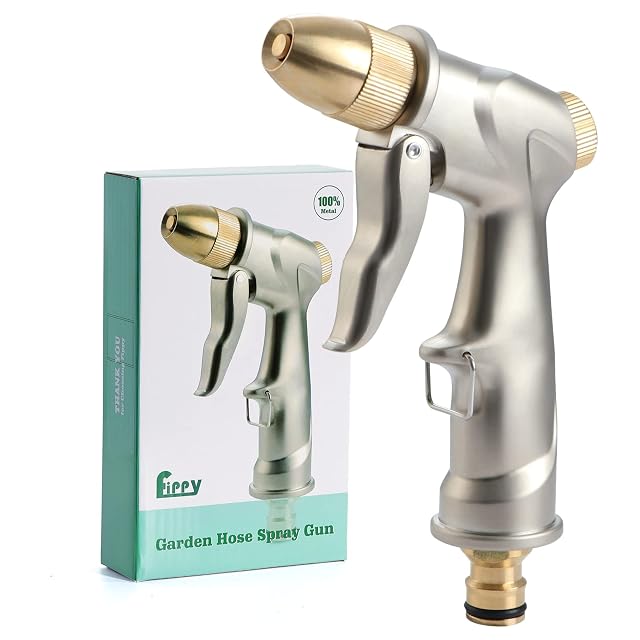
“Robust metal components” for the rest is not a material. Two other metal
guns on this shelf name theirs — one aluminium alloy, one a zinc alloy body with
a solid brass nozzle — and the nozzle material in particular decides how long a
jet stays a jet, because that orifice is eroded by grit in the water.
This listing does not say what the nozzle is.
What goes unpublished
No flow rate. No thread size. No dimensions. No weight.
The one product on this shelf that publishes a flow rate gives 44 litres a
minute at 4 bar, along with a 0.7 mm hole diameter and a 35 cm spray width —
and it is a watering lance rather than a gun.
Every gun on this shelf leaves all four blank.
Availability
From 20 € to 25 €, that being the spread across the German, French and Spanish Amazon stores on the day of the survey.
Beyond the euro zone, the British Amazon store prices it in its own currency, which the spread above sets aside.
More than 1.6× the cheapest country at the Italian Amazon store; a gap of that size normally means forwarded stock rather than a seller on the ground, so the spread above leaves it out.
Listed and unsold: the American Amazon catalogue holds the reference with nobody behind it.
Taken from Keepa on the day this page was last revised; stock and prices move without notice.
Prices quoted in this text were read on 26 September 2026. The live price is at the top of the page.