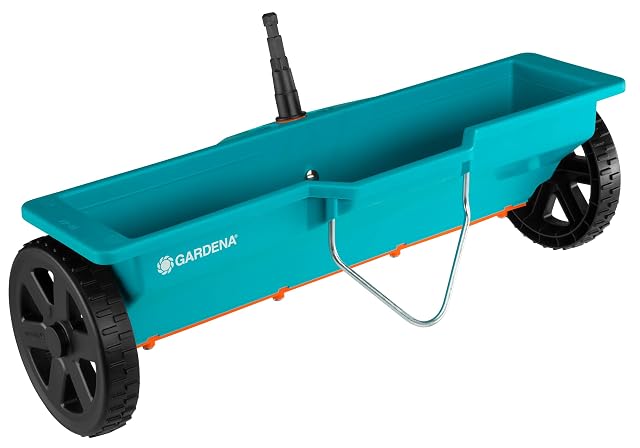
The narrowest spreader here, and that is the point
40 cm.
The rest of this shelf goes to 41 cm, 2 m per side, 2.5 to 3.5 m and up to 5 m.
A twelvefold range, on the number that looks like it should be maximised.
Drop versus broadcast, which decides everything
A drop spreader — this, and one other on this shelf — has a slot in the
bottom of the hopper. Material falls straight down between the wheels. It treats
exactly the width of the machine, at the same rate across it, and puts nothing
outside that line.
A broadcast spreader — three on this shelf — throws material off a spinning
disc or an oscillating plate. It covers two to five metres a pass, and the cone
it throws is denser near the middle and thinner at the edges.
That difference is the reason lawns end up striped.
Where the stripes come from
A broadcast spreader has to be overlapped, and by roughly the right amount.
Too little overlap and there is a pale line between passes where neither cone
reached full rate. Too much and there is a dark line where two cones stacked —
and with nitrogen, a double dose scorches.
Neither shows up on the day. Both appear about ten days later as a lawn with
stripes in it, and by then there is nothing to do but wait.
A drop spreader cannot make that mistake in the same way. Its edge is a hard
edge: you run the next pass wheel-track to wheel-track and the rate is the same
everywhere. Its failure is a missed strip if you leave a gap, which is
visible and fixable.
The levelling bar
Named in the listing as giving an even pattern across the 40 cm.
On a drop spreader that bar is the whole mechanism. Granules flow unevenly out of
a wide slot — faster where the hopper is deeper, slower at the ends — and a bar
that shears the flow to a constant depth is what makes the 40 cm even rather
than merely 40 cm wide.
And where 40 cm is worth the extra passes
A narrow, hard-edged pattern is not a compromise in three situations, and
they are common ones.
Next to a bed. Lawn fertiliser landing on a border is a nitrogen dose on
plants that did not need it, and a broadcast cone reaching two metres will put it
there.
Next to a path or a drive. Iron-containing lawn feeds stain concrete and
paving permanently, and sweeping is not enough once it has rained.
Next to water. Fertiliser in a pond feeds algae, and a broadcast spreader
run along a bank puts it in.
For an open lawn of any size, 40 cm is a great many passes and one of the
broadcast spreaders here is the better tool.
The handle, which is not included
The delivery line is explicit: one spreader head; the handle is not supplied and
is available separately.
That is the same arrangement as the aerator head on this site’s aerator shelf,
and the same trade applies. Bought into the range, the tenth tool costs the price
of a head and stores in a drawer. Bought cold, this is two purchases and the
handle is not the cheap half.
The listing does name the compensation: it fits every handle in the range,
including the longer back-sparing ones — and a spreader is pushed slowly, bent
slightly forward, which is exactly the job a long handle helps with.
What goes unpublished
No hopper capacity.
Every other spreader on this shelf publishes one, and they run from 3.3 litres to
45. On a 40 cm drop spreader, capacity is what decides how many times you walk
back to the bag — and a narrow machine covers ground slowly, so it empties
slowly too.
No metering scale. The levelling bar is named; how it is set for a 20 g/m²
seed rate against a 35 g/m² fertiliser rate is not described. One spreader on this
shelf maps its numbered settings to material types, and it is the only one.
Availability
Around 23 €, read at the German Amazon store on the day of the survey.
Beyond the euro zone, the American and British Amazon stores price it in their own currencies, which the spread above sets aside.
More than 1.6× the cheapest country at the French, Italian and Spanish Amazon stores; a gap of that size normally means forwarded stock rather than a seller on the ground, so the spread above leaves it out.
Taken from Keepa on the day this page was last revised; stock and prices move without notice.
Prices quoted in this text were read on 26 September 2026. The live price is at the top of the page.