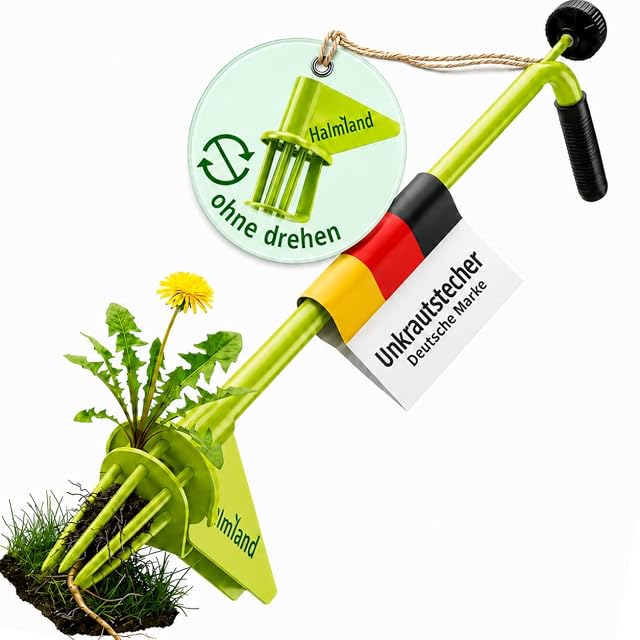
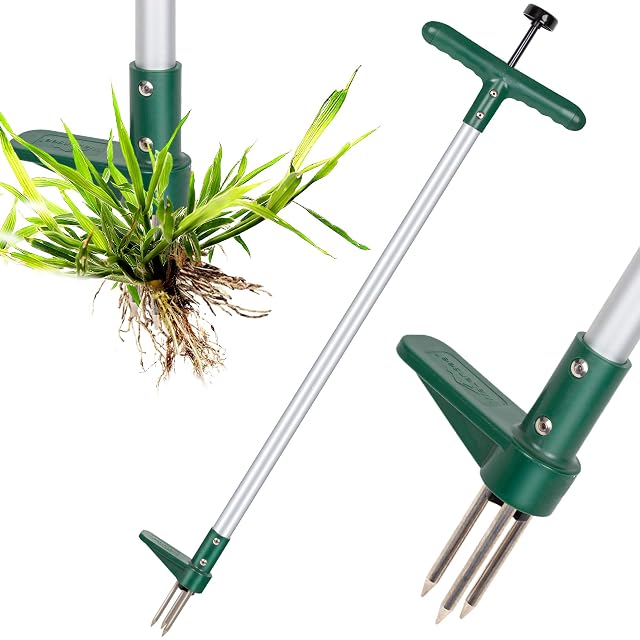
A foot pedal, and a long handle.
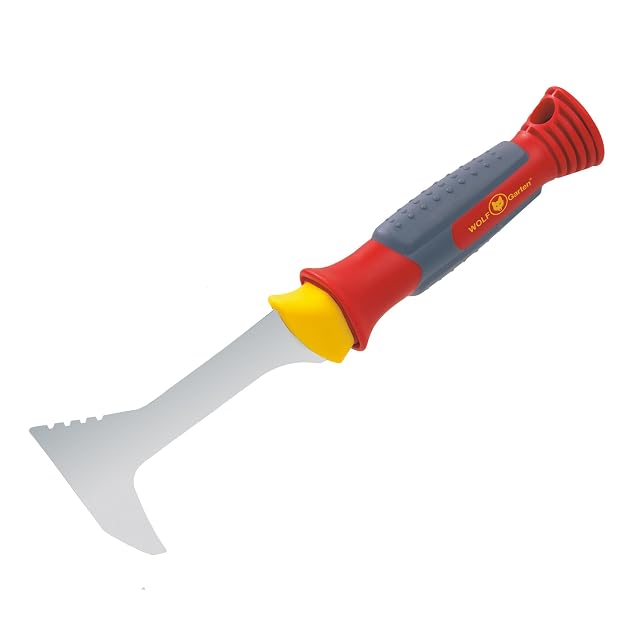
Three products here are joint scrapers for paving. Two are taproot knives used
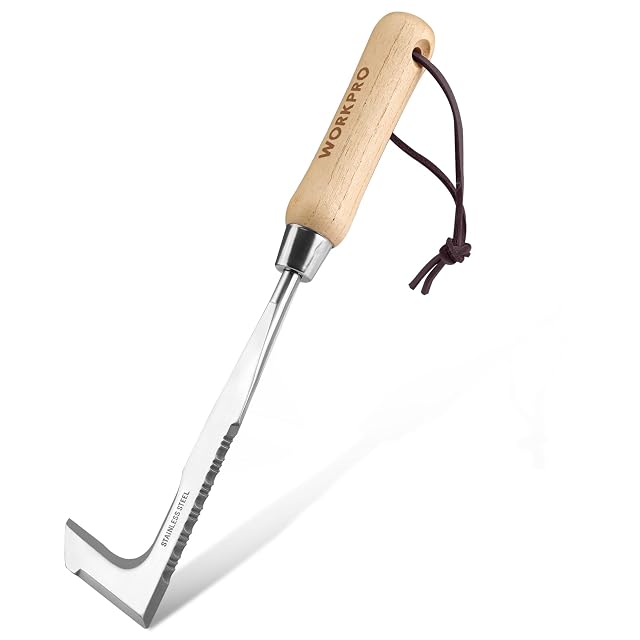
kneeling. Two — this and one other — are stand-up claw pullers.
Why standing changes the job, not just the comfort
The listing leads with backs: “back-friendly working without bending”.
That is true and it is the smaller half of the argument.
The bigger half is force.
A hand weeding knife is driven into the ground by your arm, and levered by your
wrist. In a dry compacted lawn in July, that is not much force, and it is the reason
taproots snap instead of lifting.
A pedal tool is driven by your body weight — you stand on it — and levered by the
whole handle, which is a metre of lever rather than fifteen centimetres.
That is a different order of magnitude, and it is what gets a root out whole from ground
a hand tool cannot penetrate.
It is the same argument the hollow-tine aerator on this site’s aerator shelf makes with
its own foot plate, and for the same reason: arms are the wrong muscle for pushing steel
into soil.
Six claws
The highest claw count on this shelf; the other stand-up puller has three.
The two arrangements are a genuine trade rather than a ranking:
More claws spread the grip over a wider circle. They are less likely to slide off a
rosette, they hold a spreading root mass — a plantain or a daisy clump rather than a
single dandelion taproot — and they close around it more completely.
Fewer, longer claws concentrate the same downward force on fewer points, which is
what penetrates hard dry ground. Three claws go in where six stop.
The other puller on this shelf publishes its claw length — 2.75 inches, about 7 cm —
which makes the trade legible.
This listing publishes neither a claw length nor a spacing, so the six cannot be placed
against the three on anything except the count.
And 7 cm is worth holding on to as a reference
Because it is the only depth figure anywhere in this family, and it is a sobering one.
A mature dandelion taproot in undisturbed soil goes deeper than 7 cm — often
considerably. A dock goes deeper still.
Which means a claw puller reaching that depth takes the top of the root and a good
length of it, and may leave the bottom. And a dandelion left with a few centimetres of
root regenerates, frequently sending up two or three rosettes where there was one.
Every listing on this shelf that promises the weed will not come back is promising more
than its dimensions support. This one makes the claim in general terms — “removes weeds
particularly thoroughly, even in firm ground” — without publishing a depth to check it
against.
The honest expectation: a claw puller gets most weeds out whole and misses some, and the
misses are the big established ones.
“Already assembled”
The first feature line, and it is a real saving on this kind of tool.
Stand-up pullers are shipped flat, and assembling one means fitting a claw head, a
sliding sleeve, a pedal and a handle, usually with bolts and a spanner, from an exploded
diagram. It is not difficult and it is an evening.
The other stand-up puller on this shelf ships as a kit — its competitor on this site’s
aerator shelf itemises a T-handle bar, a shaft, a foot pedal, two screws, two nuts and
two spanners for exactly this class of tool.
Arriving done is worth something, and it is the same argument the pre-assembled spiked
shoes on this site’s aerator shelf make.
Solid steel
Named twice — “solid steel” and “extra strong solid steel construction”.
That is the right material claim for this tool and it is not the same as
corrosion-resistant.
What solid steel is for: the claws are levered against soil and stone with a metre of
handle and a person’s weight behind them. Thin pressed steel bends at the claw tips and
then the tool no longer closes properly. Solid section does not.
What it does not say: whether it is protected. The other stand-up puller here
specifies hardened stainless steel claws and pedal, and the two taproot knives on
this shelf specify stainless and a thermoset coating respectively.
A solid steel claw left in wet soil rusts. It will keep working for years while doing
it, and the maintenance is the same as for everything on this shelf: wipe it dry, put
it away dry.
The hole, which is the thing nobody sells
A claw puller does not extract a root cleanly. It lifts a plug of soil several
centimetres across, with the weed in the middle of it.
That leaves a hole in the lawn, and bare soil in a lawn is where the next weed
germinates — the same mechanism this site’s lawn seed shelf describes from the other
direction, where seed needs soil contact to establish.
Working through a lawn with one of these and doing nothing else produces a lawn with
forty small holes in it, and by July it has forty new weeds in the same places.
The complete job is: knock the soil off the root, drop the plug back in the hole, and
tread it down. Where the hole is larger, a pinch of seed and a little soil from this
site’s lawn soil shelf closes it.
Not one listing on this shelf mentions it.
What goes unpublished
Everything measurable.
No handle length — the other stand-up puller here publishes 100 cm, and a joint
scraper on this shelf publishes an adjustable 138 / 105 / 69 cm.
No claw length or depth. No weight. No overall dimensions.
Five feature lines, and the closest any of them comes to a specification is the claw
count.
Availability
Around 24 €, read at the German Amazon store on the day of the survey.
Beyond the euro zone, the British Amazon store prices it in its own currency, which the spread above sets aside.
More than 1.6× the cheapest country at the French, Italian and Spanish Amazon stores; a gap of that size normally means forwarded stock rather than a seller on the ground, so the spread above leaves it out.
Nothing came back from the American Amazon store at all; the buy button there runs a search rather than opening an empty page.
Taken from Keepa on the day this page was last revised; stock and prices move without notice.
Prices quoted in this text were read on 26 September 2026. The live price is at the top of the page.