The spare inner tube
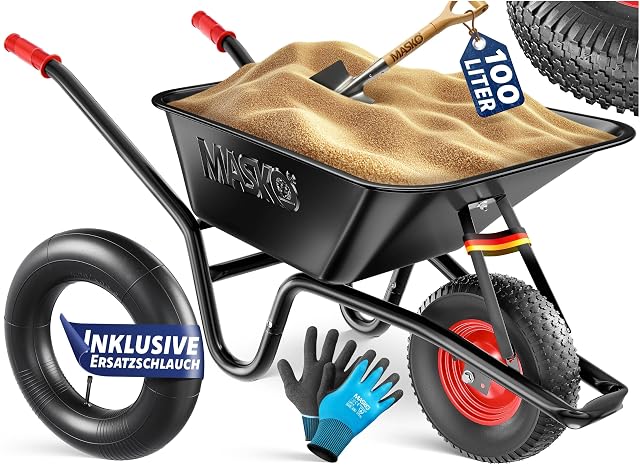
The most useful thing in the box, and no other barrow on this shelf has one.
Because pneumatic tyres puncture
Five of the seven barrows in this family run on pneumatic wheels, and one runs on a
solid polyurethane wheel.
A pneumatic tyre rolls better, sinks less into soft ground, and cushions the load — the
shock of dropping off a step goes into the air in the tyre rather than into the tub, the
frame and your wrists.
And it goes flat.
The things that puncture a barrow tyre are all things a barrow is used near: a thorn
from a rose or a bramble, blackthorn, a screw in a load of rubble, a sharp stone
under a gravel heap, and a rim pinch from running over a kerb under-inflated.
The failure is also badly timed by nature. A barrow tyre is found flat on the morning you
have a delivery of soil on the drive, and the nearest replacement tube is a trip to a
shop.
A spare tube in the shed turns that into a twenty-minute repair with two tyre levers.
One listing supplying one is an admission that its own wheel will fail, and it is worth
more than any claim on this shelf.
Galvanised, which is the right tub material
“Thanks to the galvanised sheet tub it is extremely weather-resistant and therefore cannot
rust.”
The last clause overstates it — galvanising does not make steel incapable of rusting — and
the choice is nonetheless correct, for a reason specific to wheelbarrows.
A barrow tub is scraped by a shovel on every single use. Loading soil, gravel or
rubble means a steel blade dragged along the bottom and up the front lip, dozens of times
per load.
No coating survives that. The question is what is underneath.
Paint comes off and leaves bare steel holding wet soil. One barrow on this shelf
has a painted tub, and the bottom of it will be brown by the end of the first season.
Galvanising comes off too — and it leaves zinc, which corrodes in preference to the
steel around it and keeps protecting the scrape electrically. That is the whole point of a
sacrificial coating, and it is the same principle as the galvanised lawn edging on this
site’s edging shelf.
The frame is galvanised as well, and the wheel rim is powder-coated steel.
3 cm of frame tube
Published, and it is the only frame dimension on this shelf besides one competitor’s
33 mm.
That figure is what carries the load. A barrow’s tub is a container; the frame is the
structure, and it takes the full weight in bending every time the barrow is lifted by the
handles.
Thirty millimetres of steel tube is a substantial section. Thin-wall tube of a smaller
diameter is what bends at the leg welds under a load of wet sand, and once a barrow frame
has bent the tub never sits straight again.
The assembly advice, which is genuinely useful
“Important: first tighten all the screws only lightly, then align the tub correctly again
— only then should you tighten the brackets so that there is no play left.”
That is real advice and it addresses the actual failure of self-assembled barrows.
A barrow arrives as a tub, two legs, two handles, a wheel, an axle and a bag of bolts. Every
joint has slotted holes or clearance, deliberately, because nothing lines up exactly.
Tighten as you go and the last joint will not meet. Force it, and the tub is pulled
into a twist that it keeps for the rest of its life — sitting crooked, resting on three
legs, and tipping to one side when loaded.
Tighten everything lightly, square it up, then tighten down and it goes together
straight.
Almost nothing in this network publishes assembly guidance. One competitor on this shelf
simply says its barrow is quick and easy to build.
The tipping bars
“Thanks to the integrated tipping bars the barrow can be emptied without difficulty, or
stood space-savingly against a wall in the carport, garage or garden house.”
Two functions from one part, and both are real.
Emptying. A loaded barrow is emptied by tipping forward onto the front of the tub. A bar
across the front takes that contact instead of the tub lip, which is what otherwise gets
deformed and then rusts along the crease.
Standing. A barrow stored on its nose against a wall takes up a fraction of the floor,
and the bar is what it rests on. Which is why the length of a barrow becomes its height
in storage — and this listing publishes no dimensions at all.
“Maximum load of 250 kilograms.” Unqualified.
One barrow on this shelf publishes its rating as two numbers: 150 kg dynamic and
250 kg static (not in motion).
That distinction applies to every barrow ever made. A static figure is what the frame
holds standing still; a dynamic figure is what it holds while being pushed, tipped, run
over a step and set down — which is the only way a barrow is ever used.
On the one product that splits it, the difference is 40 per cent.
This page does not move one manufacturer’s numbers onto another’s product. It notes that an
unqualified 250 kg is the less informative form, and that 100 litres of wet soil weighs
roughly 130 to 150 kg — so a full tub of it is a serious load on any barrow on this
shelf.
The gloves
A pair of work gloves is included, as it is on one other barrow here.
Worth a note because this site has a shelf of them, and the honest observation from it
applies: only one glove product on that shelf offers thorn and puncture protection, and
it is leather. A coated knit glove — which is what comes free with a barrow — protects
against dirt and abrasion and not against a bramble.
What goes unpublished
No dimensions. Not length, width or height — and width is what decides whether a
barrow goes through a gate or a side passage. Two barrows on this shelf publish all three.
No empty weight. One publishes 11.2 kg.
No tyre pressure. One publishes 2 bar, and it is the single most useful maintenance
figure in this family: an under-inflated pneumatic tyre is the commonest reason a barrow
feels heavy. On a barrow supplied with a spare tube, the absence of an inflation figure is
an odd omission.
Availability
From 55 € to 63 €, that being the spread across the German, French, Italian and Spanish Amazon stores on the day of the survey.
Listed and unsold: the American and British Amazon catalogues hold the reference with nobody behind it.
Taken from Keepa on the day this page was last revised; stock and prices move without notice.
Prices quoted in this text were read on 26 September 2026. The live price is at the top of the page.