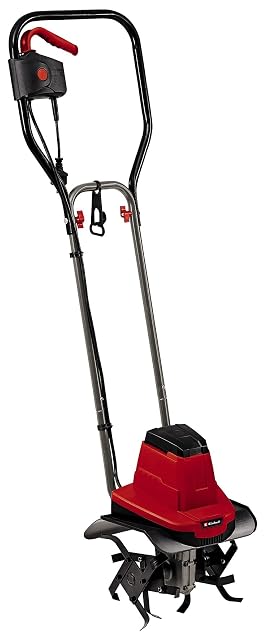
The bottom line The most completely specified machine on the shelf: 1500 W, 450 mm, 220 mm deep, 24 blades of 205 mm diameter, 400 rpm, 11 kg, with folding transport wheels, an anti-jam clutch and a guard plate. The maker also states it keeps spare parts and runs its own repair workshop, which on this shelf is unusual enough to matter.
What the maker prints on its own page
An electric tiller for loosening soil, preparing seedbeds, weeding and mixing in
shredded material, fertiliser and peat. Twenty-four rotating blades with a guard
plate against flying stones, a 450 mm working width and a 220 mm working depth.
The maker states an award from a German consumer test body, folding transport
wheels, a cable strain relief for long cable life, an extra carrying handle and
bike-style grips. Spare part supply is stated as secured long term, with the
maker’s own repair workshop holding all parts.
The technical data given: 1500 watts (2 PS), 450 mm working width, 220 mm
working depth, 24 blades of 205 mm diameter, ergonomic bike grips, weight about
11 kg, 230 V / 50 Hz, no-load speed 400 rpm. The listing covers four models
between 1050 and 1800 watts and 36 to 45 cm.
The complete specification
Weight. Tine diameter. No-load speed. Nothing else on this shelf gives any of
the three, and this listing gives all of them.
11 kg is the number that matters most. A tiller pulls itself forward when the
tines bite and pushes back when they hit something hard, and how much of that
reaches your wrists is decided by the machine’s mass. Eleven kilograms is light
for a 450 mm machine, which cuts both ways: easy to carry, livelier to hold.
The clutch
An anti-jam coupling is the component that separates a machine built to last
from one built to a price.
Tines meet stones, roots and buried rubble. Without a slipping coupling, that
shock goes into the gearbox or stalls the motor; with one, the drive gives way
and picks up again.
It is not a figure and it will never appear in a comparison table.
Four models in one listing
Width and wattage depend on which variant is selected. This page reports the
figures the listing’s own technical data block gives and states the ranges — a
comparison built on the top of a range would describe a machine nobody bought.
The workshop
The maker states it holds spare parts long term and repairs its own machines.
On a shelf where several entries are single-season imports with no parts
anywhere, that claim is the most valuable sentence in the listing — and it is a
claim, which this page reports rather than verifies.
Availability
Around 110 €, read at the German Amazon store on the day of the survey.
Listed and unsold: the French and Spanish Amazon catalogues hold the reference with nobody behind it.
Nothing came back from the American, British and Italian Amazon stores at all; the buy button there runs a search rather than opening an empty page.
Taken from Keepa on the day this page was last revised; stock and prices move without notice.
Prices quoted in this text were read on 26 September 2026. The live price is at the top of the page.
The declared figures, and the point they stop at
Strengths
The only machine here with a weight, a tine diameter and a working speed
An anti-jam clutch and a guard plate against thrown stones, both stated
The maker states long-term spare part supply and its own repair workshop
Compromises
The listing covers four models at once, so width and wattage depend on the variant
No handle-height adjustment stated, on a machine with bike-style grips
Mains power at 1500 W with 24 blades will meet the limit of the motor on hard ground
Specifications
Working width
450 mm on the model described; the listing covers 36–45 cm across four models
Working depth
220 mm, as stated
Power source
Mains 230 V / 50 Hz, 1500 W / 2 PS input as stated
Tines
24 blades of 205 mm diameter, with a guard plate and an anti-jam clutch
Transport wheels
Folding, as stated
Weight
About 11 kg, as stated
Amazon reference
B07B9L92X6 (one reference across 3 Amazon marketplaces)
EAN
4260491656575
What this machine usually gets asked
What is an anti-jam clutch?
A coupling that slips when the tines hit something immovable instead of transmitting the shock into the gearbox or stalling the motor. On a machine whose tines are the drive and which meets buried stones and roots, it is the component that decides whether an obstruction is an event or a repair.
Is 400 rpm slow?
It is the only speed published on this shelf, so it has nothing to compare against here. What a tine speed tells you is how the soil is worked — slower turns chop and lift, faster ones pulverise — and publishing it at all is more than the rest of the shelf does.
Does the spare parts statement mean anything?
It is the maker’s claim about its own supply and this page reports it as one. It is also the kind of claim that costs a company something if it is untrue, and on a shelf where several machines are one-season imports it is worth reading.
Who this one is for
A large vegetable plot worked every year, by somebody who expects to own the machine for a decade