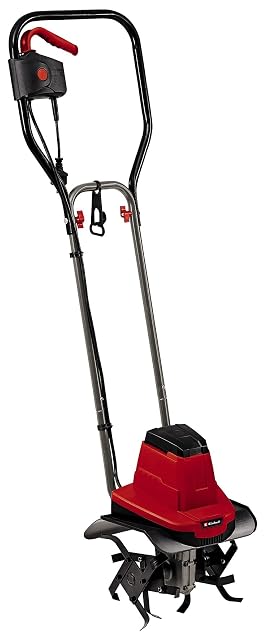
The bottom line The middle of the shelf, and correctly proportioned: sixteen blades across 360 mm, 205 mm deep, 1050 W. Four times the blade count of the small machine on a fifth more width, which is the difference between working a bed and turning one over.
What the maker prints on its own page
Ideal for smaller and medium gardens or flower beds. A powerful 1050 W motor.
A maximum working width of 360 mm and a maximum working depth of 205 mm.
Sixteen blades for even soil loosening. Instant start with a protection switch
against unintended starting. A folding handle for easier transport and storage.
Low maintenance thanks to the electric motor. Comfort grips.
Sixteen blades on 360 mm
That is one blade every 22 mm, against one every 75 mm on the small machine at
the bottom of this shelf.
Blade spacing decides the result. Widely spaced tines chop the soil into lumps
and turn easily; closely spaced ones work it to a tilth and take more power to
do it. Sixteen on 360 mm is a seedbed arrangement.
It also means this machine is harder to hold than the narrow one. More blades
in contact is more forward pull, and a tiller’s tines are its drive.
The word “maximum”
Both figures are given as maxima, which tells you something the other listings
do not: the tine assembly can be reduced.
Outer tine sets coming off is how a tiller works between rows without eating
the row. A listing that states a maximum has implied a range; most of this
shelf states a single number and leaves you to find out.
Two units for one motor
1050 W and 1.4 PS are the same thing written twice. An electric motor’s rated
input is a watt figure; the horsepower conversion beside it is a sales
convention.
This site prints both because the maker printed both, and labels the watt figure
as an input — what the machine draws, not what arrives at the soil.
What is missing
No transport wheels stated, and no weight. Both matter on a machine that is
front-heavy by design and has to get from the shed to the plot somehow.
Availability
Around 80 €, read at the German Amazon store on the day of the survey.
More than 1.6× the cheapest country at the Italian Amazon store; a gap of that size normally means forwarded stock rather than a seller on the ground, so the spread above leaves it out.
Listed and unsold: the French and Spanish Amazon catalogues hold the reference with nobody behind it.
Nothing came back from the American and British Amazon stores at all; the buy button there runs a search rather than opening an empty page.
Taken from Keepa on the day this page was last revised; stock and prices move without notice.
Prices quoted in this text were read on 26 September 2026. The live price is at the top of the page.
The declared figures, and the point they stop at
Strengths
Sixteen blades on 360 mm — a close spacing that works soil finely
Both width and depth given as maxima rather than as bare numbers
A protection switch against unintended starting, and a folding handle
Compromises
No transport wheels stated
No weight, on a machine with sixteen blades on the front
The power figure is given twice, in watts and PS, for one electric motor
Specifications
Working width
360 mm maximum, as stated
Working depth
205 mm maximum, as stated
Power source
Mains, 1050 W / 1.4 PS input as stated
Tines
16 blades
Transport wheels
Not published
Weight
Not published
Amazon reference
B0DPQNG3WJ (one reference across 4 Amazon marketplaces)
EAN
4046664258742
What this machine usually gets asked
Why give both watts and PS for an electric motor?
It is a marketing habit rather than a specification: 1050 W and 1.4 PS are the same figure twice. This site prints both because the maker did, and treats the watt figure as what it is — an input from the socket rather than work at the tines.
Sixteen blades or four?
Sixteen works the soil more finely and meets more resistance doing it. On a bed being prepared for seed that is what you want; on hard ground being broken for the first time it is more resistance than a 1050 W motor can push through.
What does “maximum” mean on a working width?
That the tine assembly can be reduced — outer sets come off — so the machine can be run narrower between rows. The listing states the figures as maxima, which is more precise than most on this shelf.
Who this one is for
Beds and vegetable plots that are worked every season and need a fine tilth