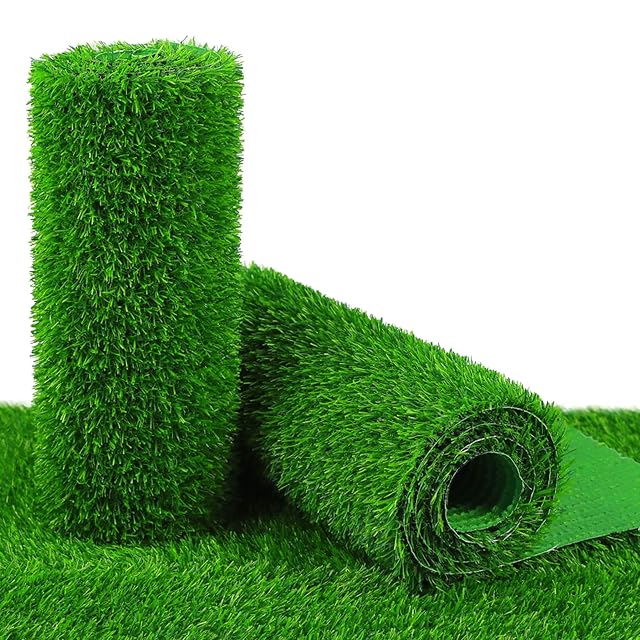
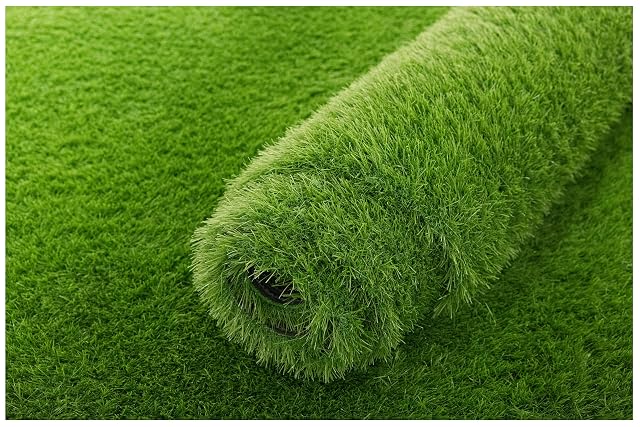
What this shelf is, and is not
All seven products here name balcony, garden, terrace, playground, garage, garden
house, patio — and this one adds hallways, corridors and offices.
None of them describes an artificial lawn installation, which is a construction:
compacted sub-base, sand levelling layer, weed membrane, jointing tape, pinned edges,
and a brushed-in sand infill to hold the fibres upright.
This shelf sells outdoor carpet. That is not a criticism; it is what the listings
describe, and it changes what the specifications mean.
The best material declaration on this shelf
“Made from polyethylene and polypropylene yarns and styrene-butadiene latex.”
Three polymers named, and each is doing a distinct job. No other listing here gets
past one.
Polyethylene (PE) is the soft fibre. It bends like a real blade and it is what
gets used for the visible grass, especially anywhere bare feet go.
Polypropylene (PP) is stiffer and springier. In a proper tufted construction it is
the curled backing fibre — short, crimped, sitting at the base of the pile and
holding the long PE blades up from below.
That combination is how commercial artificial turf is built, and a listing naming both
is describing a real construction rather than a carpet. One mat on this shelf is
100 % PP at 33 mm — tall and stiff, with nothing softer in it — and another is
PE at 14 mm, soft and short.
Styrene-butadiene latex (SBR) is the secondary backing: coated onto the back of
the primary woven layer to lock the tufts in place. Without it, fibres pull out of the
backing when the mat is brushed or walked on. It is what makes a tufted grass a
product rather than a rug.
Naming it, and stating it as non-toxic, is a level of detail the rest of this shelf
does not reach.
25 mm, in the middle of the shelf
Across this family the pile runs 5, 14, 25, 33, 35 mm, with two products
publishing nothing.
Twenty-five millimetres is the sensible middle, and the reason is the infill
problem.
A tall pile — 33 or 35 mm — has to hold itself up. In a proper artificial lawn, sand
brushed into the base of the fibres does that. A mat laid loose on a balcony has no
infill, so the fibres stand by stiffness alone, and under a table leg or a plant
pot a tall pile takes a permanent set.
A short pile — 14 mm — cannot flatten much because there is not much of it.
Twenty-five is long enough to read as grass rather than as carpet and short enough to
recover from furniture reasonably well. Combined with a PP support fibre holding the
PE blades up, it is the most coherent combination on this shelf.
The rubber backing, and the slip point
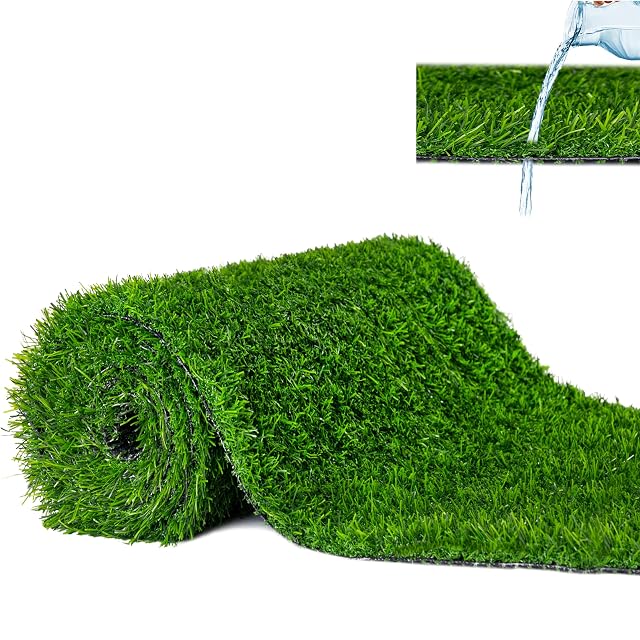
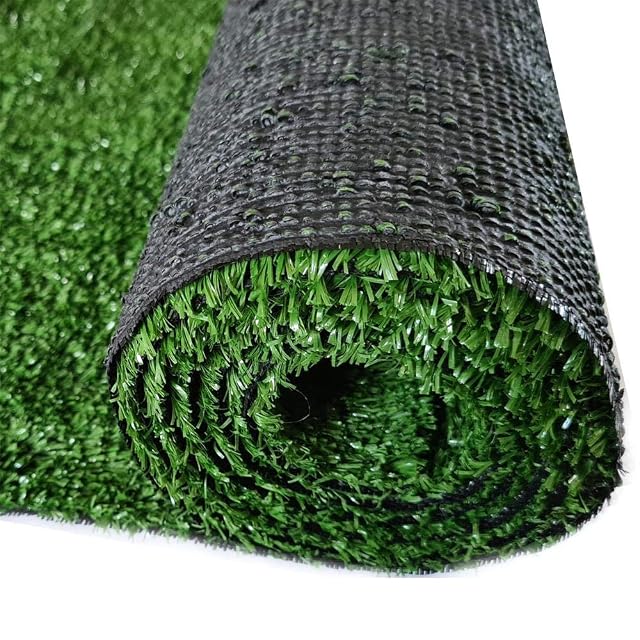
“The back of the artificial grass carpet is made of rubber with good slip resistance.
The built-in microchannels let water drain away, dry quickly and clean easily.”
Two claims, and the first is the one nobody else makes.
Slip resistance matters on a balcony more than anywhere. Balcony floors are tiles,
smooth screed or sealed concrete, and they are wet whenever it rains. A mat with a
woven or felt back slides on them: it creeps, it rucks up at one end, and the ruck is
a trip hazard at exactly the place nobody wants one.
A rubber backing grips. It is heavier and it costs more, and it is the right answer
for a loose-laid mat that is not fixed down.
The microchannels are the drainage. A latex or rubber backing is waterproof by
nature, so without channels or perforations it is a tray — water runs down through
the pile, meets the backing, spreads sideways and sits.
Six of the seven listings here name a drainage arrangement. One does not, and it is
the one sold as Premium Class.
What drainage does not prevent
Moss and algae.
A drained mat dries in hours rather than days, and it still collects leaf litter and
dust in the pile, and in shade that holds moisture and grows green film around the
fibre bases and on the backing.
This is worth saying plainly on a lawn care site: artificial grass is a hard surface
with a textured top, and the three concentrates on this site’s moss killer shelf —
the ones for stone, wood, roofs and terraces, which must never touch a real lawn —
are exactly the products for it.
The unadvertised maintenance is sweeping or blowing leaves off, several times in
autumn, before they break down into the pile and turn into soil.
“Fire-resistant”
Claimed, with no classification.
One product on this shelf publishes a fire class: Efl, under the European
reaction-to-fire standard for floorings.
That is a checkable figure. “Fire-resistant” is not, and on a terrace with a barbecue
on it the difference between a stated class and an adjective is the difference between
a specification and a hope.
Polypropylene and polyethylene both melt — a dropped ember makes a hard black
crater in any product on this shelf, and no listing here says otherwise.
Three square metres
100 × 300 cm, at about 15.31 € per square metre — near the top of a shelf
running from about 7.00 €.
A 1 metre width means a seam every metre, and seams are what give artificial grass
away: two cut edges never match exactly in pile direction, and the join catches light
differently from each side.
Two rules the listing does not give: lay every piece with the pile leaning the same
way, and butt the edges rather than overlapping them.
The widest product on this shelf is 400 cm, which takes most balconies in one piece.
What goes unpublished
No weight per square metre. One product here publishes 850 g/m², and that is
the real quality measure for artificial grass — the mass of fibre and backing per unit
area, which is what separates a mat that recovers from one that lies down after a
season.
At 25 mm with a rubber back this is plainly a substantial product, and the figure that
would prove it is absent.
Availability
Around 46 €, read at the German Amazon store on the day of the survey.
Listed and unsold: the British, French, Italian and Spanish Amazon catalogues hold the reference with nobody behind it.
Nothing came back from the American Amazon store at all; the buy button there runs a search rather than opening an empty page.
Taken from Keepa on the day this page was last revised; stock and prices move without notice.
Prices quoted in this text were read on 26 September 2026. The live price is at the top of the page.