Drip irrigation
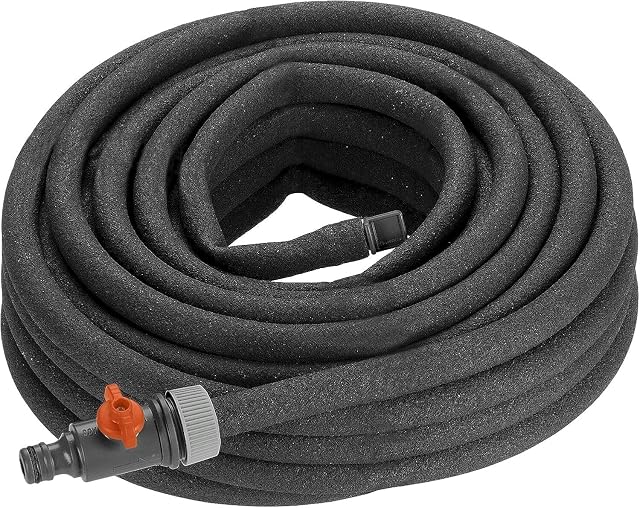
Gardena 1969-20
A soaker supplied with all its fittings and a hand valve — and with no flow rate or pressure published.
The hand valve
The best thing in this listing, and it is the feature that addresses how a
soaker actually fails.
A porous hose leaks along its whole length, so the pressure inside it falls as
you go. Near the tap it is high and the hose weeps hard; at the far end it is
low and the hose barely wets. Turn the tap up to fix the far end and the near
end floods.
The answer is to run the whole thing gently, which makes the pressure
profile flatter and the wetting more even.
A valve at the hose end is how you do that. The tap is usually round a corner,
shared with a hose reel and a sprinkler, and set by whoever used it last. A
valve on the soaker itself is adjusted where you can see the result.
The 30 metre maximum
Stated: the hose can be shortened, and joined to a maximum of 30 metres.
A maximum is a more useful number than a capacity, because it describes the
physics rather than the packaging.
Past a certain length, a leaking hose has given up so much pressure by the far
end that the far end does nothing. Where that point falls depends on the bore,
the porosity and the supply — and a manufacturer publishing its own limit is
telling you where its product stops working, which is not a commercial
instinct.
What goes unpublished
No flow rate. No operating pressure.
Those are the two numbers this shelf is otherwise comparable on, and this
listing gives neither.
For context, the three soakers here that do publish something say, converted to
one unit: 6 to 8 litres per metre per hour at 0.6 bar; about 20 to 39 at 3 to
6 bar; and 46 to 76 at 0.7 bar.
That range spans more than a factor of ten across products that look identical
on a shelf. Borrowing a figure from any of them for this one would be
inventing a specification, and this page does not.
“Anschlussfertig” — ready to connect
Every fitting included, so it works out of the bag.
That is worth more on this shelf than it sounds. A soaker has to be joined to a
tap and usually capped at the far end, and the fittings for a 1/2 inch soaker
are not the same as the click connectors on a garden hose. A product that
arrives complete removes a trip and a guess.
The 70 per cent
Claimed here, and on three other listings on this shelf. A fifth claims 80.
None of them says compared with what.
The honest version of the claim is straightforward and worth stating once: a
soaker laid on or under the soil puts water at the root zone, and loses very
little to evaporation, to wind, or to wetting leaves and paths. A sprinkler
throws water into the air over an area, and a proportion of it never reaches a
root.
That difference is real and it is large. Whether it is seventy per cent depends
entirely on what it is being measured against — a sprinkler on a hot windy
afternoon, or a watering can applied carefully at dusk.
Four listings on this shelf print the number. None prints the comparison.
About 1.81 € per metre
15 metres at the German price recorded here, which is the highest metre price
on this shelf.
The range here runs from about 0.80 € to about 1.81 € per metre. What the top
of that buys is the valve, the fittings, and a stated maximum run — and not a
flow rate.
Availability
From 27 € to 40 €, that being the spread across the German, French, Italian and Spanish Amazon stores on the day of the survey.
Beyond the euro zone, the American and British Amazon stores price it in their own currencies, which the spread above sets aside.
Taken from Keepa on the day this page was last revised; stock and prices move without notice.
Prices quoted in this text were read on 26 September 2026. The live price is at the top of the page.