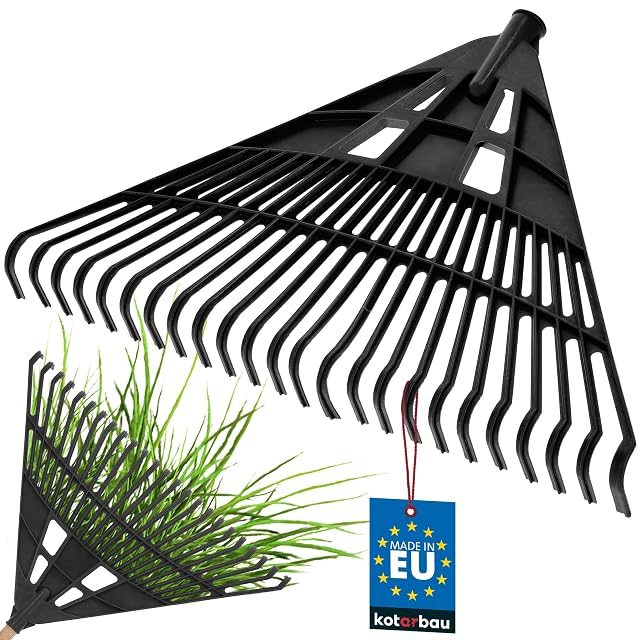
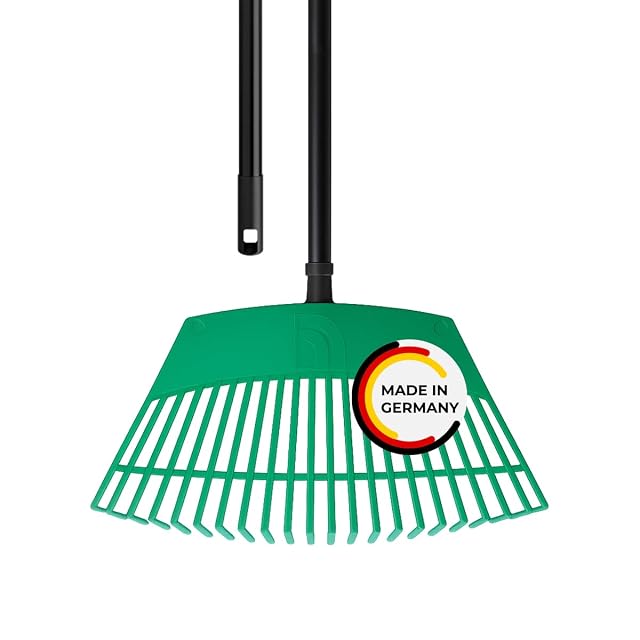
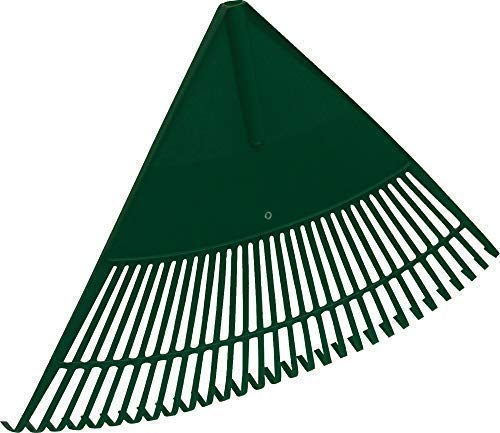
The most completely specified head on this shelf
Working width 61 cm. Working length 41 cm. Socket diameter 2.6 cm. Weight 0.36 kg.
Material: plastic.
Five figures in a technical-data line, which is more than any other rake in this family
publishes.
And two of them together are the reason to look at it.
61 centimetres at 360 grams
Those two normally fight each other.
The only other rake on this shelf that publishes a weight is 560 g for a 42 cm
head.
So this one is 45 per cent wider and 36 per cent lighter.
Which decides how long raking lasts
A rake head sits at the end of a 1.5 metre lever, and your shoulders hold it up.
The weight at your hands is not the weight of the head — it is multiplied by the
geometry, and it is carried, out in front of you, for an hour, in November, while you
pull.
Two hundred grams at the head end is a substantial difference at the hands, and it is
the figure that decides whether a lawn gets finished or half done.
Meanwhile width decides how many passes there are. The widths on this shelf run
30 to 78 cm, and a 61 cm head covers about 45 per cent more ground per pull than a
42 cm one.
Wider and lighter is the combination that matters, and only this rake publishes enough
to show it.
And the honest limit of a wide head
It does not go between things.
A 61 cm fan cannot get along a fence line, between shrubs, under a hedge or into the
corner by the shed. Used there anyway, it rakes the bed edge as well as the lawn.
And it loads every tine at once. In heavy sodden autumn leaves, a wide plastic head
stalls: the tines splay, the leaves ride over the top, and nothing moves. The remedy is
smaller bites, which gives away the width advantage exactly when it was wanted.
One rake on this shelf answers that with an adjustable width, 30 to 50 cm. Two
others are 42 and 43 cm fixed, which is the narrow-garden choice.
So 61 cm is the right tool for open lawn under trees and the wrong one for a small
enclosed garden.
The 26 mm socket, which is the fitting to prefer
Five of the seven rakes here arrive without a handle, and how knowable the fit is
divides them:
A published diameter — this at 26 mm, another at 30 mm. Any handle of that
size fits: wood, plastic, telescopic, or a broom handle from a hardware shop. A tape
measure in a shed settles it, and a replacement will still be available in twenty
years.
A proprietary part number — one head on this shelf fits one named handle from its own
maker, and the listing adds that it is not compatible with that maker’s other handle
system.
A modular range — one head fits any handle in its manufacturer’s range, with no
diameter published.
Or nothing — three heads here publish no fitting information at all.
A plain measured socket is the only one of those that does not depend on a company still
selling something.
Twenty-six millimetres is the common European garden handle size, which is what
“universal” means here.
Recycled plastic, and the property that matters
“Made of environmentally friendly, recycled plastic. The high quality of the material
guarantees appropriate flexibility of the tines and makes them resistant to
deformation.”
That claim addresses the right property, which is worth saying because it would be easy
to claim the wrong one.
A rake tine is not asked to be strong. It is asked to be elastic — to bend under
load and come back, thousands of times a season, wet and cold and full of grit.
What fails is a permanent set. A tine that stays bent no longer reaches the ground
at the same angle as its neighbours, so it stops picking material up. On an old plastic
rake the outer tines are splayed and the head has stopped working before anything has
broken.
Resistance to deformation is exactly the correct thing to claim, and recycled polymer is
a reasonable material for it.
And what plastic gives up
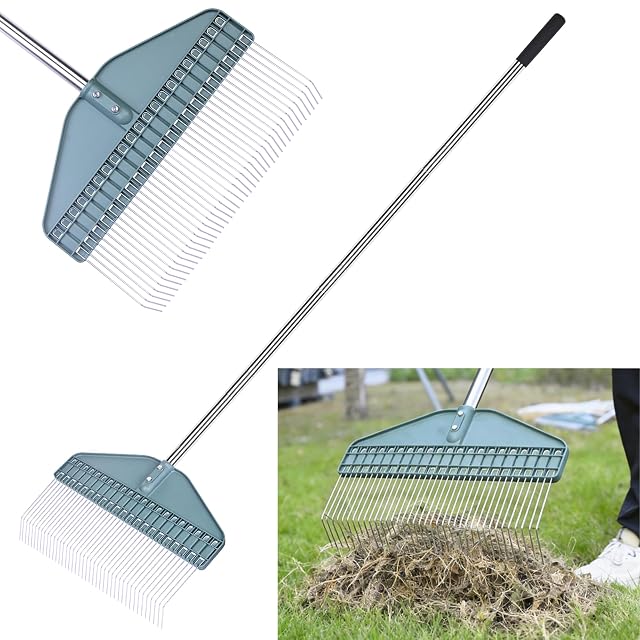
Four rakes on this shelf have plastic tines and two have steel.
Plastic flexes, so it rides over the sward and lifts loose material without
digging in or tearing grass crowns out. Light, rust-free, and it does not scratch
paving.
Steel moves matted wet material that plastic bends away from — and it digs. On a
soft wet lawn a steel fan rake pulled hard lifts grass with the leaves.
For dry autumn leaves on a lawn, plastic is the better tool. For a matted spring lawn,
steel is — and for a genuinely thatched lawn, neither: that is a dethatching rake,
and this site’s aerator shelf has one with 21 pairs of spring steel tines across a
43.2 cm head, at roughly twice the tine density of anything on this shelf.
What goes unpublished
No tine count.
That is the one gap, and it matters because count divided by width gives spacing —
and spacing is what separates a leaf rake from a dethatcher.
Two rakes on this shelf publish a count: 23 tines across 42 cm and 30 tines across
78 cm. Both work out at roughly 18 to 26 mm apart, which is leaf-rake spacing.
At 61 cm this head could be either, and nothing published says which.
Availability
From 15 € to 19 €, that being the spread across the German, French, Italian and Spanish Amazon stores on the day of the survey.
Beyond the euro zone, the British Amazon store prices it in its own currency, which the spread above sets aside.
Nothing came back from the American Amazon store at all; the buy button there runs a search rather than opening an empty page.
Taken from Keepa on the day this page was last revised; stock and prices move without notice.
Prices quoted in this text were read on 26 September 2026. The live price is at the top of the page.