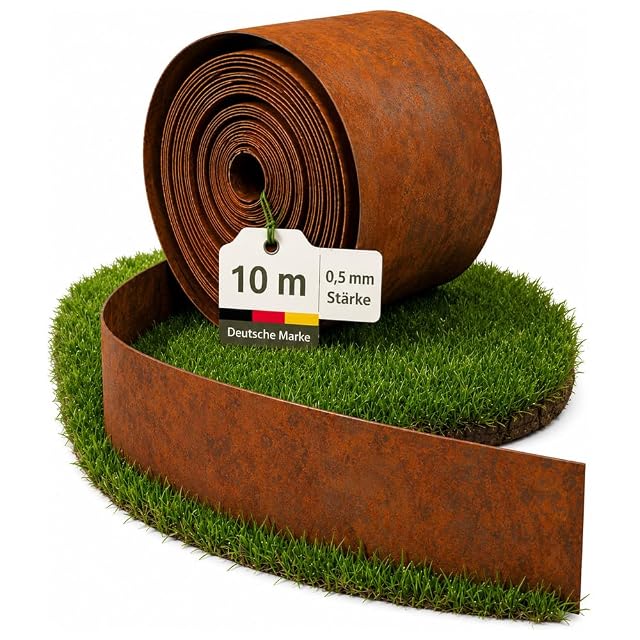
0.6 mm of material.
14 cm of height, over 10 m.
The thickness is the one that matters and it is the only Corten gauge on this shelf.
Three of the four Corten products here publish none; the galvanised steel product
publishes 0.7 mm.
Why thickness is the specification
A steel edging is a thin sheet standing on its edge in the ground, and thickness
decides two things:
Whether it holds a line. Thin sheet follows the ground — every hump and hollow
transfers into the top edge, and a run meant to read as one clean line reads as a
ripple. Thicker sheet bridges small irregularities.
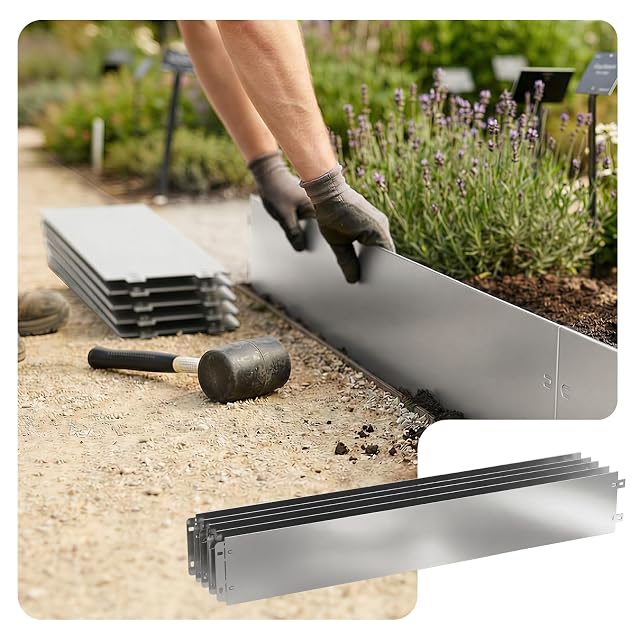
Whether it survives a mallet. Steel edging is tapped in, and thin sheet buckles
at the top where it is struck.
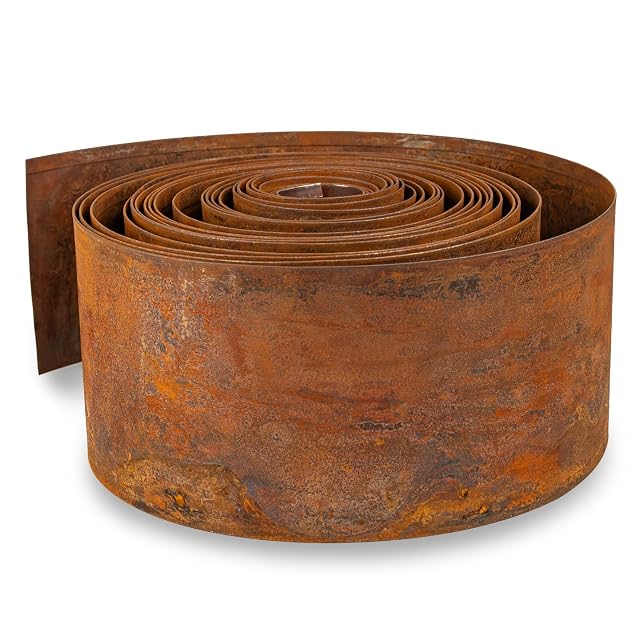
At 0.6 mm it is at the thin end, and that is the standard gauge for garden Corten —
thicker sheet is landscape-contractor material and costs several times as much.
And there is a real compensation on the other side. Thinner sheet takes a
curve far more willingly. The listing sells flexibility for curved beds and round
tree rings, and 0.6 mm is why that works. A 2 mm sheet does not bend around a tree
by hand.
What matters more than the last tenth of a millimetre is the top edge: one
product on this shelf publishes a 1 cm fold, and folding the top doubles the
material exactly where a standing sheet gets its stiffness.
“Genuine Corten, not a rust spray”
The listing states this deliberately, and it is worth explaining why the distinction
is not marketing.
A rust-effect coating is paint. A sprayed or powder-coated finish over ordinary
steel, made to look weathered. It scratches, it chips, and underneath is mild steel
which then corrodes normally — porous, flaking rust that keeps eating inwards until
the sheet is gone.
Corten is an alloy: steel with copper, chromium, nickel and phosphorus added so
that its own oxide forms a tight, adherent layer that seals the surface. The
corrosion rate drops to almost nothing and stays there.
The practical difference is what happens when a spade hits it. A coated edging gets a
scar that becomes a rust hole. A Corten edging gets a scar that patinates over and
disappears.
The patina statement, which is the most honest on this shelf
Three sentences, and together they are the best treatment of Corten in this family:
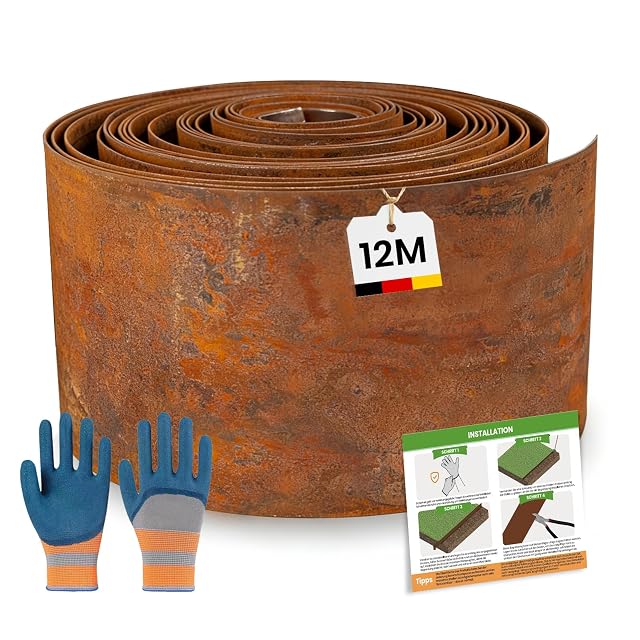
“You receive our edging already with a rusty patina, which continues to age over
time.”
“IMPORTANT NOTE: the patina on the product cannot be immediately perfect. It
develops over time. So it is not a manufacturing fault, but you will have to wait a
while until it develops.”
That is a seller managing an expectation it could have left alone, and it is
accurate.
A pre-patinated sheet arrives brown instead of grey, which is a real advantage
— one other Corten product on this shelf ships fresh and asks for months of
weathering before it looks intentional.
It also arrives unevenly brown. An even patina needs alternating wet and dry
weather across the whole surface, and a rolled, stacked, boxed sheet has not had
that. It settles over the following season.
And the thing no Corten listing on this shelf mentions
It runs rust while the patina is stabilising.
Rain carries iron oxide off a weathering steel surface and downwards, for the first
year or two, until the oxide layer has tightened.
On pale paving, render, limestone or light gravel that stains. It is the same
chemistry this site’s moss killer shelf spends several pages on: iron oxide bound
into a mineral surface does not brush off, and a pressure washer spreads it.
Against grass, dark soil or bark mulch it is invisible. Next to a light patio, the
galvanised product on this shelf is the one that will not mark it.
Pre-patinating reduces this — the process is already partly complete — and does not
eliminate it.
The protective top edge, and the gloves
“The bed edging has no standing corners on the upper side, but a protective edge
which serves to prevent injuries.”
That is the right thing to engineer, and it is less specific than one competitor’s
published 1 cm fold.
A pair of mounting gloves is also included. Three products on this shelf supply
them, and they are worth reading as an admission: thin steel sheet cuts hands,
whatever the top edge does.
What goes unpublished
No fixing. No pegs, clips or anchors, and no installation method.
Other products on this shelf variously supply 11 earth clips, colour-coded
pins, or a cutting-tooth profile hammered straight into turf, and one names a
rubber mallet.
A 0.6 mm sheet standing in soil with nothing anchoring it is held by friction alone.
On a heavy soil that is enough; on a light sandy one, frost heave lifts it over a
winter.
And which job it does
A bed border, not a mowing edge.
At 14 cm with most of it visible, a mower cannot reach the grass against it, so a
strip still needs trimming — and the edging itself is something a deck can strike.
Two products on this shelf are sold on the mowing function instead: one names robot
mower compatibility, the other states that mower wheels can run along it. That
distinction is the most useful thing on this shelf and five of seven listings blur
it.
About 5.00 € per metre
Third of four on Corten, where the runs come to about 3.83 €, 4.70 €, this 5.00 €
and 6.32 € per metre.
Galvanised steel here is about 3.10 €, the plastic border about 1.11 €, and recycled
rubber about 15.00 €.
Availability
From 50 € to 55 €, that being the spread across the German, French, Italian and Spanish Amazon stores on the day of the survey.
Beyond the euro zone, the British Amazon store prices it in its own currency, which the spread above sets aside.
Nothing came back from the American Amazon store at all; the buy button there runs a search rather than opening an empty page.
Taken from Keepa on the day this page was last revised; stock and prices move without notice.
Prices quoted in this text were read on 26 September 2026. The live price is at the top of the page.