A thousand square metres
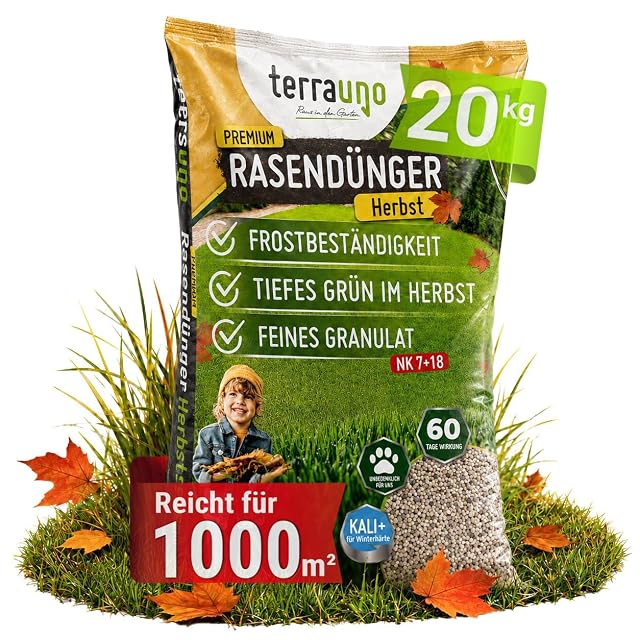
20 kg at 20 g/m².
That is the largest coverage on this shelf, and it is worth setting against the
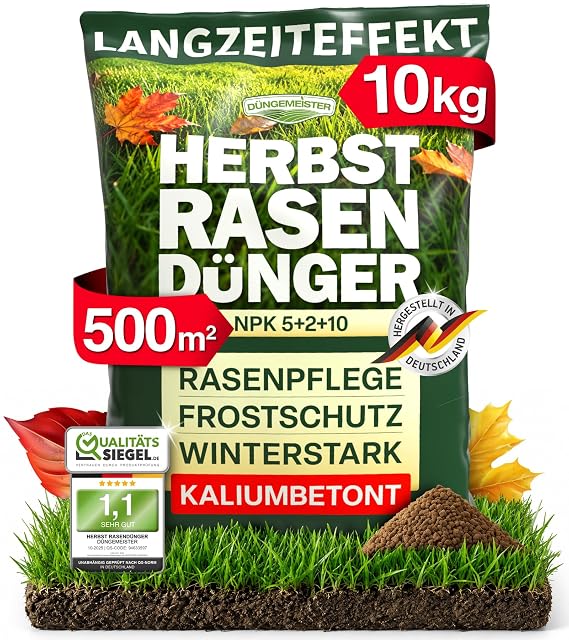
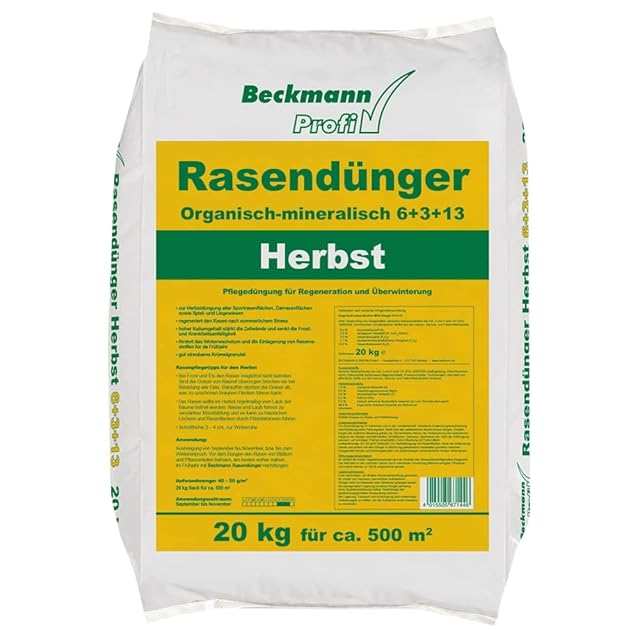
other 20 kg sack here, which states 40 to 45 g/m² and covers 500 m².
Same weight. Twice the area.
Which makes the dearest bag the cheapest lawn
This is the most expensive product in the family by bag price, and it works out
at about 0.055 € per square metre — the lowest figure on the shelf.
The range across these seven feeds runs from that to about 0.24 €, a factor
of more than four, and the ordering has almost nothing to do with what the bag
costs.
Rate, weight and price together are the comparison. Any one of them alone is
misleading, and bag price is the most misleading of the three.
Zeolite
Named, with a mechanism: it stores water and nutrients, reduces leaching, and
strengthens the lawn for the cold season.
That is a real material doing a real thing, and it is the only ingredient claim
on this shelf that describes a mechanism rather than an outcome.
What zeolite is. A naturally occurring aluminosilicate mineral with a porous,
cage-like crystal structure and a high cation exchange capacity — it carries
a negative surface charge that holds positively charged ions.
Why that matters in a fertiliser. Potassium and ammonium are both cations.
In a soil with little clay and little organic matter — a sandy lawn, in other
words — there is nothing to hold them, and rain carries them down past the roots.
That is leaching, and it is why a light soil needs feeding more often than a
heavy one.
Zeolite provides the exchange sites the sand does not have. Nutrients are held
and released as the roots take them up.
And the water. The same pore structure holds water — which is useful on the
same sandy soils, for the same reason.
The claim is not quantified: no percentage of zeolite, no measured reduction in
leaching. It is reported as published, and the mechanism behind it is genuine
rather than invented for the label.
August to November
A four-month window, and it is worth reading the early edge carefully.
November is straightforwardly right. Leaf growth has stopped; roots are still
taking up nutrients; potassium goes into cell walls and reserves rather than into
growth.
August is the early edge and it carries a real risk in a warm year.
Even a low-nitrogen autumn feed has nitrogen in it. Applied in a warm, damp
August, that nitrogen produces leaf — and leaf made in September has to harden
off before the first frost. Soft growth going into winter is exactly what frost
burns and what snow mould colonises under a wet January.
The other published window on this shelf is September to December, which is the
same four months shifted a month later, and on balance that is the safer shape
for a mild autumn.
What actually decides it is the weather rather than the calendar: feed when the
lawn’s growth is slowing, not while it is still racing.
“Green through the winter”
The listing’s opening claim, and it needs the honest qualification.
An autumn feed does keep colour later into the season than an unfed lawn, and
the reason is iron and potassium rather than growth — colour and growth are
separable in grass.
What it will not do is keep a lawn green through a hard frost. Grass discolours
when it freezes, and no fertiliser prevents that.
The genuine benefit of an autumn feed shows up in March: a lawn that came
through the winter with intact cell walls, without disease patches, and with
nutrient reserves ready when the soil warms. Two other listings on this shelf say
exactly that, and it is the better description.
What goes unpublished
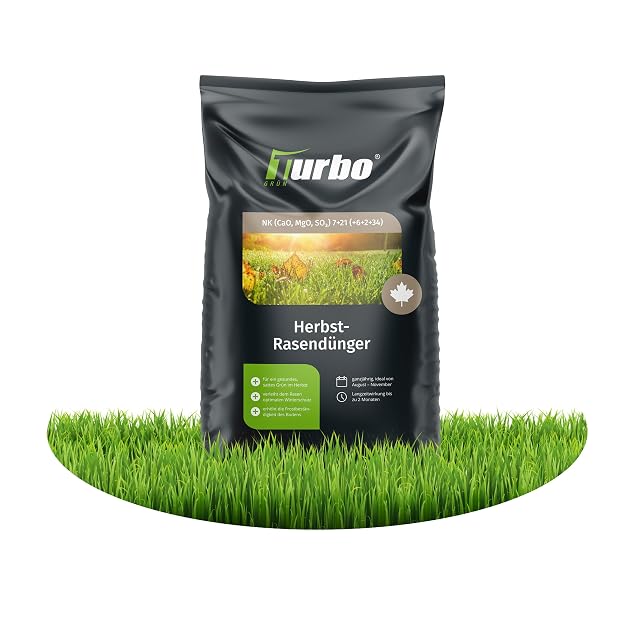
No NPK.
Five of seven feeds here omit it, and this is one of them — “a high potassium
share” with no figure.
The two that publish an analysis make the comparison that matters visible: the
potassium itself costs about 11.86 € and 23.18 € per kilogram of K₂O on
those two products, a factor of two that is invisible from either bag price.
With zeolite in the mix an analysis would be doubly useful, because zeolite is
part of the 20 kilograms and it is not a nutrient.
No granule size, where one feed here publishes 2 to 5 mm and it is what a
spreader is set for.
Availability
Around 55 €, read at the German Amazon store on the day of the survey.
Nothing came back from the American, British, French, Italian and Spanish Amazon stores at all; the buy button there runs a search rather than opening an empty page.
Taken from Keepa on the day this page was last revised; stock and prices move without notice.
Prices quoted in this text were read on 26 September 2026. The live price is at the top of the page.