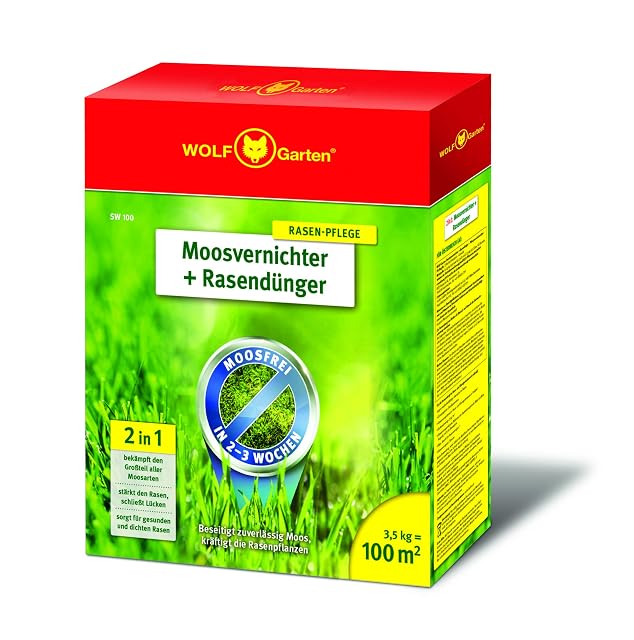
This is not a lawn product
It has to be the first line on the page, because three products on this shelf are
for hard surfaces and three are for grass, and the shelf name does not
distinguish them.
The surfaces this one names: facades, roofs, terraces, paving, wood, concrete,
natural stone, roof tiles, plastic, awnings, gravestones and garden furniture —
all water-tolerant surfaces.
Grass is not on that list and cannot be. A product formulated to kill algae, moss
and lichen on stone will kill grass, and nothing about the dilution changes that.
The lawn products on this shelf are iron fertilisers and a plant protection
product. They are a different category with different chemistry and different
rules.
The dilution, and the discovery it produces
1:20 for light growth. 1:10 for heavy.
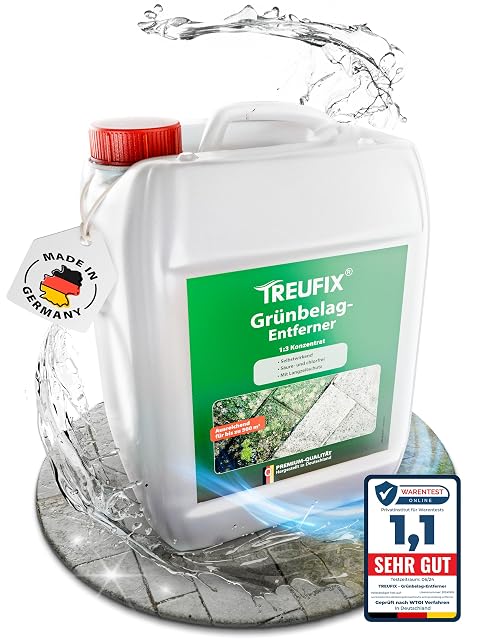
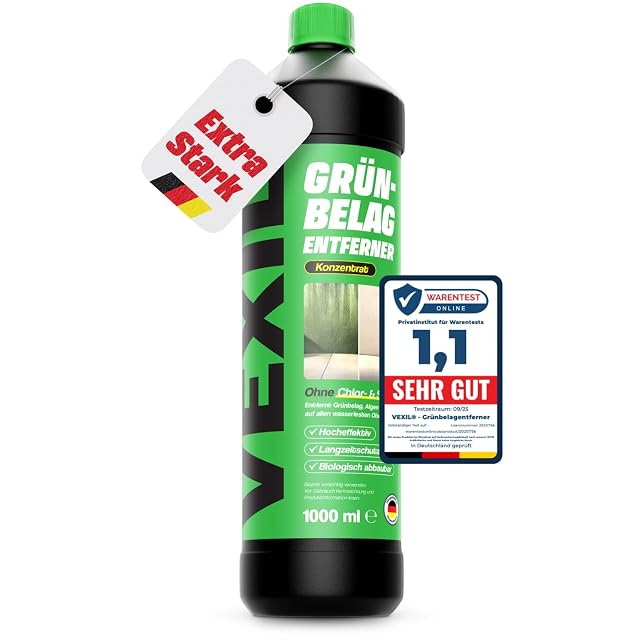
Set that against the two other hard-surface concentrates here:
One says 1:10 for light and 1:5 for heavy.
The other says 1:2 for light, 1:1 for medium, and undiluted for
heavy.
So the word “light” means 1:20, 1:10 and 1:2 depending on which bottle you
picked up.
The third product’s “light” dose is ten times more concentrated than this
one’s. Its “heavy” dose — neat product — is twenty times.
That is the single most useful thing to know about buying anything on this half of
the shelf. The adjectives are worthless for comparison. Only the ratio counts, and
the ratio has to be read against the litres in the bottle and the area claimed.
What that works out to here
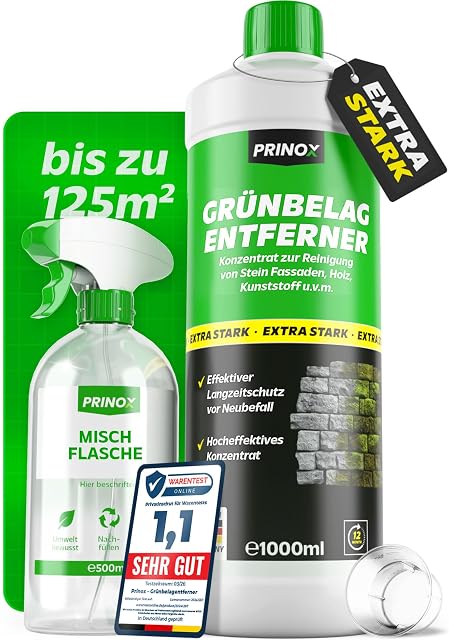
1 litre, up to 125 m² at the light dilution.
About 0.136 € per square metre, which is the lowest figure among the two
hard-surface products on this shelf that publish an area.
At 1:20, one litre of concentrate makes about 21 litres of spray — which is a
useful thing to know before mixing, because that is four fills of a five-litre
pressure sprayer.
The three or four days
Stated, with the surface to be dry when treated, and the full effect developing
over the following weeks and months.
Nobody enjoys reading that and it is the honest shape of these products.
They do not strip anything. They kill the organism, and then weather, frost
and rain break down the dead biomass and carry it away. A patio treated on
Saturday looks the same on Sunday.
The two other concentrates on this shelf put numbers on it: algae in two to three
days, moss in one to three weeks on one and three to six weeks on the
other, and lichen in three to twelve months on both.
Lichen is genuinely that slow. It is an organism that grows a millimetre a year;
killing it does not make it fall off.
Chlorine-free and acid-free
Both stated, and both are about the surface rather than the user.
Acid attacks limestone, concrete, mortar joints, natural stone and aluminium.
An acidic cleaner on a limestone patio etches it, and on block paving it eats the
jointing sand and the cement in the blocks.
Chlorine — hypochlorite — bleaches. It lightens stone unevenly, strips colour
from wood, kills plants it runs onto, and corrodes metal fixings.
A concentrate that is neither is one that can be used on a wider range of
surfaces without a test patch becoming a repair. It is why this listing can name
natural stone, wood and awnings in the same sentence.
It says nothing about what the active substance is.
What this particular listing withholds
No active substance.
The two other hard-surface concentrates on this shelf each publish a national
biocide registration number in their feature text, along with the statutory
wording that biocidal products are to be used carefully and the label and product
information read before use.
This listing’s feature text carries neither.
That is an observation about what was published, not a conclusion about the
product or its registration. What it means practically is that the label on the
bottle is the only place to look, and it should be read before mixing.
The mixing bottle, which is a real inclusion
A 500 ml mixing bottle with a spray head, and a measuring cup.
On a concentrate sold at 1:20 and 1:10, that is not a giveaway — it is the part
that makes the dilution repeatable.
Mixing 1:20 by eye in a watering can is how people end up applying 1:5, and on a
natural stone facade that is an expensive way to find out.
For larger areas the pressure sprayers on this site’s sprayer shelf are the right
tool — with the standing rule from that shelf: one sprayer, one purpose. A
sprayer that has held a biocide should be labelled and never used for anything
else.
Availability
Around 17 €, read at the German Amazon store on the day of the survey.
Nothing came back from the American, British, French, Italian and Spanish Amazon stores at all; the buy button there runs a search rather than opening an empty page.
Taken from Keepa on the day this page was last revised; stock and prices move without notice.
Prices quoted in this text were read on 26 September 2026. The live price is at the top of the page.