Not for lawns
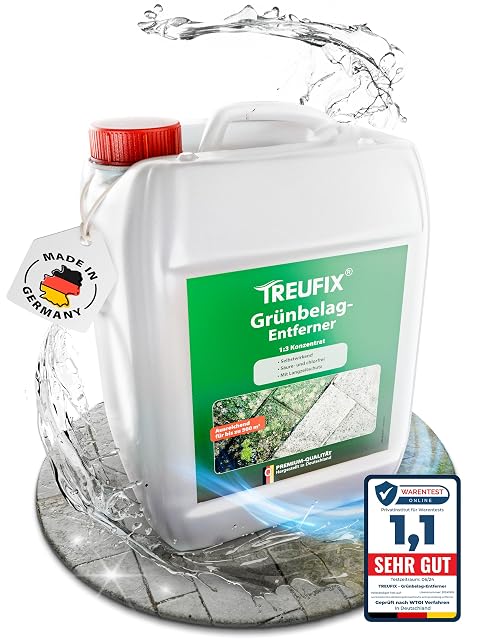
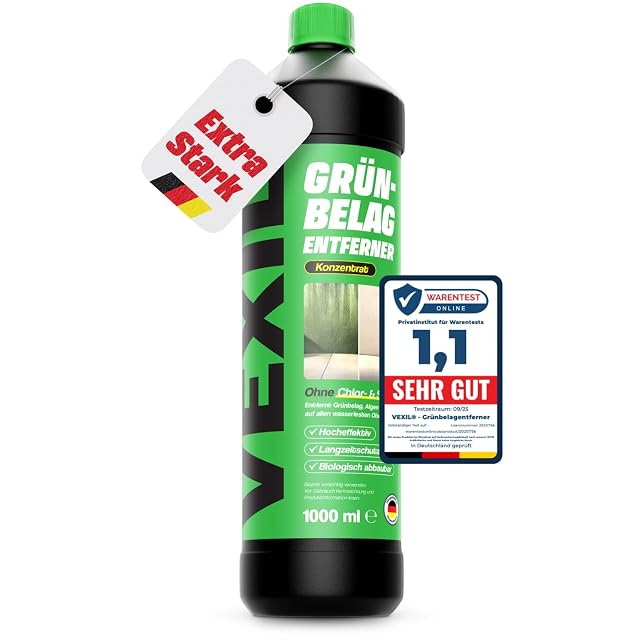
The surfaces this listing names: gravestones, roofs, wooden fences, terraces,
roof tiles, facades, paving and driveways.
It is a biocidal product for killing algae, moss, green film and lichen on
hard surfaces.
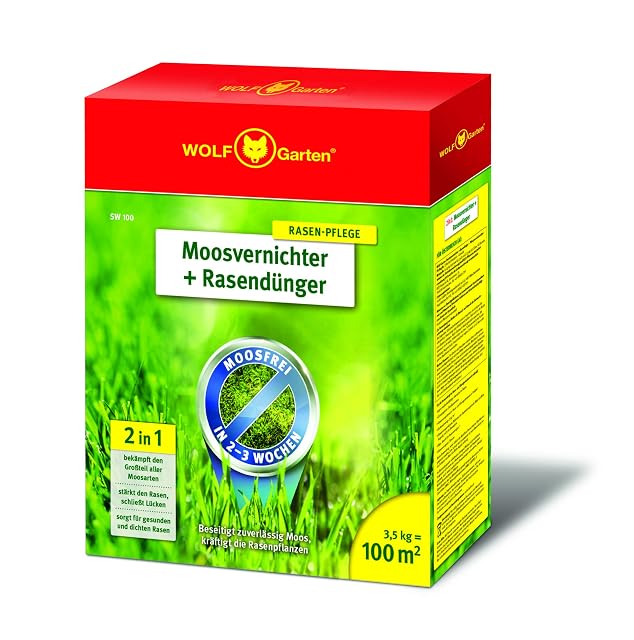
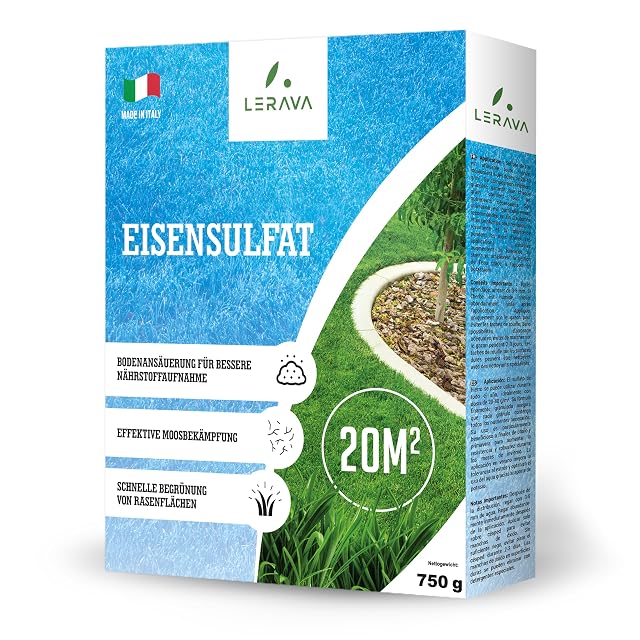
Grass is a plant and will be killed with everything else. There is no dilution at
which this becomes a lawn treatment, and the three lawn products on this shelf —
two iron fertilisers and one plant protection product — work by entirely different
chemistry.
The dilution, and what it says about this shelf
1:2 for light growth. 1:1 for medium. Undiluted for heavy.
Now set that beside the two other hard-surface concentrates in this family:
One calls 1:10 its light dose and 1:5 its heavy dose.
The other calls 1:20 its light dose and 1:10 its heavy dose.
So across three bottles, the word “light” means 1:2, 1:10 and 1:20 — and this
product’s light dose is ten times more concentrated than the weakest, while
its heavy dose, neat product, is twenty times.
That does not mean this is a stronger product or a weaker one. Three
manufacturers’ concentrates are three different formulations, and a 1:2 dilution
of one may be a weaker working solution than a 1:20 dilution of another.
It means precisely this: the words are useless and only the ratio is data —
and the ratio has to be read together with the volume in the bottle and the area
it treats.
Which is where this listing has a gap
No coverage area.
Five litres, three dilution ratios, and no square metres anywhere.
So the working solution volume can be calculated — 5 litres at 1:2 makes about
15 litres of spray — and the cost per square metre cannot. The other two
concentrates here come to about 0.136 € and 0.18 € per square metre; this cannot
be placed on that scale.
“Stubborn moss? Remove it manually first”
The best sentence on this half of the shelf, and no other listing says it.
Two reasons, and both are physical.
A thick moss cushion absorbs the liquid and holds it. Moss is a sponge. Spray
a solution onto a two-centimetre mat and it soaks into the top of the mat; the
underside, and the surface it is anchored to, stay dry. The treatment kills what
it touched and leaves the base alive.
Dead moss still has to come off. These products kill; weather removes. A dead
moss mat on a north-facing terrace can sit there for a season looking exactly like
a living one.
Scraping or brushing the bulk away first means the concentrate reaches the
residue and the spores in the pores of the stone, which is what decides
whether it comes back next winter.
The two conditions, stated plainly
The surface must be dry.
It must stay rain-free for at least 24 hours.
Those are published here and they are the two things that actually determine
whether the treatment works.
A concentrate sprayed onto a wet terrace is diluted by the water already there —
by an unknown factor, on top of whatever dilution was mixed. A concentrate rained
on two hours later is washed into the drain.
The listing also says that rain delays the effect and that a second application
after a few days may be needed on heavy growth. Both are consistent and honest.
The timings
Algae: 2 to 3 days. Moss: 3 to 6 weeks. Lichen: 3 to 12 months.
Three organisms, three timescales, and they are the slowest figures published on
this shelf — another concentrate here gives 1 to 3 weeks for moss.
The reason the three differ so much is what they are.
Algae are a film of single cells: kill them and the next rain washes them
away.
Moss is a plant with tissue that has to decay before it will move.
Lichen is a fungus and an alga living together in a crust bonded to the stone,
growing perhaps a millimetre a year. Killing it does not detach it; weather has to
erode it off, and that takes seasons.
The listing’s own conclusion — “patience leads to the best results” — is the
correct one, and it is more honest than the alternative.
The registration number
BAuA N-116020, published together with the statutory wording: use biocidal
products carefully, and always read the label and product information before use.
Two of the three concentrates on this shelf publish a number of this kind in their
feature text; one does not.
This page reports that as an observation about what was published rather than a
conclusion about any product.
Applying five litres
At 1:2 that is 15 litres of solution, which is a knapsack rather than a hand
bottle.
This site’s sprayer shelf has the relevant tools — a 15-litre knapsack, and a
battery model supplied with a plastic wand specifically for corrosive liquids
— and one standing rule that applies here with full force:
One sprayer, one purpose. Residue stays in the dip tube, the hose and the
nozzle, and rinsing does not clear it. A sprayer that has held a biocide should be
labelled permanently and never used for a feed or on a plant.
Availability
Around 24 €, read at the German Amazon store on the day of the survey.
Nothing came back from the American, British, French, Italian and Spanish Amazon stores at all; the buy button there runs a search rather than opening an empty page.
Taken from Keepa on the day this page was last revised; stock and prices move without notice.
Prices quoted in this text were read on 26 September 2026. The live price is at the top of the page.