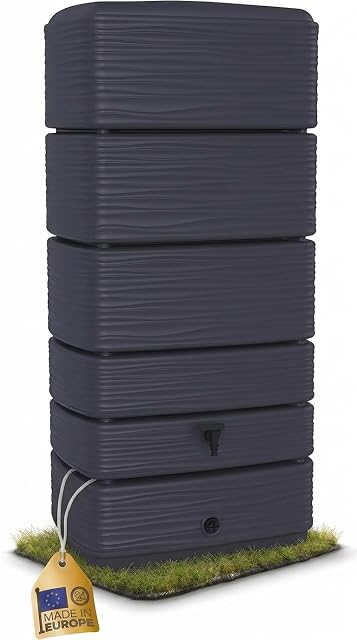
The densest tank on this shelf
About 60 × 40 cm of ground. 137 cm tall. 300 litres.
That footprint is 0.24 m², and 300 litres over it is roughly 1,250 litres
per square metre of ground.
Across the five butts on this shelf that publish dimensions, the same calculation
gives 707, 739, 868, 1,013 and this 1,250.
So it holds nearly twice as much per square metre of garden as the round barrel
on this shelf.
And the listing makes the comparison itself
“Comparable 310-litre rain tanks need about 80 × 80 cm of floor area.”
That is 0.64 m², against 0.24 — and a manufacturer publishing the competitor
geometry it is beating is unusual enough to check.
It also holds up. A round 300-litre butt has to be roughly 70 cm across and
about a metre tall; a flat-backed tank achieves the same volume by going up and
staying thin.
Where it matters is the place these tanks actually go: a side passage between a
house and a fence, a corner behind a shed, the gap beside a bin store. Forty
centimetres of depth fits in places eighty does not.
Two outlets, which is the best answer on this shelf
Every water butt in this family has the same unspoken problem: a full watering
can is 30 to 35 cm tall, and a tap near the base of a tank standing on the
ground cannot fill one.
The answers elsewhere on this shelf are a four-part stand, a hole you drill
yourself, threaded bosses at fixed heights, or nothing.
This one has two outlets:
A raised one, for a watering can.
One at floor level, to empty the tank completely.
That second one is the part that is usually missing, and it is what makes the
November drain-down a two-minute job instead of a siphon and a bucket. Water
expands as it freezes, and a tank left full through a hard frost bulges or breaks
its tap.
The plinth, recommended and explained
“To make full use of the whole 300 litre capacity, placing it on a plinth is
recommended. But even at ground level, most of the water can be drawn off
through the raised outlet.”
That is the trade stated honestly, and it is the same trade the whole shelf
has.
On the ground: the raised outlet works for cans, and the water below it needs the
floor outlet and something flat to catch it in.
On a plinth: the raised outlet clears a can easily, and the floor outlet still
empties the tank.
The dimpled surface
Named twice, as regular depressions in the surface that protect against
bulging.
That is structural rather than decorative, and it is the reason a flat-backed
tank can be thin.
Three hundred litres of water at the bottom of a 137 cm column pushes outward
hard. A flat panel that size wants to belly out, and once it has, the tank never
stands straight again and the lid stops fitting. Dimples stiffen the panel
exactly as ribs do, without adding thickness or weight.
Which is presumably why the tank is only 15 kg empty for 300 litres of
capacity.
The collector, which is not included
Stated plainly: the rain collector is not in the box.
What is provided instead is two pilot-drill marks at the top edge, and the
note that the tank can be drilled anywhere.
That is more honest than it sounds and it is also a real omission. Five of the
seven butts here come without a collector; one includes one that filters and
stops when full, and that is the part that connects a tank to a roof.
Without it, a water butt collects what lands on its own lid — about a quarter of
a square metre.
The listing does at least explain what to look for: a collector with a leaf
filter, so little dirt reaches the tank.
About 0.53 € per litre
In the upper half of a shelf running from about 0.25 € to 0.56 €.
What it buys is the geometry — 300 litres in 0.24 m² — plus two outlet heights, a
tap, and a stated 15 kg empty weight.
What it does not buy is the collector, and on a tank this size that is a purchase
to plan for rather than an afterthought.
Availability
Around 158 €, read at the German Amazon store on the day of the survey.
Listed and unsold: the American, British, French, Italian and Spanish Amazon catalogues hold the reference with nobody behind it.
Taken from Keepa on the day this page was last revised; stock and prices move without notice.
Prices quoted in this text were read on 26 September 2026. The live price is at the top of the page.