The one honest number on this shelf
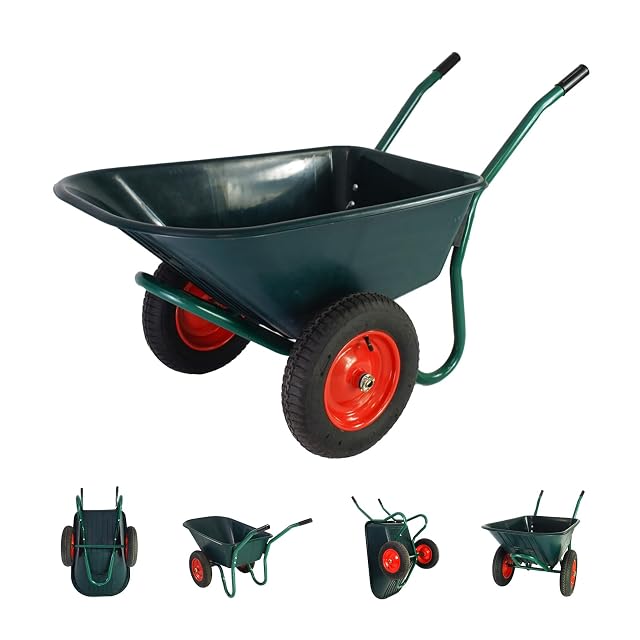
“Max. load capacity: 150 kg dynamic and 250 kg static (not in motion).”
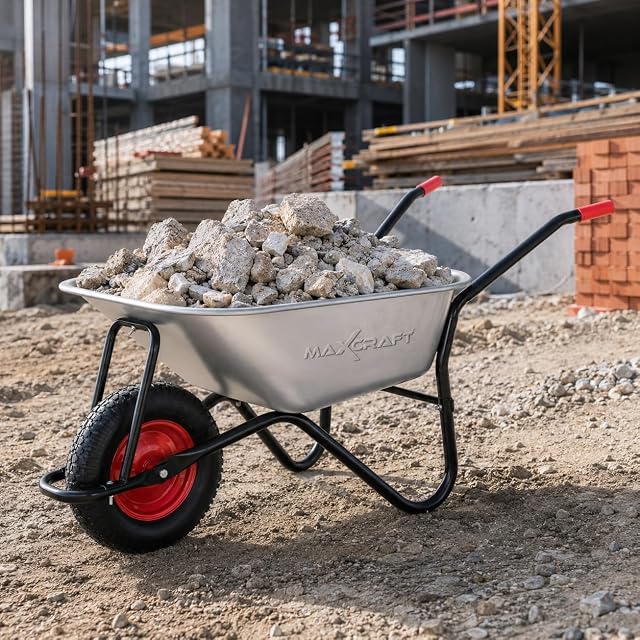
Five other barrows in this family publish a single headline figure — four of them
250 kg — with no qualifier at all.
This listing publishes both, and names which is which.
Why that distinction is not a technicality
A static load is what the tub and frame will hold standing still on level ground.
A dynamic load is what they will hold while the barrow is being used: pushed over
a lawn, bumped up a step, tipped forward to empty, dropped the last few centimetres when
your arms give out, and steered one-handed round a corner.
Those are completely different loadings. A tub that is fine holding a weight is being
shock-loaded when the wheel drops off a kerb, and the force at that moment is several
times the static weight.
Here the difference is 250 kg down to 150 kg — a 40 per cent reduction.
And the consequence for the rest of this shelf
Four barrows here advertise 250 kg and say nothing more.
On the evidence of the one listing that splits the figure, a 250 kg headline on a barrow
of this construction should be read as a standing figure, and the load that can
actually be moved is substantially lower.
This page does not transfer one manufacturer’s numbers onto another’s product. What it
does say is that a single unqualified rating is the less informative of the two forms, and
that this is the only listing in the family that gives both.
For practical purposes: 100 litres of wet soil weighs roughly 130 to 150 kg, which is
the dynamic figure here almost exactly. A 100 L barrow filled to the brim with wet soil is
at its moving limit, and that is worth knowing before filling one with gravel.
The wheel, specified properly
Ø about 38 cm. 9 cm wide. Axle 17 cm. Tyre pressure about 2 bar.
Four figures, and no other barrow on this shelf publishes more than two.
Diameter is what decides rolling. A larger wheel rides over a lawn edge, a root and a
paving joint instead of stopping at it, and it sinks less into soft ground. Across this
shelf the wheels are 38 cm, 40 cm, 400 mm and an unstated pair — so 38 cm is at the
smaller end.
Width is what decides sinking. Nine centimetres spreads the load over a longer contact
patch, which is the difference between rolling across a wet lawn and cutting a line into
it.
Axle length matters for one reason only, and it is the reason to write it down:
replacement. A barrow wheel is a consumable, and an axle dimension is what lets you
buy the right one in five years.
The only tyre pressure published on this shelf, and it explains a universal
experience.
A barrow that has stood in a shed since last spring feels heavy.
People assume the bearing has seized or that they are older. Usually the tyre is soft.
An under-inflated pneumatic tyre deforms under load: the contact patch grows, the
sidewall flexes, and the rolling resistance rises steeply. A barrow at 1 bar carrying
100 kg is genuinely hard work; the same barrow at 2 bar is not.
Five minutes with a pump, once a season, is the single highest-value maintenance on
anything in this family — and it is only possible to do correctly because one listing
published the figure.
Painted steel, which is the weak point
“Material: painted steel sheet.”
This is the least durable tub material on this shelf, and the reason is specific to what a
barrow does.
A barrow tub is scraped by a shovel on every single use. Loading soil, gravel or
rubble means a steel blade dragged along the bottom and up the front lip, dozens of times
per load.
Paint does not survive that. It comes off along the bottom within the first few loads, and
from then on the tub is bare steel holding wet soil — which is the definition of a
rusting environment.
Across this shelf:
Galvanised steel — two barrows. Zinc corrodes in preference to the steel underneath, so
a scrape does not become a rust hole. This is the right answer for a steel tub.
Plastic or PVC — three barrows. Cannot rust at all; goes brittle in frost and chalky in
UV, and one publishes a 3 mm wall thickness.
Painted steel — this one.
It will work for years while rusting, and it is the cheapest 100 L barrow on the shelf.
The honest expectation is that the bottom of the tub will be brown by the end of the first
season, and that keeping it under cover and empty is what extends it.
142 × 58 × 51 cm
Published in full, which four barrows here do not manage.
The 58 cm width is the number to check first: it is what decides whether the barrow
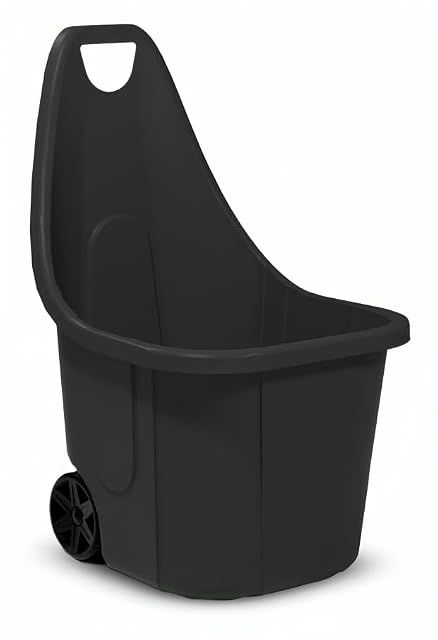
fits through a gate, a side passage, and a shed door. The small plastic garden cart on this
shelf is 50 cm wide, and at 100 L the builder’s barrows are wider.
142 cm of length is also worth noting, because a barrow is stored standing on its nose
against a wall, and its length becomes its height.
The hard rubber grips
“Including anti-slip hard rubber grips, high load capacity.”
Small, and on a loaded barrow it is the interface that fails first in use.
Pushing 150 kg means gripping two handles hard while your palms are wet and muddy, and a
bare steel or painted tube is where hands slip. It is also what raises blisters — the same
failure the joint scraper on this site’s weeder shelf designs its grip against.
What goes unpublished
No empty weight. One barrow on this shelf publishes 11.2 kg, and it is the only
figure of its kind. Empty weight matters because it is subtracted from what you can carry
and because it is what you lift over a step.
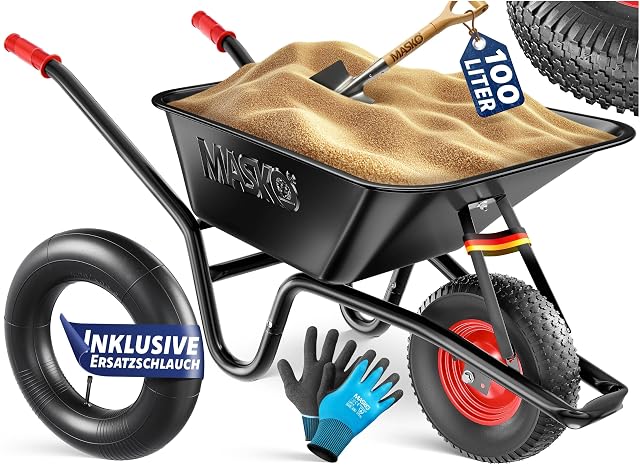
No spare tube, and no puncture note. One barrow on this shelf includes a spare inner
tube in the box — which is the most honest inclusion in this family, since a pneumatic
tyre punctures and a barrow with a flat is useless the day you need it.
Availability
From 50 € to 70 €, that being the spread across the German and French Amazon stores on the day of the survey.
More than 1.6× the cheapest country at the Spanish Amazon store; a gap of that size normally means forwarded stock rather than a seller on the ground, so the spread above leaves it out.
Listed and unsold: the British and Italian Amazon catalogues hold the reference with nobody behind it.
Nothing came back from the American Amazon store at all; the buy button there runs a search rather than opening an empty page.
Taken from Keepa on the day this page was last revised; stock and prices move without notice.
Prices quoted in this text were read on 26 September 2026. The live price is at the top of the page.