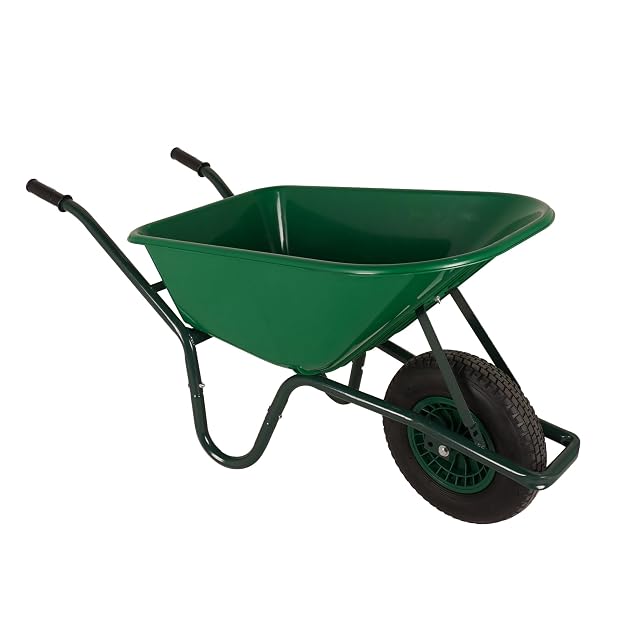
The line at the end of the listing
“Dimension and weight figures are guide values.”
A reasonable disclaimer in itself — and this listing publishes no dimensions and no
weight at all, so there is nothing for it to qualify.
Which matters more on a wheelbarrow than on most things
Because of where a barrow lives and how it is stored.
Width decides whether it goes through a gate, along a path between beds, and
through a shed door. On this shelf the published widths are 50 cm and 58 cm, and those
are a genuinely different proposition in a terraced garden with a side passage.
Length becomes height in storage, because a barrow is stood on its nose against a
wall. One barrow here is 142 cm long, which is taller than most shed walls are clear.
Empty weight is what you lift over a step, and it is subtracted from what you can
carry. One barrow on this shelf publishes 11.2 kg and it is the only such figure in the
family.
Two barrows here publish all three overall dimensions. This publishes a capacity, a load
rating and a disclaimer.
“A stable pneumatic wheel with a metal axle for easy movement on any surface.”
Small, specific, and it identifies the component that ends cheap barrows.
Everything a barrow carries turns on one axle. The whole load — tub, soil, water, a
person leaning on the handles — passes through a single bearing surface a couple of
centimetres across.
A plastic bushing in that duty wears oval. The wheel develops play, then it leans,
then it rubs against the frame, and then it stops turning freely and the barrow feels
heavy no matter how well the tyre is inflated.
A steel axle in a steel or bearing-fitted hub does not, and it can be greased.
One barrow on this shelf goes further and specifies ball-bearing wheels. Another
publishes an axle length of 17 cm, which is the figure that lets you buy a replacement
wheel in five years.
“An additional metal support reinforces the construction and ensures lasting stability
with regular use.”
Worth explaining, because it addresses a real weakness of the plastic-tub arrangement.
A steel tub is a structural part. Formed sheet steel is stiff in itself, and the tub
contributes to holding the frame square.
A plastic tub is not. It is a container bolted to a frame, and it carries almost no
load between the frame members. So a plastic-tub barrow’s frame has to be stiff on its
own — which is why a brace across it is not decoration.
Without one, the two legs and the two handles can rack: the barrow twists under a side
load, the tub flexes at its bolt holes, and eventually the holes tear.
Another plastic-tub barrow on this shelf makes the same argument by publishing a
33 mm powder-coated steel tube frame, welded and bolted.
Plastic, and the honest trade
What it gains: it cannot rust.
That is a bigger advantage than it sounds, because of what happens to steel tubs. A barrow
tub is scraped by a shovel on every use — a steel blade dragged along the bottom and up
the front lip, dozens of times a load. No coating survives it.
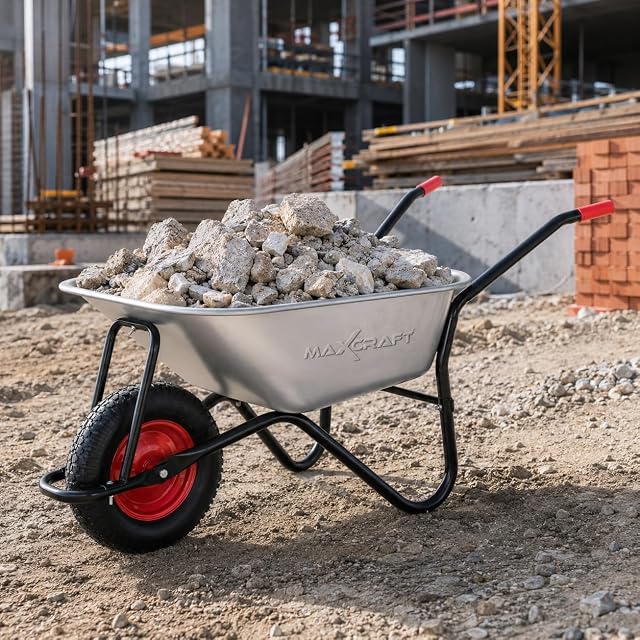
One barrow on this shelf has a painted tub, which leaves bare steel holding wet soil.
Two are galvanised, which leaves zinc that corrodes in preference to the steel — the
correct answer for a steel tub.
Plastic simply has nothing to corrode. Left out in the rain full of wet leaves all winter,
it is unchanged.
What it loses: cold and sunlight.
Polypropylene and PVC go brittle below freezing and chalky under UV. A plastic
barrow stored outdoors for five summers and then loaded with rubble on a frosty February
morning is the one that cracks at a bolt hole.
And a shovel corner used carelessly can split a rim, where steel would dent.
The figure that would settle it is wall thickness, and one plastic barrow on this shelf
publishes about 3 mm. This one does not.
“Optimally aligned centre of gravity”
The second feature line, and it is the one genuine ergonomic claim on this shelf.
It is also the thing that most separates a good barrow from a bad one, and it is almost
never specified.
The wheel position relative to the tub decides how much of the load you carry. A wheel
set well forward means the load sits over it and your hands hold very little; a wheel set
back means you are lifting a share of 100 kg the whole way.
There is a limit in the other direction — too far forward and the barrow tips over its own
wheel when tipped to empty, and it steers badly.
Nothing on this shelf publishes a wheel position, and a claim about the centre of gravity
is at least pointing at the right property.
The 250 kg, unqualified
Like four other barrows here.
One barrow on this shelf publishes its rating as two figures — 150 kg dynamic and
250 kg static (not in motion) — and that distinction applies to every barrow ever made.
A static figure is what the frame holds standing still. A dynamic figure is what it
holds while being pushed, tipped, run over a step and set down, which is the only condition
a barrow is used in. On the one product that splits it, the gap is 40 per cent.
For scale: 100 litres of wet soil weighs roughly 130 to 150 kg. A full tub of it is a
serious load on anything on this shelf.
What goes unpublished
No wheel diameter. Across this shelf the wheels run 38 cm, 40 cm, 400 mm
solid PU, and a pair of unstated pneumatics. Diameter is what decides whether a barrow
rides over a lawn edge, a root or a paving joint or stops at it.
No tyre pressure. One barrow here publishes 2 bar, and an under-inflated tyre is
the commonest reason a barrow feels heavy — five minutes with a pump is the highest-value
maintenance in this family.
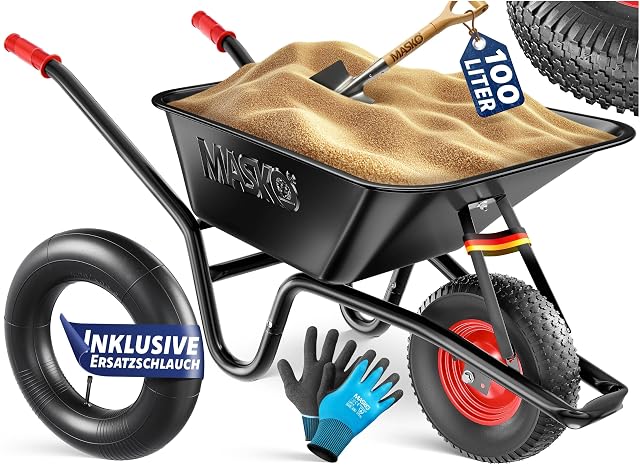
No spare tube. One barrow on this shelf includes one, which is the honest
acknowledgement that a pneumatic tyre punctures on thorns, screws and sharp stones.
Availability
Around 60 €, read at the German Amazon store on the day of the survey.
Listed and unsold: the Italian and Spanish Amazon catalogues hold the reference with nobody behind it.
Nothing came back from the American, British and French Amazon stores at all; the buy button there runs a search rather than opening an empty page.
Taken from Keepa on the day this page was last revised; stock and prices move without notice.
Prices quoted in this text were read on 26 September 2026. The live price is at the top of the page.