An analysis, which is the rare thing here
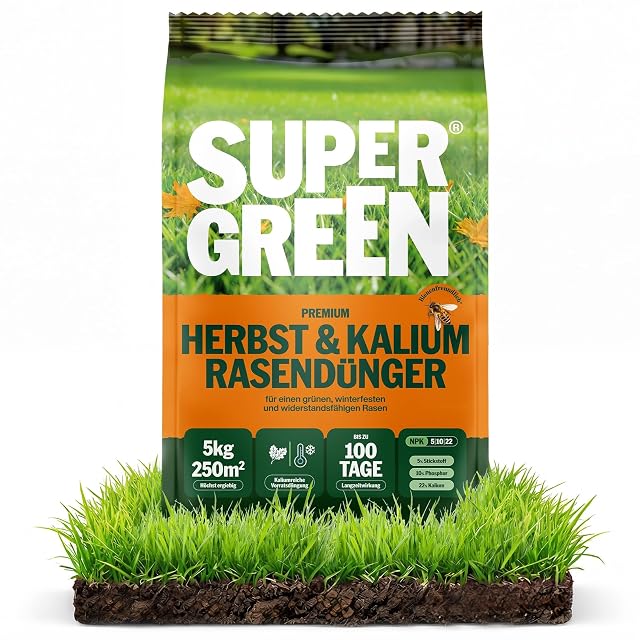
NPK 5-10-22.
Five of the seven autumn feeds on this shelf publish no analysis at all. They say
“potassium booster”, “potassium SchutzPlus”, “high potassium content”, “rich in
potassium” — and give no number.
An NPK is what turns those phrases into something that can be compared.
What the three numbers do
5 % nitrogen. Low, deliberately. Nitrogen drives leaf growth, and soft new
growth going into winter is what frost damages and what fungal disease
colonises. An autumn feed is low in nitrogen on purpose.
10 % phosphate. Root development. Modest, and it is the figure that changes
least across autumn feeds.
22 % potash. The point of the product. Potassium thickens cell walls, which
is the physical mechanism behind every frost-hardiness claim on this shelf.
Twenty-two per cent is the highest figure published here — the other analysed
feed gives 13.
And then the sum nobody does
Twenty-two per cent sounds like the better product. Work out what the potassium
costs and it is not.
This feed: 5 kg at 22 % is 1.10 kg of K₂O, for the price of the bag —
about 23.18 € per kilogram of potash.
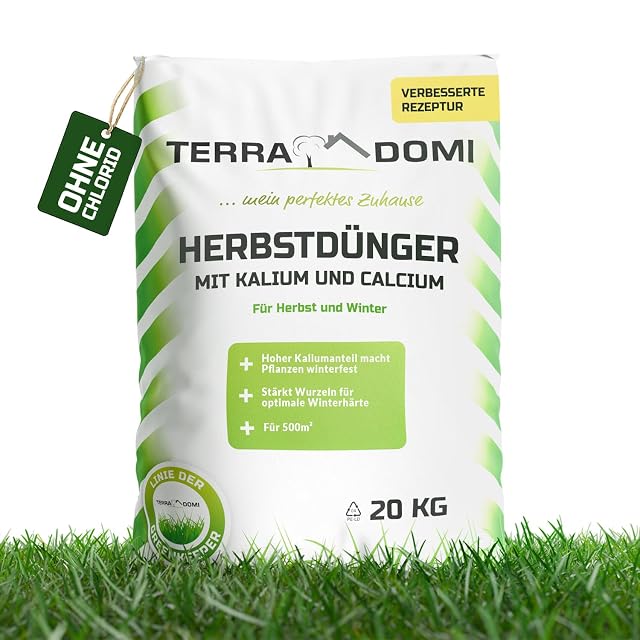
The other analysed feed here: 20 kg at 13 % is 2.60 kg of K₂O — about
11.86 € per kilogram of potash.
Roughly half the price, from the bag with the lower headline percentage.
That is the whole argument for publishing an analysis, and it is why five
products on this shelf cannot be compared on anything except the price of the
sack.
The granule size
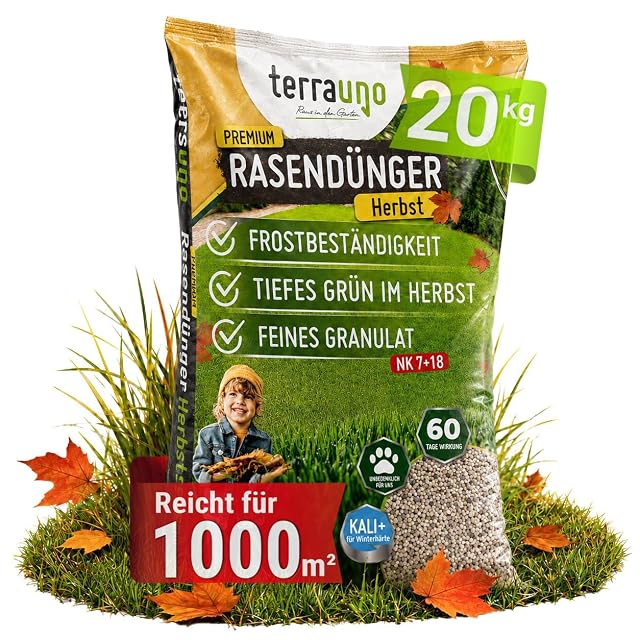
2 to 5 mm. The only one of its kind here.
It is a more practical figure than it looks, because a granular fertiliser is
almost always applied with a spreader, and the granule is what the spreader is
set for.
This site’s spreader shelf carries one machine that maps its eight numbered
settings to material: 1–3 for fine seed, 4–6 for medium fertiliser, 7–8 for
coarse grit. A 2 to 5 mm granule is squarely the middle case.
Get it wrong and there are two failures. Too tight a gate and a 5 mm granule
bridges — it arches across the opening, nothing comes out, and then a lump
breaks free and dumps. Too open and the whole bag goes down in a third of the
lawn.
Six feeds on this shelf leave the buyer to find out on the grass.
The rate, and the arithmetic that agrees
5 kg for 250 m² is 20 g/m².
Three other feeds on this shelf state or imply 20 g/m², and one states 40 to 45.
One contradicts itself between 25 and 50.
Twenty grams a square metre is a small quantity — a handful covers a couple of
square metres — and that is exactly why the granule size and the spreader setting
matter more than they would at 45.
“Nitrate-free”
Stated, and worth reading carefully.
The analysis declares 5 % nitrogen. So there is nitrogen in the bag; the
claim is about the form it is in, not its absence.
Nitrogen in a fertiliser can be present as nitrate, as ammonium, or as urea.
Nitrate is immediately available and the most readily washed out of soil by rain;
the others convert more slowly.
The listing does not say which form is used here, so what can be said is exactly
this: the nitrogen is not in nitrate form, and nothing published says what it is
instead.
A hundred days
The stated duration of action, and the longest figure on this shelf.
For an autumn feed that is the design: applied in September or October, still
releasing in December, and with something left in the soil when growth restarts.
The listing calls this a Vorratsdüngung — a reserve feed — and the logic is
sound. Grass roots keep working at soil temperatures well below the point where
the leaf stops growing, so potassium applied in autumn is taken up over months
rather than days.
Availability
Around 26 €, read at the German Amazon store on the day of the survey.
Nothing came back from the American, British, French, Italian and Spanish Amazon stores at all; the buy button there runs a search rather than opening an empty page.
Taken from Keepa on the day this page was last revised; stock and prices move without notice.
Prices quoted in this text were read on 26 September 2026. The live price is at the top of the page.