Forty to forty-five grams, which is double most of this shelf
Four autumn feeds here state or imply 20 g/m². This states 40 to 45.
So the same 20 kilograms covers 500 m² here, and 1,000 m² on another sack
of identical weight on this shelf.
And that is not, by itself, a criticism
A fertiliser’s rate follows from its concentration. A feed with 22 % potash goes
on at a lower rate than a feed with 13 %, and both can deliver the same potassium
to the lawn.
What it means practically is straightforward:
More product to carry and spread. Twenty kilograms for 500 m² instead of
1,000.
A different spreader setting. Twice the rate is twice the gate opening, and
this site’s spreader shelf shows how much that matters — one machine there maps
its numbered settings to fine seed, medium fertiliser and coarse grit, and the
same setting at the wrong rate is a striped lawn.
And a lower risk of unevenness. At 40 g/m² there are twice as many granules
per square metre as at 20, so a small error in the spread averages out more
readily. Low-rate feeds are the ones that show mottled colour a fortnight later.
Per square metre it works out at about 0.088 €, in the lower half of a shelf
running from roughly 0.055 € to 0.24 €.
The numbers agree, which this shelf does not always manage
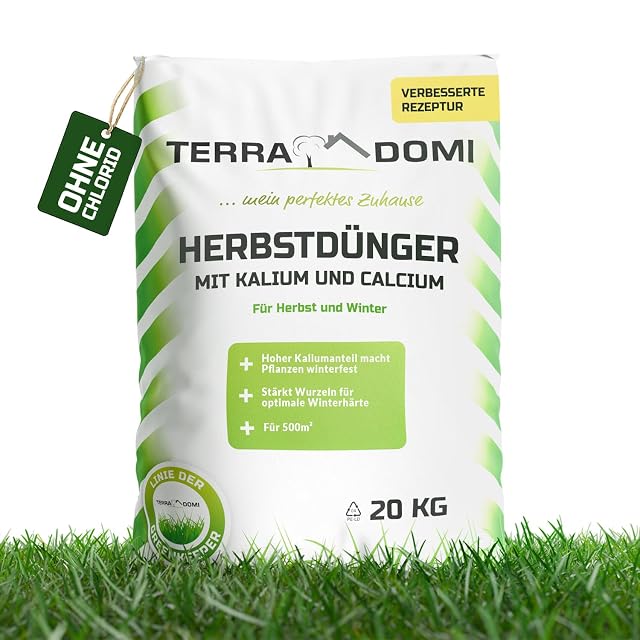
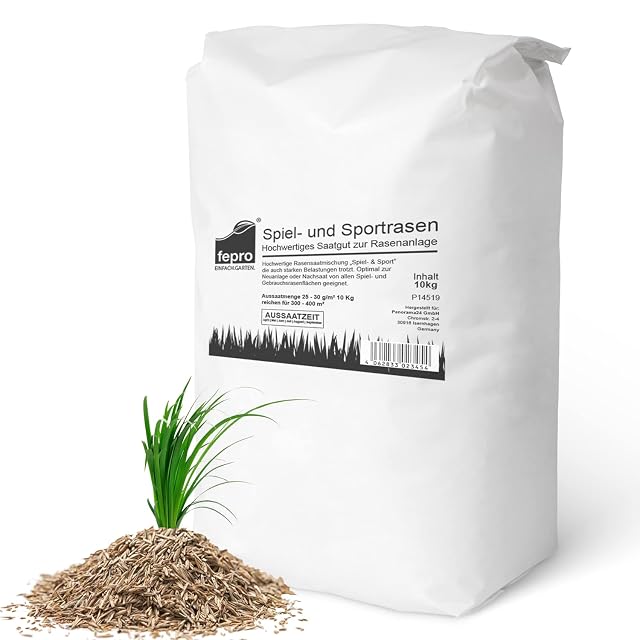
20 kg. 40 to 45 g/m². Up to 500 m².
20,000 grams divided by 40 is exactly 500.
Worth pointing at, because one feed on this shelf publishes a title and a feature
line that disagree about coverage by a factor of two — 60 m² against 120 m²
for the same 3 kg bag — and another publishes a rate with no area at all.
Chloride-free, and what it is actually for
The only such claim on this shelf, and the listing explains it properly: the feed
can therefore also be used on beds, spares sensitive plants, prevents quality
losses, and improves the taste and keeping quality of fruit and vegetables.
That is a real distinction, and here is the mechanism.
Potassium in fertiliser is normally supplied as potassium chloride — muriate
of potash — because it is the cheapest source. The potassium is what the plant
wants; the chloride comes along with it.
Most plants do not care. A group of them do: soft fruit, beans, tomatoes and
potatoes are the usual list, and on those chloride can reduce yield, flavour
and storage life.
A chloride-free feed supplies potassium as sulphate of potash instead. It
costs more to make and it is what growers of those crops use.
Grass is not chloride-sensitive. So on a lawn alone, this claim buys nothing.
What it buys is the ability to use one sack in two places — and on a 20 kg sack
that will otherwise sit in a shed for two years, that is a genuine argument.
“Safe for children and dogs”
Stated in the listing, and this page will report it rather than endorse it.
What can be said accurately: this is a fertiliser, not a pesticide. There is
nothing in it intended to kill anything, which is a real distinction on a
neighbouring shelf of this site where one moss product is a plant protection
product requiring the lawn to be left alone for two to three days and applied at
most once a year.
What a fertiliser is, chemically, is a concentrated salt. Granules on a lawn
before watering in are attractive to a dog and not good for one in quantity.
Watering in thoroughly after spreading — which one other listing on this shelf
makes a point of — is the practical answer, and it is also how the feed gets to
the roots.
The label on the sack is the authority here, not a feature line.
What goes unpublished
No NPK.
The sack is named for its potassium and does not say how much there is.
Two products on this shelf publish an analysis, and on those two the cost of the
potassium itself can be worked out: about 11.86 € and 23.18 € per kilogram
of K₂O — a factor of two, entirely invisible from the price of either bag.
Here, with a rate of 40 to 45 g/m² and no analysis, there is no way to tell
whether the higher rate reflects a lower concentration or simply a heavier
recommendation.
No granule size — one feed here publishes 2 to 5 mm. No application
window, where two feeds on this shelf name months.
Availability
Around 44 €, read at the German Amazon store on the day of the survey.
Nothing came back from the American, British, French, Italian and Spanish Amazon stores at all; the buy button there runs a search rather than opening an empty page.
Taken from Keepa on the day this page was last revised; stock and prices move without notice.
Prices quoted in this text were read on 26 September 2026. The live price is at the top of the page.