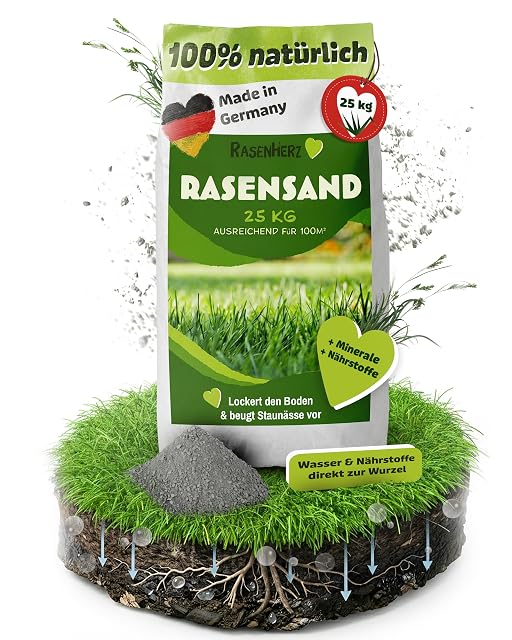
It is not sand, and that has to be said first
The title calls it Rasensand — lawn sand.
The fifth feature line states the form: powder.
Those two things cannot both be right for the job lawn sand does, and the powder
is the accurate one.
Why the distinction is the whole page
The two other “sands” on this shelf are washed quartz at published grades:
0.4 to 1.4 mm and 0.3 to 1.5 mm.
Those grades exist for one reason. Drainage happens in the pores between
particles; coarse grains leave large pores that water moves through, and fine
particles fill pores rather than opening them. A fine sand worked into clay makes a
denser, less permeable layer than the clay was alone — which is the classic way of
making a lawn worse.
A powder is finer than any of that.
So whatever this product does for a lawn, it is not improving drainage by
mechanical means, and the listing’s claim that the contained stones loosen the soil
and thereby aerate it sits awkwardly with its own description of the form.
What it actually is, and why that is worth having
Diabase is a fine-grained basic volcanic rock — the same family as basalt.
Crushed to a meal it is a traditional soil amendment, sold across European
horticulture as rock flour.
What it supplies is minerals and trace elements, and the listing names six:
iron, calcium, silica, magnesium, boron and zinc.
That is more chemical information than any other product on this shelf gives, and
five of those six are genuinely useful on a lawn:
Iron for colour — the same element that every product on this site’s moss killer
shelf uses, at much higher concentration, to blacken moss.
Calcium and magnesium as cations, which is where the next section comes in.
Silica, which strengthens grass leaf tissue.
Boron and zinc as trace elements, needed in tiny quantities and occasionally
short in sandy or intensively cut turf.
No percentages are published for any of them.
The most technical claim on this shelf, and it is real soil science rather than
marketing.
A clay-humus complex is what makes a good soil good. Clay particles carry a
negative surface charge and so does humus; on their own they repel each other and
stay dispersed. Bridged by polyvalent cations — calcium above all, magnesium,
iron — they bind into stable crumbs.
Those crumbs are the whole of soil structure. They hold water inside them and let
air through the spaces between them, they resist compaction, and they do not
collapse when wet.
A rock powder supplying calcium and magnesium is supplying exactly the bridging
cations that process needs. The mechanism is sound.
What is not established is the quantity — nothing here says how much calcium
is in 250 grams of it, or over what timescale a basic rock weathers enough to
release it. Rock flour is slow. That is its nature and it is also why it is sold
as a long-term improver rather than a treatment.
The rate, which nobody else publishes
250 g/m². 25 kg for 100 m².
Those two figures agree, and this is the only product on this shelf that gives a
rate at all — the two quartz sands publish grades and no dose, and the four
substrates publish nothing.
It is also a genuinely useful benchmark for the whole shelf: 250 g/m² is roughly
what a light top dressing of anything amounts to.
The claim this page does not accept
“Make constant fertilising unnecessary.”
Rock powder supplies minerals and trace elements. It does not supply
meaningful nitrogen.
Nitrogen is the nutrient a lawn consumes fastest, and it is what every product on
this site’s fertiliser shelf is built around — from 5 % in the autumn feeds to 14 %
in a moss-and-feed and 23 % in a starter dressing.
A grass plant cut weekly loses nitrogen with every clipping removed. No rock
weathers fast enough to replace that, and diabase contains very little of it to
begin with.
So the honest position: this is a complement to feeding, supplying what a feed
does not, and it does not replace one.
“Displaces weeds and moss”
Also claimed, and worth the same treatment as the claim on this site’s moss killer
shelf that a well-fed lawn keeps moss out.
The logic is indirect and it is not wrong. Moss colonises where grass is weak, and
grass is weak where the soil is poor, compacted, acidic or badly drained. Improve
the mineral status and the structure, and the grass competes better.
It is not a moss killer, it does not blacken moss, and it will not clear an
existing moss mat. That still needs raking out — this site’s aerator shelf carries
the rakes.
And the storage note, which is a real one
“Store dry; for longer storage transfer to a firm container with a lid. Stored dry,
it can be used indefinitely.”
Rock powder does not spoil, and that is a genuine advantage over almost everything
else in this network’s garden chemistry: fertiliser cakes, seed loses germination,
biocides have shelf lives.
What powder does do is absorb moisture and set solid, which turns 25 kg of
usable amendment into a block. A sealed tub is the answer, and the listing says so.
Availability
From 21 € to 31 €, that being the spread across the German, French and Italian Amazon stores on the day of the survey.
Nothing came back from the American, British and Spanish Amazon stores at all; the buy button there runs a search rather than opening an empty page.
Taken from Keepa on the day this page was last revised; stock and prices move without notice.
Prices quoted in this text were read on 26 September 2026. The live price is at the top of the page.