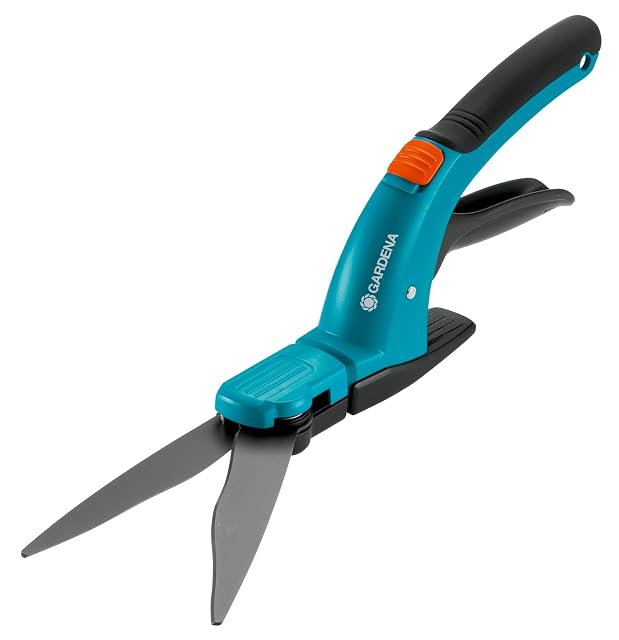
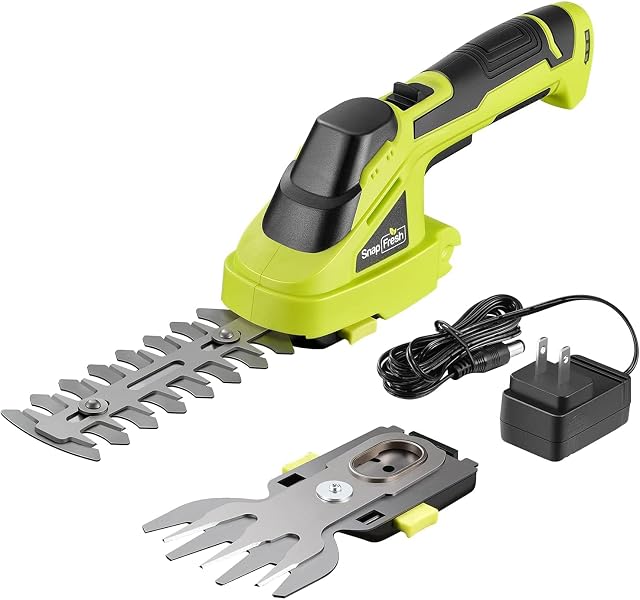
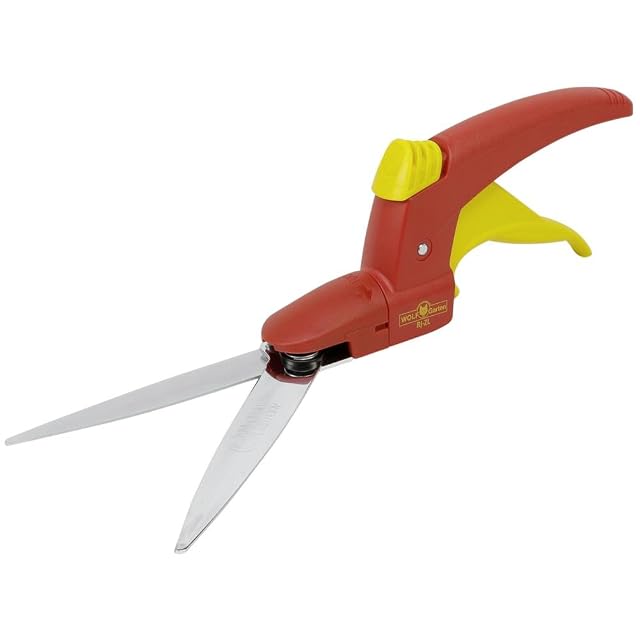
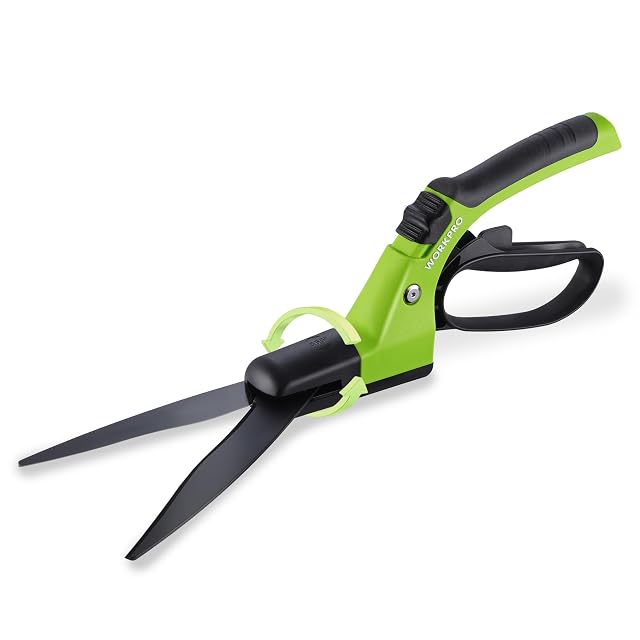
The skid plate, which nothing else here has
“The slide runner of the grass shears makes a constant cutting height easy.”
That is the most useful mechanism on this shelf and it addresses the reason hand-cut
lawn edges look hand-cut.
Why an even height is the hard part
A grass shear cuts wherever you hold it.
Which means the cutting height is set by your wrist, elbow and shoulder, moving
along a boundary, for twenty metres, while your body position changes and the ground
rises and falls.
The result is the familiar one: an edge that undulates, with scalped patches where
the blade dipped into the soil and tufts where it lifted. On a lawn edge — which is
exactly where the eye goes — that is more visible than anywhere else.
A skid plate is a flat sole under the blade that rests on the ground. The blade
sits a fixed distance above it, and the height becomes a property of the tool rather
than of your arm. You slide it along and the cut is level because the ground is the
reference.
It also stops the blade touching soil, which is what blunts grass shears.
No other product on this shelf has one, including the three battery models.
The serrated blade
“Non-stick coated wave-ground cutting blade.”
Two features in one phrase and both are correct for grass.
Serration solves the specific problem that grass is slippery and flexible. A smooth
blade closing on a grass blade pushes it along the edge rather than cutting it, and
it escapes at the tip. That is why blunt shears fold grass over instead of cutting it,
and why grass shears feel worse than they are.
A wave-ground edge grips. Each hollow holds the grass while the cut happens — the same
principle as a bread knife on a soft crust.
Non-stick coating addresses the other failure. Grass sap sets to a varnish on a
blade, and a shear put away dirty after one session is stiff at the pivot and dragging
at the faces by the next. A coated face releases it.
Neither replaces wiping the blades dry and oiling the pivot, and no listing on this
shelf mentions either.
The two-finger action
“The ergonomic, non-slip grip with a soft component sits very well in the hand and can
be operated with the index and middle fingers with little force.”
That is a different design from the rest of this shelf, where the handle is a loop the
whole fist closes around.
The difference shows up over time. A whole-hand squeeze is powerful and tiring; a
two-finger action is weaker and can be repeated far longer.
Edging a lawn is several hundred small cuts, none of which needs much force. For that
job the weaker, repeatable action is the right one — and for cutting through something
thick it is not.
One shear on this shelf publishes a claim of 20 % less force from improved
mechanics, without naming a baseline.
The restriction nobody else states
“For right-handers.”
It is in the listing, in the title, and it is the only handedness statement on this
shelf.
It follows from the design. A skid plate, a blade offset and a grip shaped for
particular fingers are all asymmetric — a tool that cuts level when held in the right
hand will not when mirrored, and the plate ends up on the wrong side of the blade.
For a left-handed gardener this is the wrong tool, and the listing deserves credit for
saying so rather than leaving it to be discovered.
What it gives up
No rotation.
Two shears on this shelf rotate — one through 180°, one through 360° in 16 locked
positions — and rotation is what lets a shear cut a vertical line against a wall,
around a tree or behind a downpipe.
This one cuts in the plane it is held in, and that plane is horizontal, set by the
skid plate.
So the trade on this shelf is clear and it is a real one:
A skid plate gives an even cut along an open boundary and cannot work into a
corner.
Rotation works into corners and gives whatever height your wrist gives.
Neither product does both.
What goes unpublished
No cutting width. None of the four hand shears here publishes one, while all three
battery models do — 83, 100 and 120 mm. Tool length and cut width are different
measurements and this shelf mixes them.
No weight. One battery shear publishes 0.62 kg and it is the only figure in the
family.
Availability
From 17 € to 24 €, that being the spread across the German, French, Italian and Spanish Amazon stores on the day of the survey.
Beyond the euro zone, the American and British Amazon stores price it in their own currencies, which the spread above sets aside.
Taken from Keepa on the day this page was last revised; stock and prices move without notice.
Prices quoted in this text were read on 26 September 2026. The live price is at the top of the page.