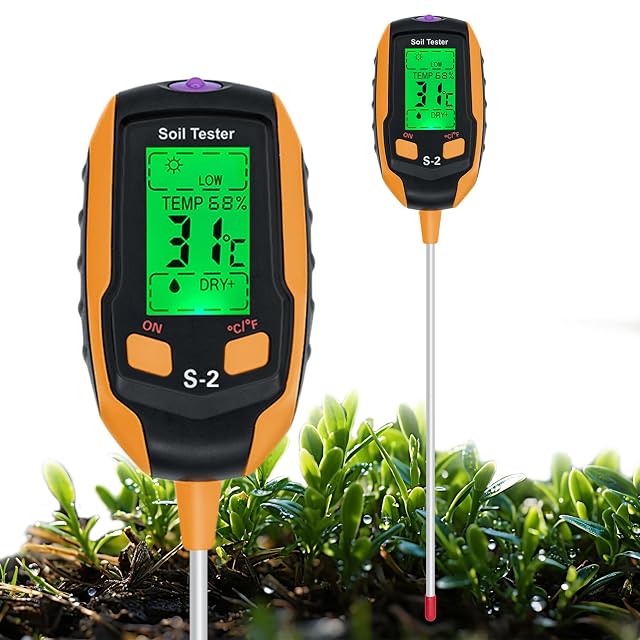
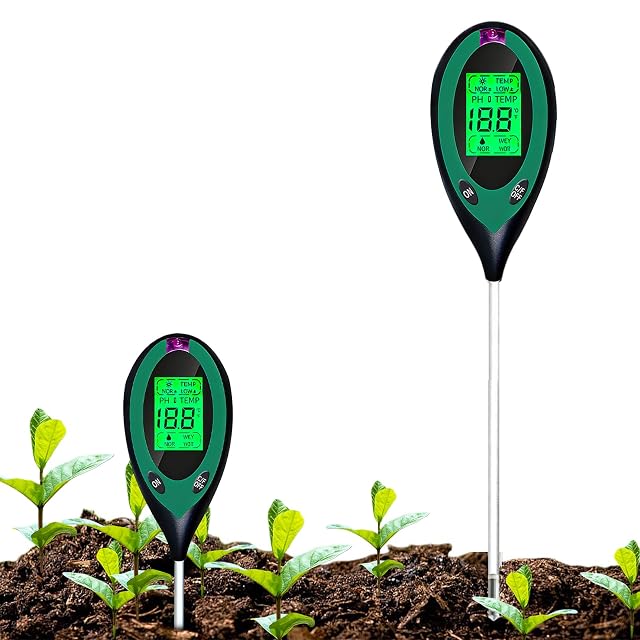
The most candid listing on this shelf
Its first feature line is not a benefit. It is a set of operating warnings, and they
are the most useful text in this family:
“Clean the probe thoroughly before use and press the measure button before each
measurement.”
“The device is only suitable for soil; never immerse the probes in water.”
“Should the pH value constantly show 7, please clean the probe thoroughly and
measure again at a different spot.”
And in the third feature line:
“The soil must be compacted before testing the pH value, otherwise the probe
cannot register the soil.”
What those four sentences establish
A pH reading from a metal probe depends on probe cleanliness, on soil
compaction, and on the probe having proper contact — and a constant 7 is a
documented failure mode rather than a result.
That last one is the most valuable admission on this shelf. A meter that has lost
contact does not show an error; it shows exactly neutral, which looks like a
perfectly plausible garden soil. Somebody who did not read this warning would act on
it.
Two other makers on this shelf add two more variables from their own listings:
insertion depth — inconsistent depth in the same sample gives inaccurate pH
readings — and soil moisture, with dry or hard soil needing to be moistened and
left ten minutes.
Four manufacturers, four user-controlled variables, and not one of the six probe
meters here publishing an accuracy figure, a calibration step or a reference
solution for pH.
And the compaction requirement is worth a second look
“The soil must be compacted before testing the pH value.”
That instruction is honest and it contains a problem the listing does not name.
Compacting soil around a probe changes the thing being measured. The pH of a
pressed lump around a metal rod is not necessarily the pH of the soil as grass roots
encounter it — pore water, air spaces and aggregate structure all change under
pressure.
It is the right instruction for getting a reading. It is also a reason the reading
should be treated as an indication.
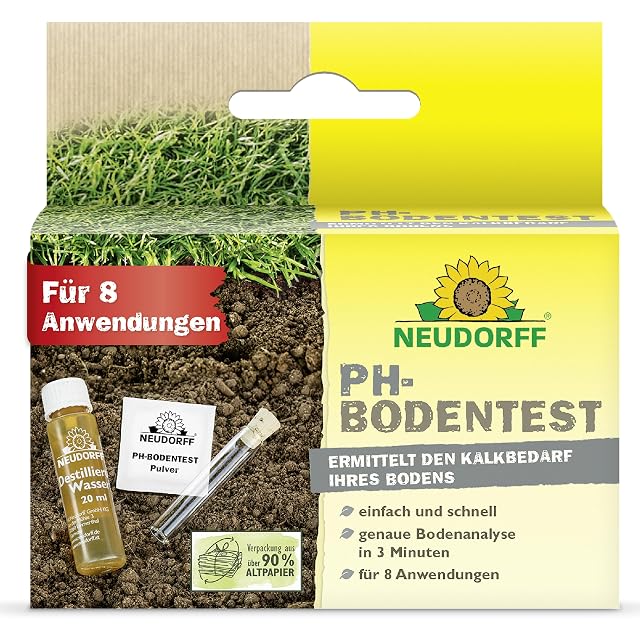
One product on this shelf measures pH by chemistry: reagent powder, distilled
water, a tube, a colour scale, and a table converting the result into a lime
requirement. Nothing about that depends on how hard anybody pushed, and it
produces a decision rather than a number.
The fifth function, which is the honest kind
“5-in-1” means different things on this shelf, and this is the version worth having.
Here the fifth reading is ambient air humidity — a separate sensor, and the
listing states where it is: mounted at the top of the body, specifically to
avoid being blocked during measurement.
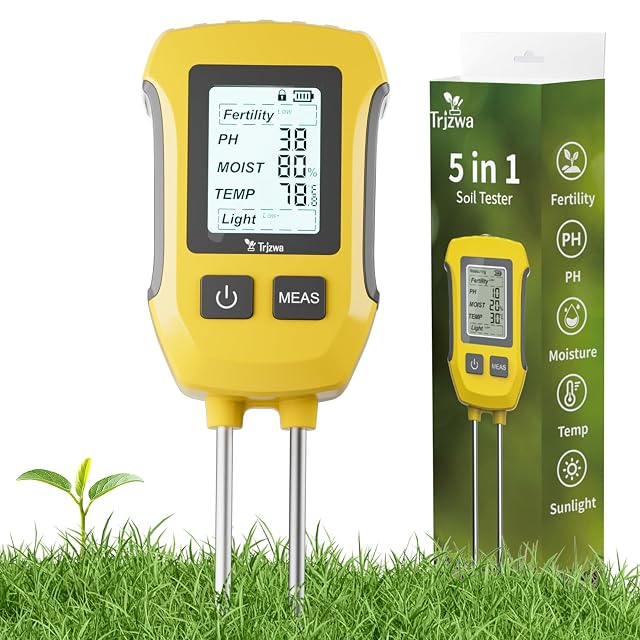
Two other meters here claim soil fertility as their fifth reading, from the same
probe that gives moisture and pH. There is no chemistry in that: an electrode pair
cannot distinguish nitrogen from potassium from dissolved salt.
Air humidity is different. It needs its own sensor, it is a real measurement, and
it is genuinely useful in one place: a greenhouse or a propagator, where
humidity drives both germination and fungal disease. Damping-off in a seed tray is a
humidity problem, and this is the one reading on this shelf that would catch it.
The five readings, ranked
Temperature — dependable. A thermistor does not care about contact area. And it
is the most useful figure on this shelf for a lawn: this site’s lawn seed shelf
publishes germination thresholds of 8 °C and 10 °C, below which seed sits in
cold ground rather than germinating.
Light — dependable. A photocell measures light properly. Shade is one of the
four reasons moss gets into a lawn.
Ambient humidity — dependable, via its own sensor.
Soil moisture — comparative. A conductivity reading, so dissolved salts affect
it. A lawn fed a week ago reads wetter than the same lawn a month later — and this
site’s fertiliser shelf is a shelf of concentrated salts.
pH — conditional, per the manufacturer’s own four warnings.
A full minute
The slowest reading time on this shelf — others state 5 to 10 seconds and 8
seconds.
The listing also asks for several measurements in different positions for a more
accurate pH, and recommends taking soil temperature half an hour after
watering.
Both are sound practice and both make the minute worse. Four positions at a minute
each, plus the compacting, plus cleaning the probe between them, is a real
procedure rather than a quick check.
Which is the trade this listing makes throughout: it is slower and more demanding
than its neighbours, and it tells you why.
What it must not be used in
“Only designed for soil, not for sawdust, pebbles, powder, pellets or organic
matter.”
The only exclusion list on this shelf, and it is relevant to two other shelves on
this site.
A peat-free substrate is largely wood fibre. Lawn sand is graded quartz at
0.3 to 1.5 mm. A rock powder amendment is exactly the “powder” being excluded.
None of those is soil, and a probe in any of them is not measuring what the scale
was calibrated against.
Four AAA batteries, not included
Stated plainly, twice. Worth checking the drawer before the meter arrives.
Availability
From 20 € to 25 €, that being the spread across the German, French, Italian and Spanish Amazon stores on the day of the survey.
Listed and unsold: the British Amazon catalogue holds the reference with nobody behind it.
Nothing came back from the American Amazon store at all; the buy button there runs a search rather than opening an empty page.
Taken from Keepa on the day this page was last revised; stock and prices move without notice.
Prices quoted in this text were read on 26 September 2026. The live price is at the top of the page.