It has to lead every page in this family, because nothing in these listings says it.
A flame does not distinguish between grass and weeds. The heat that kills a dandelion
seedling kills the turf around it just as completely, and a burner passed over a lawn
leaves a brown patch that has to be reseeded.
Everything on this shelf is for hard surfaces and bare ground: paving joints, gravel
drives, block paving, path edges, the strip between a wall and a slab, a yard.
For weeds in a lawn, this site’s weeder shelf carries the right tools — taproot knives
and stand-up claw pullers that lift the root out and leave the grass.
And it does not kill roots
The second thing nothing on this shelf states plainly, and it is the reason flame weeding
disappoints people.
What the heat actually does is rupture cell walls in the foliage. Water inside the
cells expands, the membranes fail, and the plant dries out over the following days. Two
listings on this shelf describe that mechanism accurately.
What it does not reach is the root. Soil is an excellent insulator, and a few
seconds of hot gas on the surface raises the temperature a centimetre down by very
little.
So the outcome divides by plant type:
Annual weeds die. Groundsel, chickweed, annual meadow grass, seedlings of anything.
The whole plant is above ground and it is gone.
Perennials regrow. Dandelion and dock from a taproot; couch grass, bindweed and
ground elder from rhizomes. The top dies back and a new shoot appears within a fortnight.
The method that works on those is repetition. Burn the regrowth each time it appears,
every two to three weeks, and the root spends its reserves rebuilding leaves it never
gets to use. It exhausts itself over a season or two.
Anybody expecting one pass in April to clear a drive for the summer will be back in May.
And the three seconds nobody mentions
You do not need to burn the plant.
The correct technique is two to three seconds per plant, until the leaf darkens and
goes limp — the visible sign that the cells have ruptured. A leaf that has been heated
enough to change colour is already dead.
Burning it to ash takes ten times as long, uses ten times the gas, and achieves nothing
extra, because the root was never going to be reached.
That single fact roughly halves the running cost of every product on this shelf, and none
of them prints it.
EN 417
The one standard this listing names, and it is worth having.
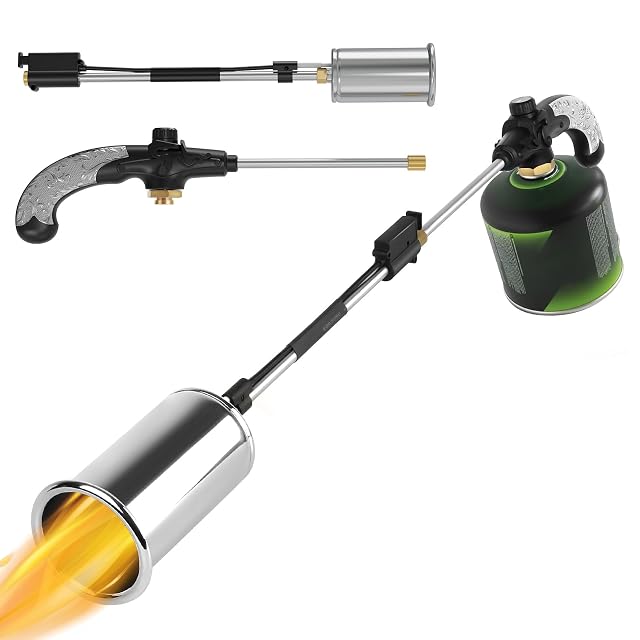
EN 417 is the European specification for the valve fitting on small, non-refillable
gas cartridges. A torch that takes an EN 417 cartridge takes any EN 417 cartridge,
from any brand, from any hardware shop.
The alternative is a proprietary thread, which ties the tool to one manufacturer’s fuel
for as long as that manufacturer keeps selling it.
The cartridge is not included, which the listing says clearly.
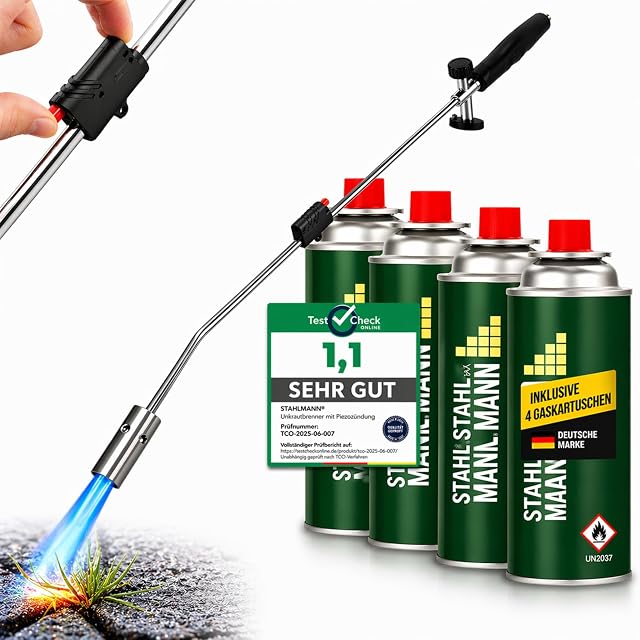
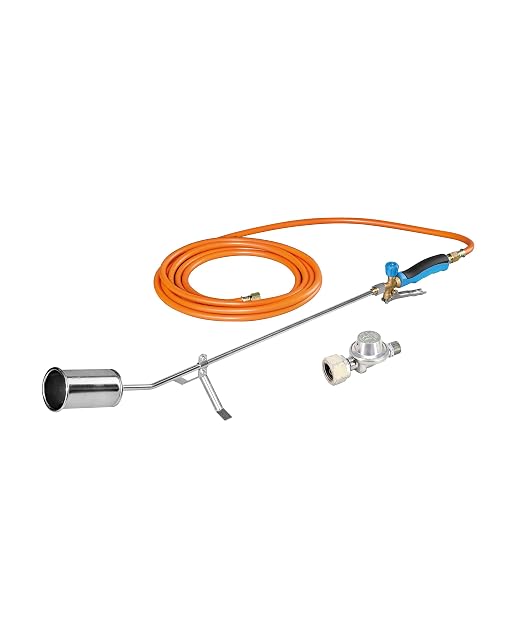
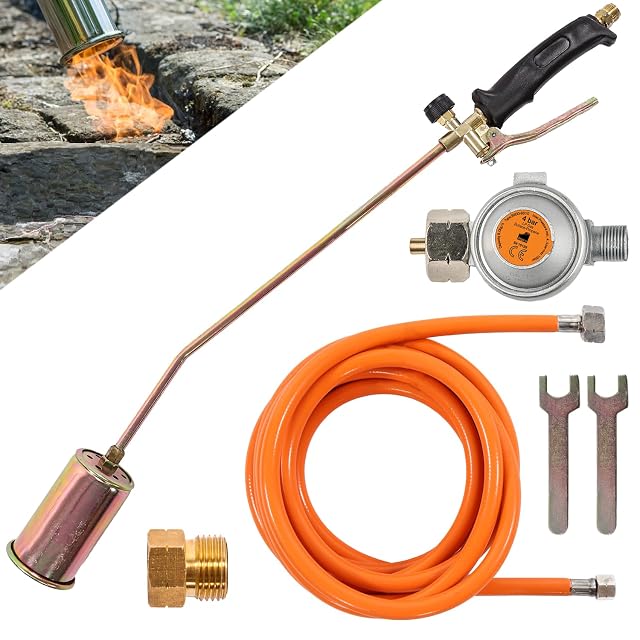
For comparison on this shelf: one burner arrives with four 227 g butane cartridges,
and three others connect by hose to a refillable cylinder — a completely different
fuel arrangement, discussed below.
The safety claims, and what they describe
Three of the five substantive feature lines are about safety, and one of them is specific
enough to be useful:
“Internal safety mechanisms which restrict 99 % of the propane flow in the event of a
leak.”
That describes an excess-flow device: a valve that closes if the gas flow suddenly
exceeds what the burner should draw, which is what happens if a hose or a seal fails. It
is a real mechanism and it is the right one for a cartridge torch.
“100 % passed a high-standard leak test before shipping.” A per-unit test rather than
a type approval.
“Double-sealed barrel design” and heat-resistant steel throughout.
What is not named is any third-party certification. Two other burners on this shelf
publish those: one cites three EN standards for the appliance plus EN 417 for its
cartridges, and one cites a TÜV SÜD GS mark with a DVGW-certified regulator and
hose.
On an open-flame appliance fuelled by pressurised gas, that difference is worth stating
plainly, and this page states it without drawing a conclusion about any product’s
compliance.
The duplicated feature line
The first and second published feature lines are identical, word for word — the same
paragraph about chemical-free weeding and the same list of other uses.
It is reported here because this page describes what was published, and because the
effect is that the listing has five slots and uses four.
The list of other uses
Burning weeds and stumps, melting snow and ice, searing meat or fish, lighting fires,
soldering, scorching wood grain, softening asphalt, removing paint from non-combustible
surfaces.
Most of those are genuine uses for a propane torch. Two are worth a comment.
“Melting snow and ice” works and is a poor use of gas — a torch melts a small patch
at enormous fuel cost, and the meltwater refreezes.
“Searing meat or fish” is a real technique and it is worth noting that this is a torch
sold without a food-grade specification, running on whatever cartridge the buyer fitted.
The 36-month warranty
Stated, with a replacement offered for quality problems.
Three years is a long warranty on a gas appliance and it is the second longest in this
family — one competitor states 10 years of spare parts availability, which is a
different and arguably more useful promise on a tool whose seals and piezo will wear.
What goes unpublished
No flame temperature and no output. Three burners on this shelf publish a temperature
— 1000 °C, 1300 °C and 1800 °C — and one publishes 58 kW.
No ignition method. Three burners here name a piezo igniter, which means no
lighter and no matches in the wind.
No length and no weight. One burner publishes 97 cm and 1.6 kg, and another
80 cm — and length is what decides whether the job is done standing or bent over.
No burn time. One burner publishes 1 to 3 hours per 227 g cartridge.
Availability
From 30 € to 40 €, that being the spread across the German, French, Italian and Spanish Amazon stores on the day of the survey.
Nothing came back from the American and British Amazon stores at all; the buy button there runs a search rather than opening an empty page.
Taken from Keepa on the day this page was last revised; stock and prices move without notice.
Prices quoted in this text were read on 26 September 2026. The live price is at the top of the page.