Two statements that must lead every page in this family.
A flame kills grass exactly as readily as it kills the weed in it. Used on a lawn it
leaves a scorched patch to reseed. This is a tool for paving joints, path edges,
terrace edges, drives and bed borders — which is precisely the list this listing gives.
And the heat does not reach roots. This listing’s own mechanism statement is the more
careful of the two on this shelf: “the heat destroys the cell structure of the plant,
the weed dries out within a few days.”
Cell structure of the plant, not of the roots — which is accurate.
Soil insulates. Two or three seconds of hot gas at the surface barely warms the root a
centimetre down. So annual weeds die outright, and dandelion, dock, couch grass and
bindweed regrow from what is below.
The method that works on perennials is repetition: burn the regrowth every two or three
weeks and the root exhausts its reserves rebuilding leaves it never keeps. Over a season
or two it gives up.
The burn time, which nothing else here publishes
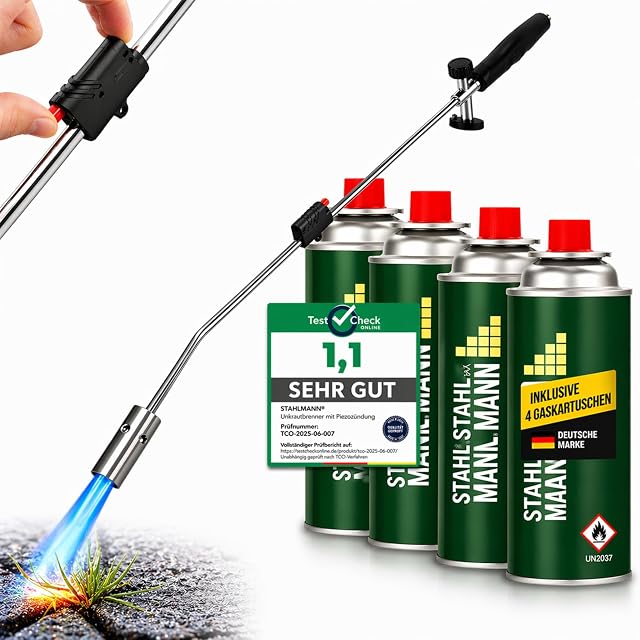
Four butane cartridges of 227 g. One to three hours each. Up to 12 hours.
That is the only runtime figure in this family, and it is the number that tells you what
this tool actually costs to run.
Three burners on this shelf arrive without fuel — two cartridge tools whose cartridges
are sold separately, and three hose tools that need a cylinder and a regulator.
Here the first session is included, and eleven more after it.
And the range, 1 to 3 hours, is the honest part
It is a factor of three, and it is real rather than vague.
What makes it one hour: the flame turned up, held on one plant for ten seconds,
working in cold weather. A butane cartridge’s output falls as it cools, and a cartridge
running hard cools itself by evaporation — which is why the flame weakens towards the end
of a cartridge and recovers if you stop for a few minutes.
What makes it three hours: the flame turned down to what the job needs, and two to
three seconds per weed.
Which brings up the thing no listing on this shelf prints.
You do not need to burn the plant
Two to three seconds, until the leaf darkens and goes limp. That colour change is the
cells rupturing, and the plant is already dead — it will brown over the following days.
Charring it to ash takes ten times as long, uses ten times the gas, and adds nothing,
because the root was never going to be reached.
On the arithmetic above, that single fact is the difference between four cartridges lasting
four hours and lasting twelve.
1100 °C, peaking to 1300 °C
Published, and worth reading correctly.
Across this shelf the temperatures are 1000 °C, this 1300 °C, and 1800 °C, and
one product publishes 58 kW instead.
Those are two different quantities. Temperature is how hot the flame is; kilowatts are
how much heat it delivers per second. A small very hot flame can deliver less heat to a
weed than a large cooler one.
And for this job neither figure is the limiting factor. Plant cells rupture at
temperatures far below any of these, in seconds. Every burner on this shelf is hot
enough, several times over.
What actually differs between them is the flame’s size and reach — how wide an area
one pass treats, and how well the heat gets down into a joint — and only one product here
publishes anything about that: a 60 mm burner head.
Publishing a working temperature alongside a peak is nonetheless the more honest
form. A single headline figure is a peak by default.
Three EN standards, cited by number
EN ISO 9012:2011. EN 1326:1996. EN 521:2006. And EN 417 for the cartridges.
That is the most substantial compliance statement in this family, and on an open-flame
appliance running pressurised fuel it is the thing worth looking for.
EN 417 is separately useful in practical terms: it is the European standard for the
valve fitting on small non-refillable cartridges, so any EN 417 cartridge fits, from any
brand. The alternative is a proprietary thread that ties the tool to one supplier’s fuel.
Across this shelf: this cites four standards, one cites a TÜV SÜD GS mark with a
DVGW-certified regulator and hose, one cites EN 417 and a per-unit leak test — and
three cite nothing at all.
This page reports that difference without drawing conclusions about any product’s
compliance.
The safety line, which is the only one on this shelf
Published in full, and it deserves reprinting because five other listings in this family
have nothing comparable:
Open flame and extremely flammable gas. Use outdoors only. Keep your distance from
hedges, wood, mulch and dry lawn. Do not work in drought or wind. Let the tool
cool after use, remove the cartridge, store cool and below 50 °C. Keep out of reach of
children.
Every item in that list is the right one, and two are worth expanding.
“Do not work in drought or wind.” Dry organic matter does not catch and flare — it
smoulders. A fire started in bark mulch, in the dry litter at the base of a hedge, or
under decking can burn unseen for an hour before it shows, by which time nobody is
watching. That is how flame weeding causes fires, and it is not the obvious mechanism.
“Remove the cartridge.” A cartridge left screwed on is a live gas appliance in a
shed, and the seal at that joint is under load the whole time.
80 cm
The shortest published length on this shelf, against 97 cm on one competitor and an
85 cm handle on another.
The listing sells it as reaching paving joints, path edges, terrace edges and bed borders
standing — and for most adults 80 cm is the shorter end of that. It is a lever between
your hands and the flame, and the difference between 80 and 97 cm is the difference between
a slight stoop and standing straight.
No weight is published, which matters on a tool held out in front of you pointed
down. One burner on this shelf publishes 1.6 kg, and it is the only figure in the
family.
The stainless burner head
Named, and it is the right place for it.
The head is the part held in a 1100 °C flame continuously, and ordinary steel in that duty
scales — it forms a loose oxide that flakes away, thinning the metal and eventually
distorting the jet. Stainless resists it.
The other named feature, a steplessly adjustable flame, is what makes the
two-to-three-second technique possible: a burner with one setting is a burner run at full
gas whatever the weed.
Availability
Around 38 €, read at the German Amazon store on the day of the survey.
Listed and unsold: the American, British, French, Italian and Spanish Amazon catalogues hold the reference with nobody behind it.
Taken from Keepa on the day this page was last revised; stock and prices move without notice.
Prices quoted in this text were read on 26 September 2026. The live price is at the top of the page.