The first line on every page in this family, because no listing here says it.
A flame kills grass exactly as readily as the weed in it. Used on a lawn it leaves a
brown patch to reseed.
This is a tool for paths, drives, terraces — the listing’s own list — and for
bitumen and tar work around the house. For weeds in a lawn, this site’s weeder shelf
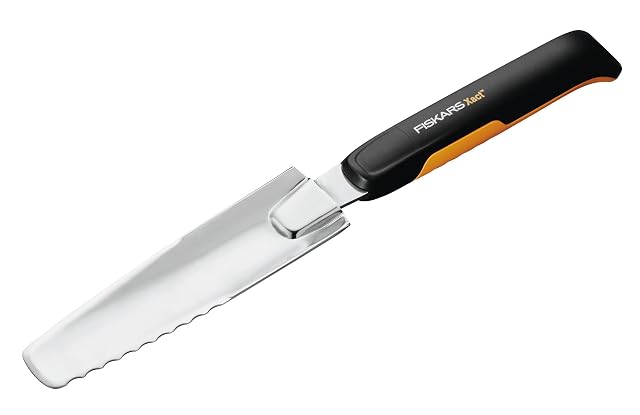
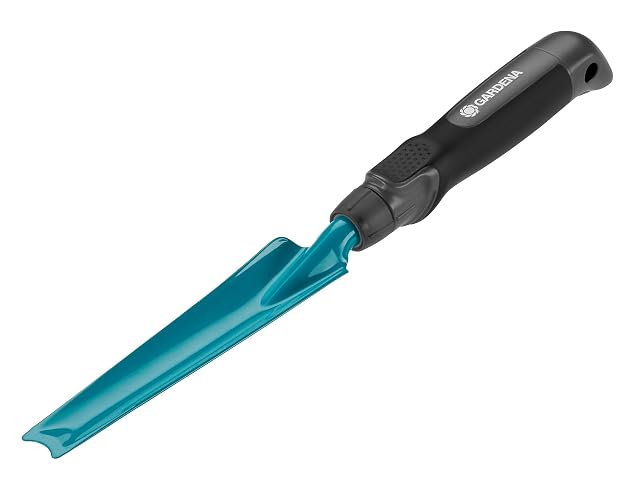
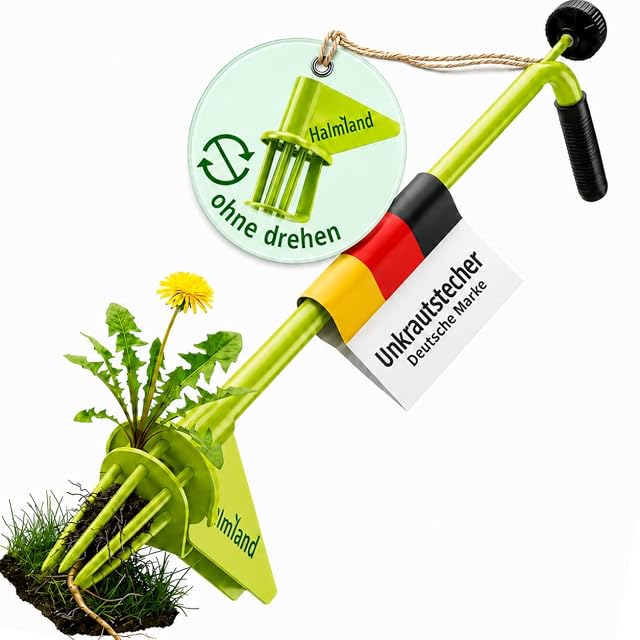
has the taproot knives and claw pullers that lift a root and leave the turf.
The certifications, which are the reason to look at this one
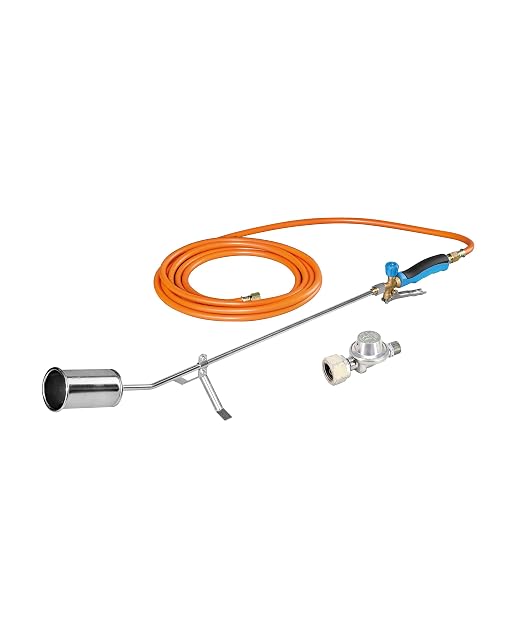
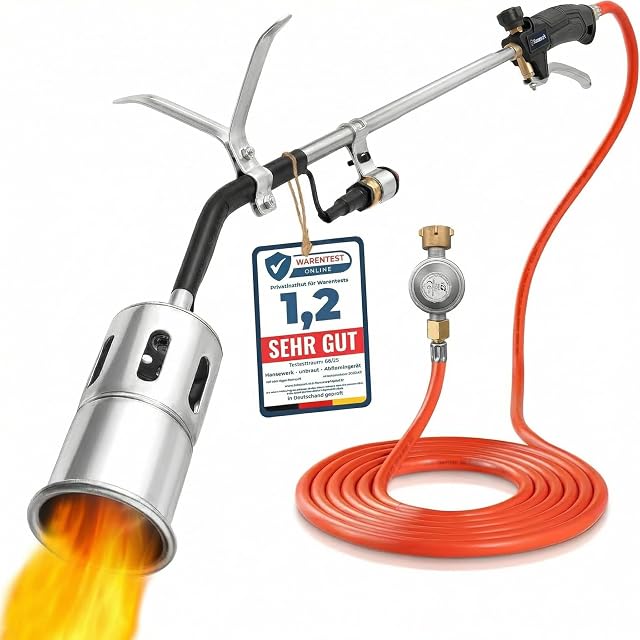
TÜV SÜD GS for the appliance. DVGW certification for the regulator and the hose.
Made in Europe.
That is the most substantial third-party statement on this shelf, and on an open-flame
appliance running pressurised gas it is the right thing to look for.
Why the second one matters as much as the first
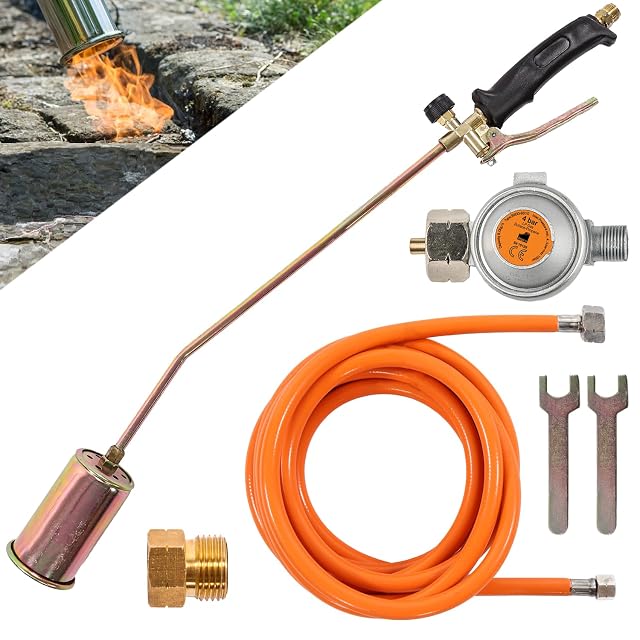
The appliance mark covers the burner. The DVGW claim covers the two parts that are
between a pressurised cylinder and your hands.
The hose is a rubber tube carrying gas at cylinder pressure, coiled and uncoiled,
dragged across a drive, and left in a shed through summers and winters. It perishes. It is
the component with a service life and a date stamp on it, and it is the one that fails.
The regulator is the device deciding what pressure reaches the burner. A regulator that
drifts or sticks is a flame that changes without being touched.
Both are safety-critical in a way the steel tube is not, and both are supplied here rather
than bought separately — three burners on this shelf run on cartridges instead, and one
supplies a hose and regulator without naming a certification for either.
Across the six products in this family: this cites GS plus DVGW, one cites three EN
standards plus EN 417, one cites EN 417 and a per-unit leak test, and three cite
nothing at all.
This page reports that difference without drawing conclusions about any product’s
compliance.
“Constant 2.5 bar output pressure”
Published, and the word constant is the useful part.
A gas cylinder’s internal pressure is not a fixed number. It falls as the bottle
empties, and it changes substantially with temperature — a cylinder in April sun and
the same cylinder at 5 °C deliver differently.
Without regulation, the flame changes through the job and between days.
A regulator holding 2.5 bar at the burner means the flame you set in the first minute
is the flame you have in the last. On a tool whose correct technique is a measured two or
three seconds per weed, that consistency is what makes the technique repeatable.
For comparison, the other hose burner on this shelf that publishes a regulator supplies
4 bar — a higher pressure, matched to a larger 60 mm burner head.
1800 °C, read honestly
The highest temperature on this shelf, against 1000 °C and 1300 °C — and one
product publishes 58 kW instead, which is a different quantity entirely.
Temperature is how hot the flame is. Power is how much heat it delivers per second.
They are not comparable, and what kills a plant is heat transferred, not the
temperature of the gas passing over it.
And for weeding, temperature is nowhere near the limiting factor. Plant cells rupture
in two or three seconds at temperatures far below 1000 °C. Every burner on this shelf is
hot enough many times over, and 1800 °C does not kill a dandelion any deader than 1000 °C
does.
Where it is genuinely useful is the listing’s other stated job: bitumen and tar
work. Melting roofing felt into a lap joint needs the material brought to temperature,
not a leaf killed — and there a hotter, more concentrated flame does real work.
So the figure is a specification for the second use, and a marketing number for the first.
What the flame is actually doing to the weed
No listing on this shelf explains it fully, and it decides how to use the tool.
The heat ruptures cell walls in the foliage. Water inside the cells expands, the
membranes fail, and the plant dries out over the following days. That is why flame weeding
looks like it has done nothing on the day and looks convincing a week later.
The root is not reached. Soil is an excellent insulator; a few seconds of hot gas at
the surface barely warms what is a centimetre down.
So: annual weeds die — groundsel, chickweed, annual meadow grass, seedlings of
anything. Perennials regrow — dandelion and dock from a taproot, couch grass and
bindweed from rhizomes.
What works on perennials is repetition: burn the regrowth every two or three weeks,
and the root spends its reserves rebuilding leaves it never keeps. Over a season or two it
exhausts itself.
And the technique that follows: two to three seconds, until the leaf darkens and goes
limp. Charring it to ash takes ten times as long, uses ten times the gas, and achieves
nothing extra.
Cylinder and hose, and the 5 metres
Three burners on this shelf run on a cartridge screwed to the tool; three, including
this one, run on a hose to a refillable cylinder.
A cylinder gives hours of running at a fraction of the cost per hour of a
non-refillable cartridge, and the weight stays on the ground rather than in your hand.
A cartridge tool is self-contained: nothing to trip over and nothing to set up. One on
this shelf publishes 1.6 kg and 97 cm for the whole thing.
Five metres of hose is the working radius before the cylinder has to be moved, and it
is the figure that decides how often you stop. The other hose burner here publishes 5 m in
its title and 4.5 m in a feature line, which is an inconsistency this one does not have.
The safety, which this listing does not print
One burner on this shelf publishes a full warning, and it applies to all six:
Outdoors only. Distance from hedges, wood, mulch and dry lawn. Not in drought or
wind. Let it cool before storing. Disconnect the fuel.
The mechanism worth naming, because it is not the obvious one: dry organic matter does not
flare, it smoulders. A fire started in bark mulch, in the dry litter at the base of a
hedge, or under decking can burn unseen for an hour before it shows.
Working a joint against a timber fence or beside a mulched bed is where this category
causes damage.
What goes unpublished
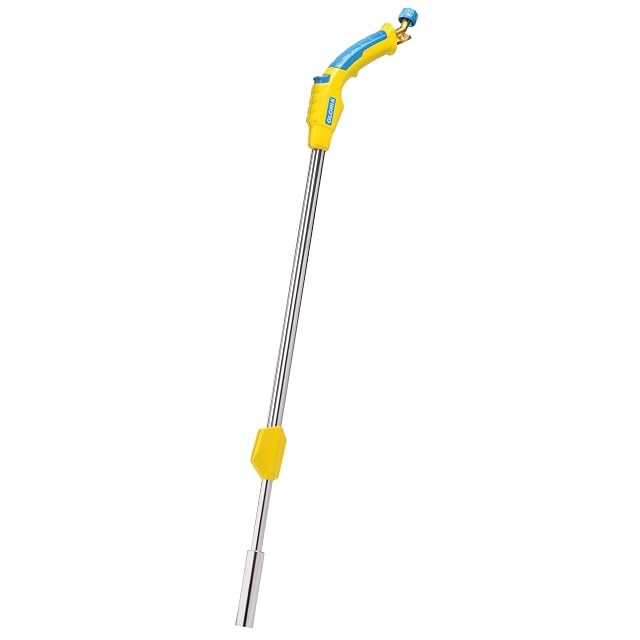
No tool length. Two burners on this shelf publish 97 cm and 80 cm, and length
is what decides whether the job is done standing or stooped.
No weight. One publishes 1.6 kg.
No burner diameter. One publishes Ø 60 mm, which together with an output describes
how wide a strip one pass treats.
No ignition method. Three burners here name a piezo igniter, which means a button
rather than a lighter held to a gas jet in the wind.
No burn time, though on a cylinder tool that depends on the cylinder rather than the
burner. One cartridge burner on this shelf publishes 1 to 3 hours per 227 g
cartridge.
Availability
From 44 € to 57 €, that being the spread across the German, French, Italian and Spanish Amazon stores on the day of the survey.
Beyond the euro zone, the British Amazon store prices it in its own currency, which the spread above sets aside.
Listed and unsold: the American Amazon catalogue holds the reference with nobody behind it.
Taken from Keepa on the day this page was last revised; stock and prices move without notice.
Prices quoted in this text were read on 26 September 2026. The live price is at the top of the page.