Every page in this family has to say it, and at 58 kW it bears repeating.
A flame kills grass exactly as readily as the weed in it. This is a tool for paving
joints, drives, gravel, bare ground — and, the listing adds, for welding bitumen
roofing sheets.
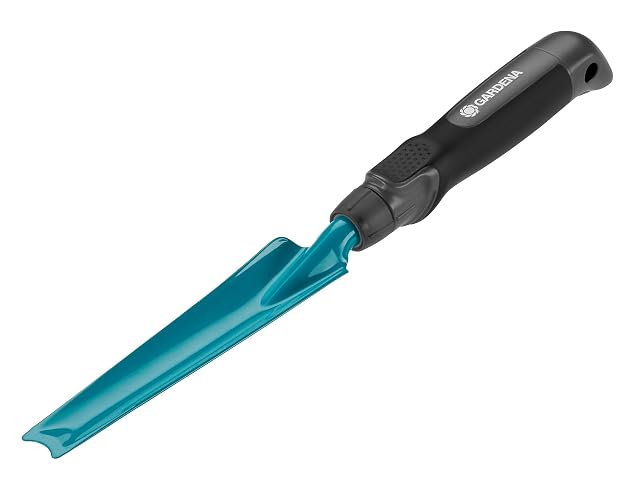
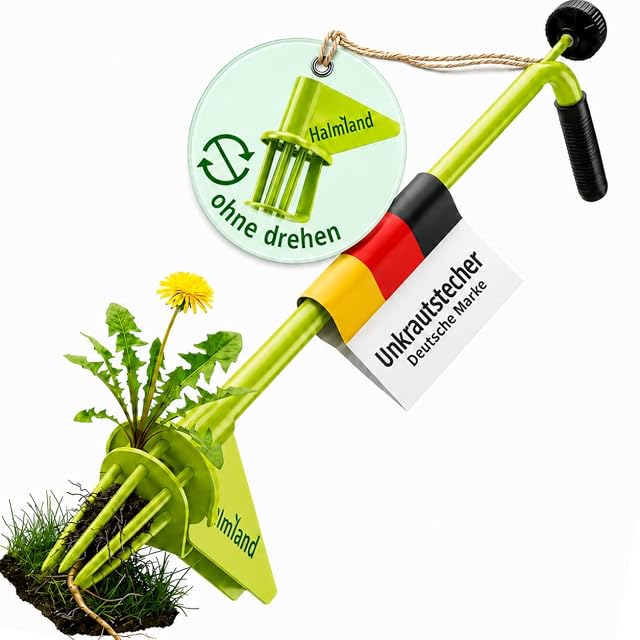
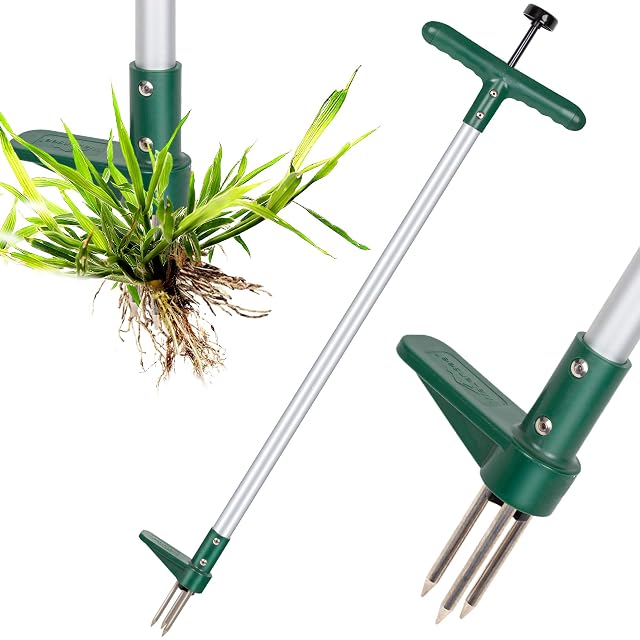
For weeds in a lawn, this site’s weeder shelf carries taproot knives and claw pullers that
lift the root and leave the turf.
Up to 58 kW.
Three burners in this family publish a flame temperature — 1000 °C, 1300 °C, 1800 °C.
This publishes a power, and two others publish neither.
Which are different quantities, and it matters
Temperature is how hot the flame is.
Power is how much heat it delivers per second.
They are not interchangeable and they are not comparable. A small very hot jet can deliver
less heat into a weed than a large cooler flame, because what kills the plant is heat
transferred, not the temperature of the gas passing over it.
And for this job, temperature is not the limiting factor at all: plant cells rupture far
below any of these figures, in a couple of seconds. Every burner on this shelf is hot
enough several times over.
Power and burner size are what actually differ, and this is the only listing that
publishes either.
60 millimetres
The only burner diameter on this shelf, and combined with the output it describes the tool
better than a temperature would.
A 60 mm head at 58 kW throws a wide flame. On a drive, that means one pass covers
a strip rather than a point, and forty metres of joint is a walk rather than an afternoon.
It also means it is not a precise tool. Working a single weed in a gap beside a wooden
fence post, or a joint against a timber deck, with a 60 mm flame at 58 kW, is where this
goes wrong — and the dry-organic-matter warning below applies with more force than it does
to a cartridge torch.
Cylinder and hose, which is the other half of this shelf
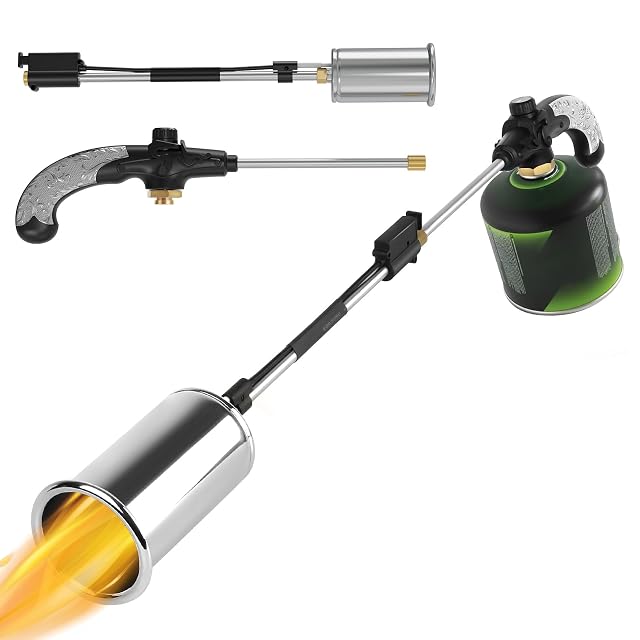
Three burners here run on a cartridge screwed to the tool. Three, including this one,
run on a hose to a refillable cylinder.
A cylinder gives hours of running at a fraction of the cost per hour of a
non-refillable cartridge, and the weight stays on the ground rather than in your hand. For
a drive that takes two hours, it is the correct arrangement.
A cartridge is self-contained: nothing to trip over, nothing to set up, and it goes in
a shed as one object. One cartridge burner on this shelf publishes 1.6 kg and 97 cm
and the whole tool is that.
The trade is a hose across the ground and a cylinder to move. Which is why the hose length
is a real specification.
And the hose length disagrees with itself
The title says 5 m. The accessory list says 5 m. The application line says
“4.5 m hose line included”.
Nothing published resolves it, and half a metre is not trivial: hose length is the radius
you can work in before the cylinder has to be moved, and on a drive the far corner is
always just out of reach.
What is in the box, itemised
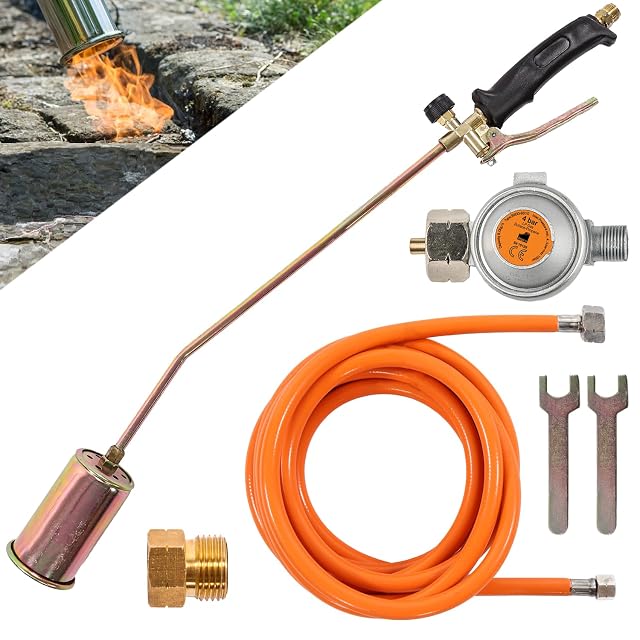
The most complete kit on this shelf, and it is worth listing because a cylinder burner is
useless without it:
The burner at 58 kW. A 5 m gas hose. A 4 bar gas pressure regulator. Two
back-up spanners. An adapter, specified as 3/8 inch left-hand female thread to 21.8
left-hand male.
Two of those are worth a sentence.
The regulator at 4 bar. A cylinder’s internal pressure is far higher than any burner
can use and it varies with temperature; a regulator delivers a constant working pressure.
Four bar is a high-pressure setting suited to a large burner — one competitor on this shelf
supplies 2.5 bar with a smaller head.
The left-hand threads. Gas fittings use left-hand threads deliberately, so that a gas
connection cannot be mistakenly made to a non-gas fitting. Publishing the thread
specification is the only way a buyer can check it against their own cylinder, and it is
the sort of detail nothing else on this shelf gives.
The two-to-three-second technique
Nothing on this shelf prints it, and at 58 kW it saves the most.
You do not burn the plant. Two to three seconds until the leaf darkens and wilts —
that colour change is the cells rupturing, and the plant is already dead.
Charring to ash takes ten times as long, uses ten times the gas, and adds nothing, because
the root was never going to be reached.
And the root is not reached. Soil insulates; a few seconds of hot gas at the surface
barely warms what is a centimetre down. Annual weeds die outright. Dandelion, dock, couch
grass and bindweed regrow, and the method that works on them is repetition — burning
the regrowth every two or three weeks until the root exhausts itself.
The safety, which this listing does not cover
One burner on this shelf publishes a full warning line. It applies to all six, and most
sharply to this one:
Outdoors only. Distance from hedges, wood, mulch and dry lawn. Not in drought or
wind. Let it cool before storing. Disconnect the fuel.
The mechanism worth naming: dry organic matter does not flare, it smoulders. A fire
started in bark mulch, in the litter at the base of a hedge, or under decking can burn
unseen for an hour before it shows. A 60 mm flame at 58 kW starts one considerably faster
than a small torch does.
What goes unpublished
No ignition method. Three burners on this shelf name a piezo igniter — which means
a button rather than a lighter held to a gas jet in the wind, and instant relighting, which
is what makes short bursts practical. This listing does not say.
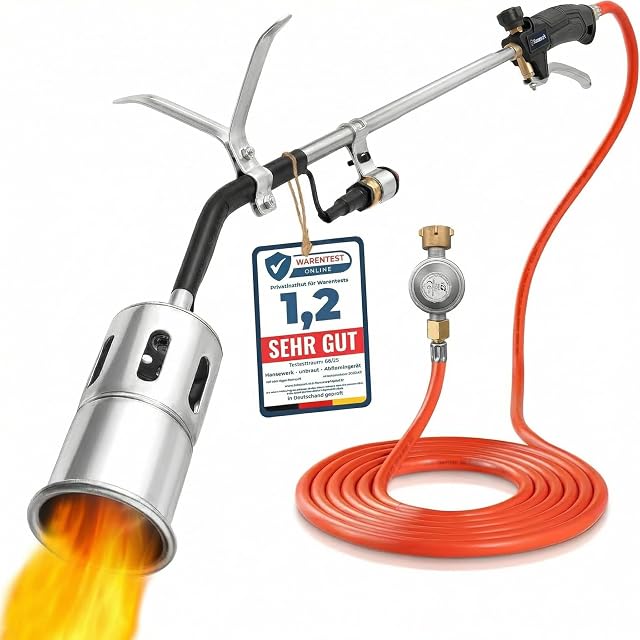
No standards or certifications. Two burners here cite them: one names three EN
standards plus EN 417 for its cartridges, and one names a TÜV SÜD GS mark with a
DVGW-certified regulator and hose. On a 58 kW open-flame appliance that is a
difference worth stating, and this page states it without inferring anything about
compliance.
No weight. One burner on this shelf publishes 1.6 kg.
No flame temperature, though as above that is the less useful of the two quantities.
And the packaging note
“Shipping may take place in manufacturer-neutral packaging.”
Reported as published. On a gas appliance it is worth checking on arrival that the
regulator, hose and adapter are all present, since a neutral box is one nobody has
itemised on the outside.
Availability
From 40 € to 51 €, that being the spread across the German and Spanish Amazon stores on the day of the survey.
Nothing came back from the American, British, French and Italian Amazon stores at all; the buy button there runs a search rather than opening an empty page.
Taken from Keepa on the day this page was last revised; stock and prices move without notice.
Prices quoted in this text were read on 26 September 2026. The live price is at the top of the page.