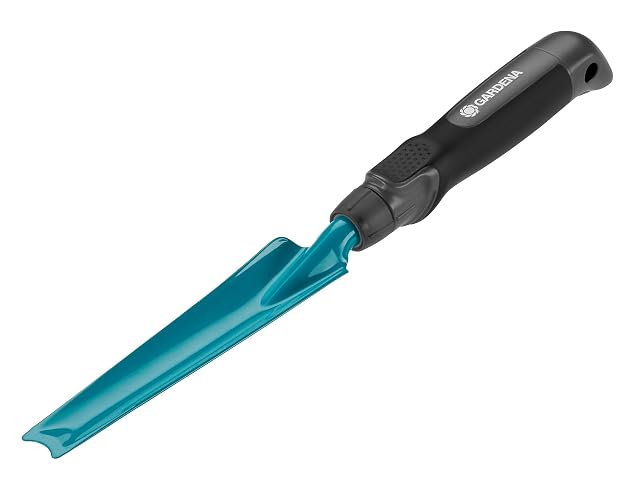
Taproot knife. A blade pushed into soil to lift a rooted weed out.
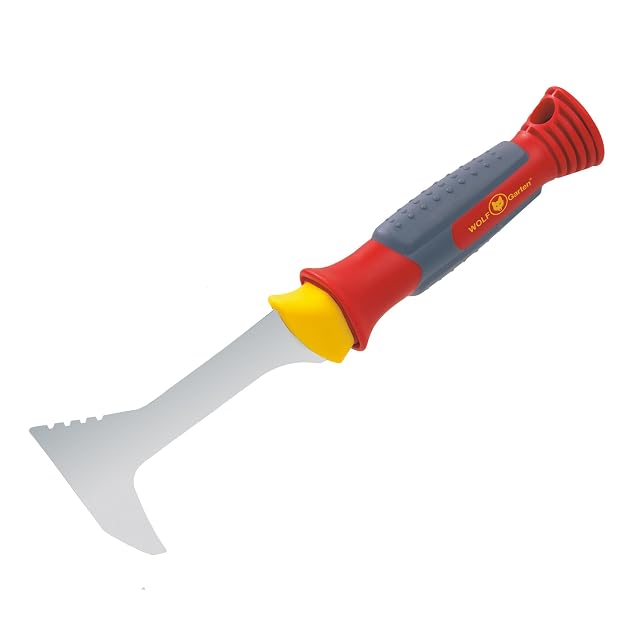
Not a joint scraper — three products on this shelf are those, for the gaps between
paving slabs on a terrace or drive, and they do nothing to a weed in grass.
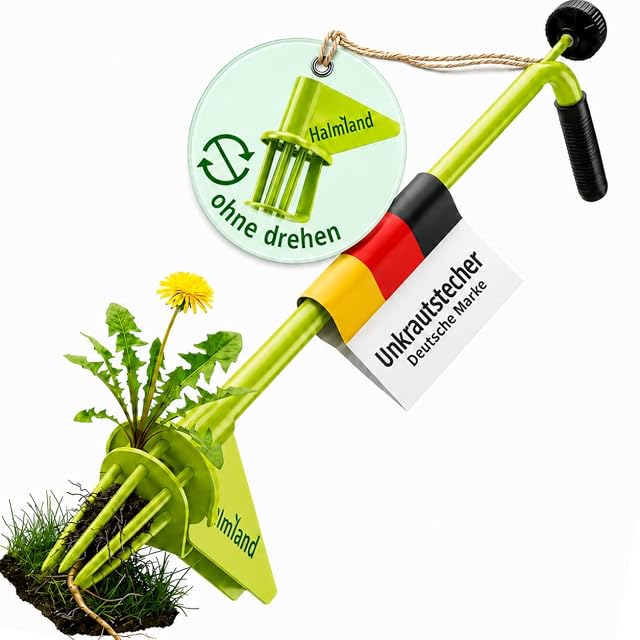
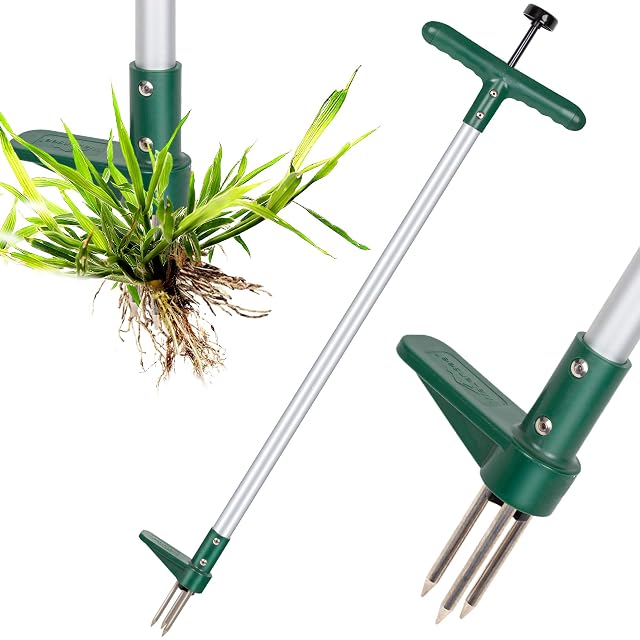
Not a claw puller — two products here are those, used standing with a foot pedal.
This is a lawn and bed tool, used kneeling, one weed at a time.
14.5 centimetres, which is the right thing to publish
A working length, not a total length.
That distinction matters more on this shelf than almost anywhere. Two tools here publish
39.6 cm and 31.5 cm — and both of those include the handle, so neither says how
far the steel goes into the ground.
A working length of 14.5 cm says exactly that.
And depth is the whole question, because of how these weeds behave.
What a taproot does when it breaks
The weeds the listing names — dandelion, thistle and the like — share one anatomy: a
single thick root going straight down, with the growing point at the very top, level
with the soil.
Break the root and the remainder regrows. A dandelion left with a few centimetres in
the ground sends up a new rosette, and frequently two or three where there was one.
Pulling the leaves off does nothing at all; the plant loses a week.
So the measure of a weeding knife is how deep it reaches and whether it lifts rather than
severs. Fourteen and a half centimetres is a genuine depth for a hand tool — for
comparison, the only other depth figure on this shelf is 2.75 inches, about 7 cm, on
a claw puller whose listing nonetheless promises the weed will not grow back.
On a mature dandelion in undisturbed soil, neither is guaranteed to get all of it.
The V-shaped tip
“Through the V-shaped tip, easy and deep penetration into the soil is possible, to remove
even long taproots and prevent the weed returning.”
That is the correct geometry and it is worth explaining why it is not a cutting edge.
A V or forked tip pushed in beside a root passes on either side of it. The root
sits in the notch, and levering the handle prises it upward — the tool is a lever
with the soil as its fulcrum and the root as its load.
A straight blade pushed at a root cuts across it, and a cut root regrows.
So the V is not about penetration, despite the listing’s phrasing. It is about what
happens once the tool is down there: it grips the root instead of slicing it.
The practical technique follows: push in beside the plant, not at it; loosen on two or
three sides; then lever, slowly, and let the root come rather than pulling the top off.
The angled handle end
“The angled handle end prevents the hand slipping off.”
A small detail with a specific mechanical purpose.
Levering a taproot out of dry compacted soil takes a hard sustained pull, and it is
done with wet or muddy hands, often wearing gloves.
A straight handle relies entirely on grip friction to transmit that pull. A hooked or
angled end gives the hand something to pull against — a positive stop rather than a
friction surface. It is the same principle as the D-handle on a spade and the loop on a
walking stick.
It is also what keeps a weeding knife out of a shin when the root suddenly releases.
Quality steel with a thermoset coating
Named, and the coating is the significant half.
A weeding knife lives in soil, which is wet and full of grit, and it is put away
dirty because it is the last tool used before going in.
A thermoset coating is a baked plastic film — hard, thick and well bonded, which is
the right answer for that duty. It keeps water off the flat of the blade indefinitely.
What no coating survives is the tip and the edges, which are abraded by sand and
stone on every use. Those are bare metal within a season, and they are also the part that
matters.
One tool on this shelf uses stainless steel instead, which does not depend on a
coating staying intact — and which costs more.
Either way the maintenance is the same and no listing here states it: wipe it dry
before putting it away.
The hole it leaves, and the step nobody mentions
Lifting a dandelion out of a lawn leaves a hole 15 mm across and several centimetres
deep.
Bare soil in a lawn is where the next weed germinates. That is the same mechanism
this site’s lawn seed shelf describes from the other side — seed needs soil contact, and
a hole is soil contact.
The complete job is: lift the weed, press the hole shut with a heel, and where it is more
than a hole, drop in a pinch of seed and a little soil. This site’s lawn soil shelf
carries the substrate for exactly that.
Skipping it is how a lawn weeded in April has as many weeds in July.
What goes unpublished
No weight. One tool on this shelf publishes 260 g, and it is the only figure of
its kind in the family.
No overall length, and no blade width — one tool here publishes 4.3 cm.
Availability
From 11 € to 13 €, that being the spread across the German, French, Italian and Spanish Amazon stores on the day of the survey.
Beyond the euro zone, the American and British Amazon stores price it in their own currencies, which the spread above sets aside.
Taken from Keepa on the day this page was last revised; stock and prices move without notice.
Prices quoted in this text were read on 26 September 2026. The live price is at the top of the page.