Skip to content

Watering a garden while you are away

A tap timer is bought for a fortnight in August and judged on what it did while nobody was watching. That makes silence the important property: none of these five has a rain sensor, only one is stated to survive water in its battery compartment, and every one of them will keep its schedule perfectly while a kinked hose delivers nothing. This guide is the five, and the sequence that makes them work.

The property that matters is silence

A tap timer is a device whose entire value is realised while nobody is present.

Which inverts how it should be judged. The question is not what it does when it works — they all open a valve on a schedule — but what happens when it does not, and whether you find out.

The answer, across all five, is that nothing happens and you do not find out. A timer with a flat battery does not water. A timer with a kinked hose waters into a kink. A timer whose tap was left closed runs its programme perfectly against a shut valve.

None of these five reports back on whether water actually moved.

So the first decision is not the radio

It is what fails first, and on a tap timer that is the batteries.

One of these five publishes the relevant claim: standard batteries stated to last several growing seasons, in a double-sealed compartment.

That second half is the one that matters. A tap timer sits outdoors, on a tap, in the rain, for a whole season. Water reaching the battery contacts corrodes them, the contact resistance rises, and the valve stops having enough current to open — mid-schedule, in the second week of August, with nobody there.

It is the commonest way one of these dies and only one of the five addresses it.

The habit that costs nothing: new batteries at the start of every season, whatever the old ones read. A set of alkaline cells is a fraction of the cost of the plants.

The three ways to set one

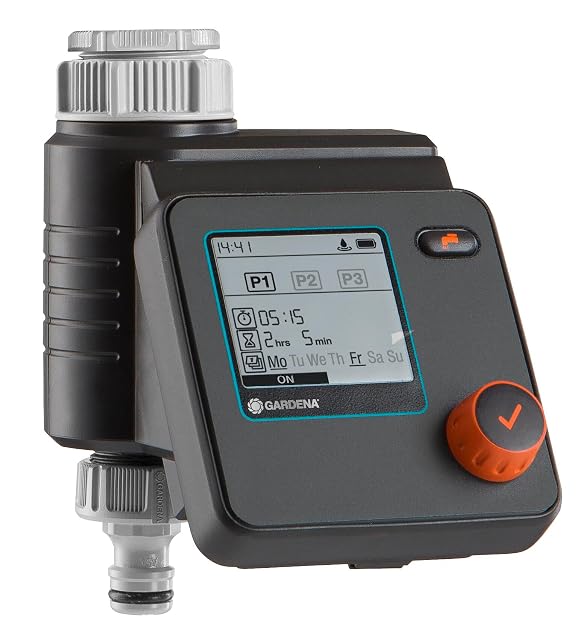
A dial, at the tap. One of these is set by turning and pressing, and gives three independent schedules by weekday plus a Water Now button. Nothing to pair, nothing to update, nothing that depends on a network being up in a fortnight’s time.

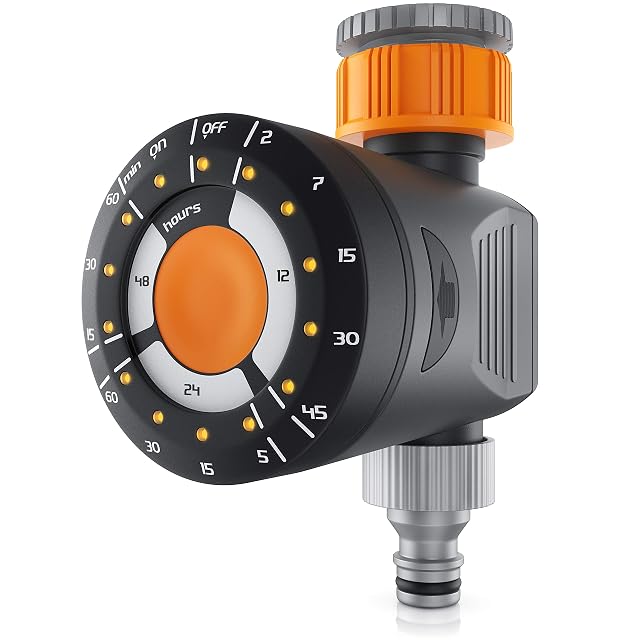
Fixed cycles and LEDs. Another gives three cycles — 12, 24 and 48 hours — with fourteen LEDs and a start delay of up to 23 hours. Less flexible and entirely self-contained, and the LEDs mean the state is readable at a glance without a phone.

An app. Three of these are app-controlled, and the app is where the flexibility is: one publishes up to 20 independent schedules, one publishes 8 programmes and 15 frequencies with an LCD, and one can water by volume as well as by time.

And the app ones split on something that is easy to miss

One needs a hub. One does not.

The Zigbee model requires a Zigbee 3.0 gateway, and it names the compatible models — which is the right thing to publish, because a hub you do not own is a second purchase and a second box on a socket.

The Wi-Fi model needs nothing but a 2.4 GHz network with no gateway, and adds Alexa and Google Assistant.

The trade is coverage. Wi-Fi reaches as far as your router does, and a tap at the bottom of a garden behind a brick wall is frequently just past that line. Zigbee is low-power and forms a mesh, so it hops through other devices and reaches further — at the cost of the hub.

There is one clear test and it takes a minute: stand at the tap with a phone and look at the signal. If it is one bar, the Wi-Fi timer will be unreliable exactly when it matters.

Watering by volume, which is the more precise instruction

One of these five can be set to deliver a quantity rather than a duration.

That is a better instruction than minutes, and the reason is pressure.

A schedule set in minutes delivers whatever the mains happened to be doing. Pressure varies through the day — higher at dawn, lower when the street is showering — so a ten-minute programme delivers different amounts on different days, and a timer that counts litres does not.

On a bed of pots, where the difference between enough and too much is small, that is worth having.

The rain problem, stated honestly

None of these five has a rain sensor.

Two publish a manual rain delay instead — one of them up to 30 days — which is you looking at a forecast and deciding, from a phone, not to water.

That is useful and it is not automatic. A fortnight of rain while the timer runs its programme is a fortnight of waterlogged pots, and nothing on this shelf prevents it.

The cheap workaround is a saucer test: if the pots are sitting in water when you get home, the schedule was too generous, and next year’s setting is shorter.

The sequence that makes any of them work

Test it for three days before leaving. Not the timer — the whole system. Tap open, timer set, hose laid, and go and look at whether water arrives where it is supposed to. A timer that opens a valve into a kinked hose is a timer that reports success.

Check the filter. Every one of these is fed from a tap that carries grit, and a blocked inlet screen is a timer that runs dry. This site’s drip irrigation shelf makes the same point about emitters, and its sprinkler shelf about nozzles: the water arriving is never as clean as it looks.

Water fewer times, for longer. A daily two-minute programme wets the top two centimetres and trains roots to live there, where they dry out fastest. Two or three long soaks a week get water down to where the roots should be.

And pick the hour. Early morning: the soil is cool, evaporation is lowest, and the leaves dry during the day. Evening watering leaves foliage wet all night, which is how fungal disease gets going — and one of these five is the one that will do it at five in the morning without anybody getting up.
The short list, and the reasoning behind its order

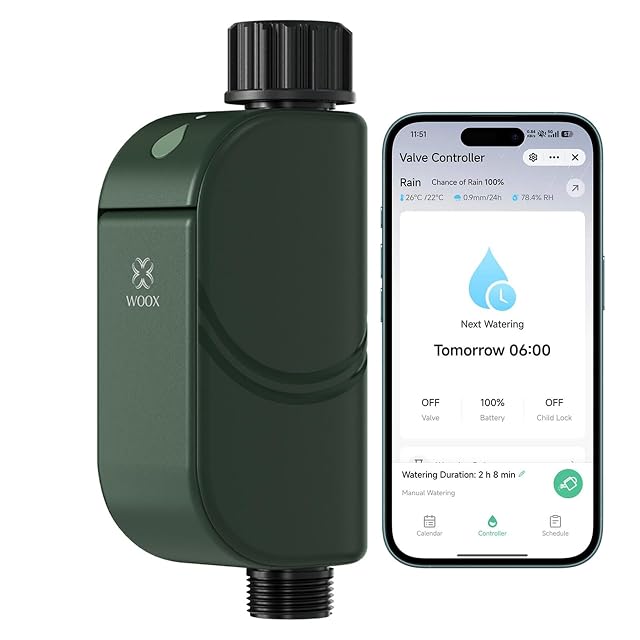
  1. Woox R2603

    2.4 GHz Wi-Fi, no hub, IP65, 20 schedules, 1–30 day rain delay

    Wi-Fi without a gateway, IP65 with double silicone seals, twenty schedules, a rain delay and offline alerts.

    Best for: A tap within Wi-Fi range, where the watering should be checkable from somewhere else

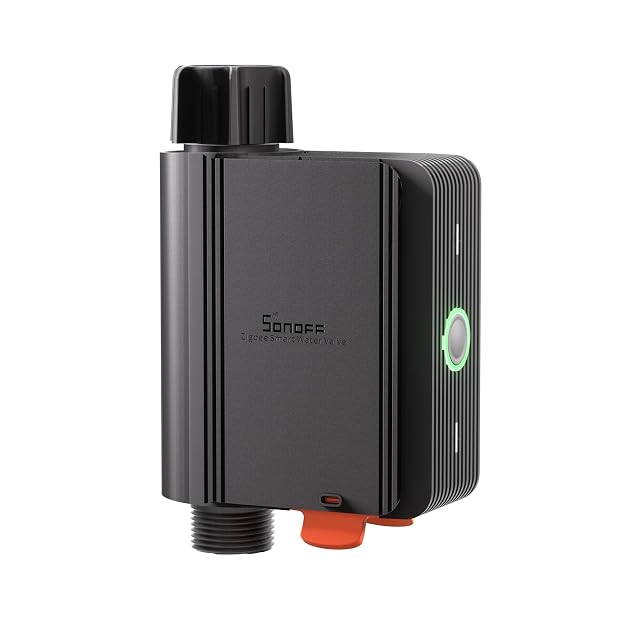
  2. SONOFF SWV-BSP

    Zigbee 3.0, hub required, volume control, 6 months of history

    A Zigbee valve with quantitative watering and six months of history — and it needs a hub, which the listing says twice.

    Best for: A household that already runs a Zigbee hub and wants watering in the same automation as everything else

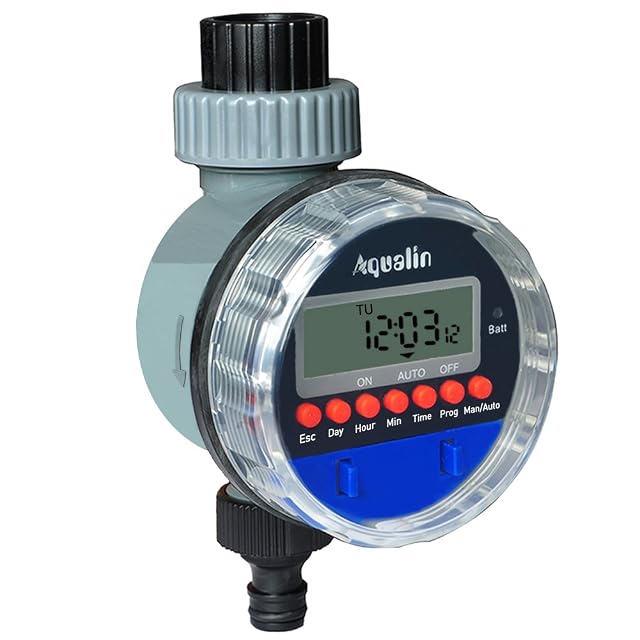
  3. Aqualin YL21026

    8 programmes, 15 frequencies, 0–8 bar, ¾" thread, LCD

    Eight programmes and fifteen frequencies on an LCD, a stated 0 to 8 bar range, and it works at no pressure at all.

    Best for: A rain butt or a low-pressure line, where the timer has to open with almost nothing behind it

What this guide tends to leave open

Which of these works without an app?

Two. One is set with a dial and a press and gives three independent schedules by weekday; another has three fixed cycles at 12, 24 and 48 hours with fourteen indicator LEDs. Both are set standing at the tap, which is the arrangement that keeps working when a router does not.

Wi-Fi or Zigbee?

Wi-Fi needs no extra hardware and reaches only as far as your router does — and a tap at the end of a garden is often exactly where the signal stops. Zigbee is low-power, forms a mesh and reaches further, and it needs a hub. One of these is Wi-Fi with no gateway; another requires a Zigbee 3.0 hub and names the compatible models.

Do any of them have a rain sensor?

No — not one of the five. Two publish a manual rain delay instead, one of up to 30 days, which is you deciding not to water from a phone rather than the timer deciding for itself. That is the honest version of the feature and it is worth knowing before a wet fortnight.

What actually goes wrong?

The batteries, and water reaching them. A tap timer lives outdoors on a tap, in the rain, all season, and corroded contacts stop a schedule mid-programme while nobody is there. Only one of these five publishes a sealed battery compartment, and it is the single most relevant durability claim in the category.

Why each one, and for whom

Gardena 1891

For : One tap, three different watering needs — a lawn, a bed and pots on different days

Main strength : Three schedules that are genuinely independent, including by weekday

Main limitation : No connection thread, no power source, no IP rating and no pressure range

Read the full review →

Woox R2603

For : A tap within Wi-Fi range, where the watering should be checkable from somewhere else

Main strength : An IP65 rating with double silicone seals, published — the only IP code on this shelf

Main limitation : No connection thread and no pressure range published

Read the full review →

SONOFF SWV-BSP

For : A household that already runs a Zigbee hub and wants watering in the same automation as everything else

Main strength : Waters by volume, not only by duration — unique on this shelf

Main limitation : Needs a Zigbee 3.0 hub, which is a separate purchase and a separate ecosystem

Read the full review →

Aqualin YL21026

For : A rain butt or a low-pressure line, where the timer has to open with almost nothing behind it

Main strength : A published working pressure range — the only one on this shelf

Main limitation : Waterproof only with the cover screwed on, which is a condition rather than a rating

Read the full review →

Brandson 722304260722

For : A single tap and a single hose, for somebody who wants a timer and not a smart device

Main strength : Every available watering time is listed for every cycle — no other listing here does that

Main limitation : No screen, so the state has to be read off fourteen indicator lights

Read the full review →

Useful comparisons

Head-to-heads already published between two models from this guide or this aisle.

How this guide is built

The models here come from the catalogue of this site. Specifications are those published by the manufacturer and on the Amazon product page; prices are what Keepa reported on the date below, and both move. The ranking uses declared specifications, the balance of stated strengths and limitations, and price. No product on this site has been physically tested, and nothing here claims otherwise.

Last checked on

The tool we use ourselves

Model settled? Then find out whether the figure next to it means anything at all.

A mower gets bought when the grass is already too long, which is the worst possible moment to weigh up a price: demand on this shelf climbs from March and drops away after July, so a price struck through in May tells you nothing whatever about what the same reference cost in October. UniverTrack keeps a week-by-week record for each retailer, so a cut price can be set against one somebody really paid rather than one composed for the banner — and it says when ordering is genuinely the moment.

Real price historyBuy-now alertsAI buying assistant
Try free for 14 days →
No commitment · Cancel in one click · 5 languages