Skip to content

Choosing a mower for a large lawn

Past a certain size a lawn stops being a job about cutting and becomes a job about walking. A 55 cm deck covers 37 per cent more ground per pass than a 40 cm one, and a self-propelled machine means the 35 kilograms is not yours to move. These six are picked on deck width and on drive, and on which of them publish an area figure they can actually be held to.

The arithmetic that decides this shelf

Cutting a lawn is walking in stripes, and the length of the walk is the area divided by the width.

500 m² at 40 cm is 1 250 metres of walking.

500 m² at 55 cm is about 909.

That is a quarter off the distance, for the same lawn, from one specification — and it is why every pick here is 40 cm or wider.

On top of it sits the overlap nobody counts: passes have to overlap slightly or the lawn gets stripes of uncut grass, so the real distance is longer than the arithmetic in both cases and the ratio holds.

And the second figure, which is the one that hurts

Weight.

One of the mowers here publishes 35.1 kg, and it is the only weight on the petrol shelf.

Thirty-five kilograms is not a problem while the machine is driving itself. It becomes the whole problem the moment it is not: turning at the end of a run, reversing out of a corner, crossing a path, going up a bank, and lifting it into a shed.

Three of these six drive their own rear wheels. On a large lawn — and on any lawn with a slope in it — that is not a comfort feature. It is what decides whether the far end gets cut.

Petrol, mains or battery at this size

Petrol is the answer that scales without a caveat. It cuts wide, it drives itself, and it does not run out — the tank is refilled in a minute.

What it costs is the servicing, the fuel, the starting, and the noise. Which is worth naming precisely: not one petrol mower on this shelf publishes a guaranteed sound power level, which is the declared figure the category is regulated on. Two of the picks here are petrol and both are silent about it.

Mains at 1800 W with a 40 cm deck covers a stated 600 m², and the cable is the price. On a large open lawn a cable is workable in a spiral pattern from a single socket; through a garden with beds and a tree it is a continuous negotiation.

Battery is the interesting case, and the honest figure is watt-hours. Two 20 V 4 Ah packs come to about 160 Wh, on both of the battery picks here, and one of those makers states it covers 500 m² while the other publishes no area at all.

Past that number it is a second set of packs and a wait, and at that point petrol is simpler.

The catcher, which is where the time actually goes

Underrated on a large lawn, and easy to check.

A full bag stops the cut. You walk to the heap, empty it, walk back and find where you were. On 600 square metres that happens several times, and it is a meaningful share of the afternoon.

Across these six: 80 L, 60 L, 60 L, 40 L, and two that publish nothing.

One of them publishes something better than a volume — a two-layer bag with a level indicator. The two layers are the interesting part: a single-layer fabric bag clogs with dust until air stops passing through it, and a bag that cannot exhaust air stops filling long before it is full. It is the commonest complaint about collecting mowers and it is a fabric problem rather than a volume one.

The alternative nobody puts on this shelf

Mulching.

Three of these six publish a 4-in-1 deck: mow, collect, mulch, side discharge. Mulching means the clippings are recirculated under the deck, cut small, and dropped back into the sward — so there is no bag to empty at all.

On a large lawn that removes the interruption entirely, and it returns the nitrogen in the clippings to the soil, which is a real if modest contribution.

Two conditions, and no listing states them. The grass must be dry, because wet clippings clump and sit on the surface in rows. And it must be short — mulching a lawn that has grown 10 cm produces more material than any deck can disperse.

Which is the same rule as everything else on this page: a large lawn is manageable when it is cut often, and punishing when it is not.
The short list, and the reasoning behind its order

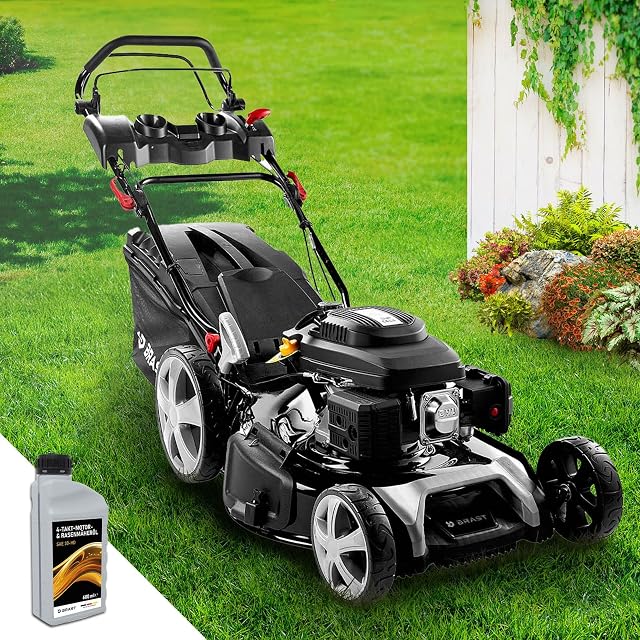
  1. BRAST 55 cm, 5.2 kW

    55 cm, 224 cm³, 5.2 kW, rear drive, 60 L, 30–80 mm, 35.1 kg

    The widest deck and the only published weight in this family: 224 cm³, 55 cm, 35.1 kg, with assembled dimensions and both wheel sizes given.

    Best for: A large open lawn where width and engine matter more than the machine being easy to put away

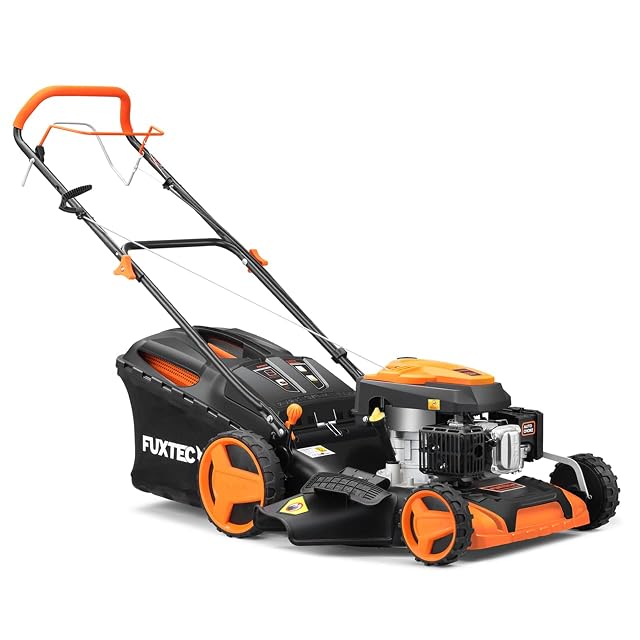
  2. Fuxtec FX-RM5196

    51 cm, 196 cm³, 6 PS, rear drive, 60 L, 25–75 mm

    A 196 cm³ rear-wheel-drive machine at 51 cm, with a 60-litre box and a central height range — the most completely specified listing in this family.

    Best for: A large lawn where the width is wanted and the specification needs to be readable before buying

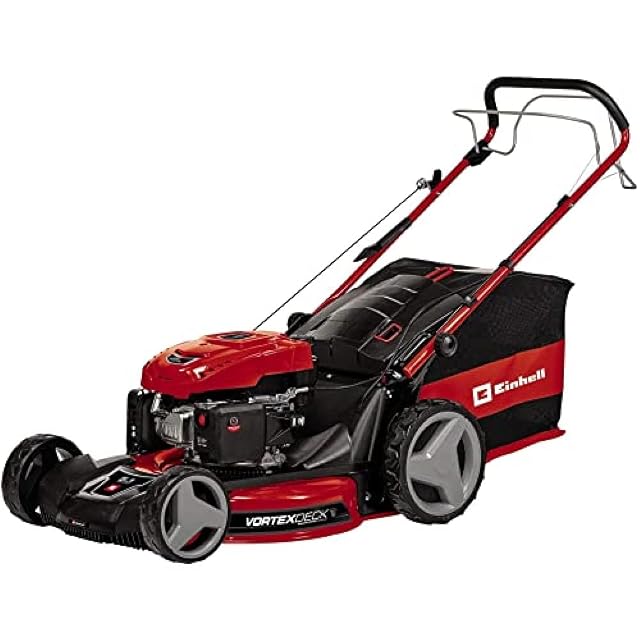
  3. Einhell GC-PM 56/2 S HW

    One-piece metal deck, disengageable rear drive, 80 L, 6 steps

    A one-piece metal deck, a disengageable rear drive and an 80-litre box with two emptying handles — the largest catcher in this family.

    Best for: A large lawn, for a buyer who already knows this maker’s range and does not need the listing to describe it

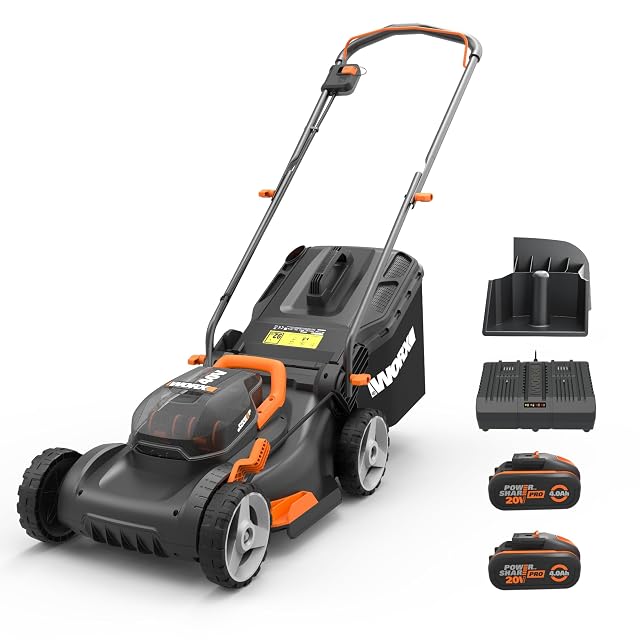
  4. WORX WG743E

    40 cm, 2× 20 V 4 Ah, load-sensing, 7 heights, 500 m² stated

    A load-sensing motor that raises power in thick grass, a deck shaped to cut close to fences, and a stated two-hour charge for both packs.

    Best for: A medium lawn with a lot of boundary, where the strip left for the shears is the annoyance

What this guide tends to leave open

How large is a large lawn?

Around the point where the number of passes starts to matter more than the shape. A 40 cm deck crossing 500 square metres is well over a kilometre of walking; a 55 cm deck is nearer 900 metres. Two of the picks here publish a stated area — 500 m² and 600 m² — and those figures are the only ones on this shelf that can be held against a lawn.

Does self-propelled matter or is it a luxury?

On a large lawn, and on any slope, it is the feature that decides whether the lawn gets finished. A petrol mower weighs around 35 kilograms and pushing it up a bank is the work, not the cutting. Three of these six drive their own rear wheels; the other three are pushed.

Can a battery mower do a large lawn?

On one charge, up to the area its own packs cover — and only one listing on this shelf publishes that number. Two 20 V 4 Ah packs come to about 160 watt-hours, which one maker states covers 500 m². Beyond that it is a second set of packs and a pause, and at that point petrol is the simpler answer.

Why is the catcher volume the figure people forget?

Because a large lawn produces a great deal of grass and the cut is interrupted every time the bag fills. A 45 litre catcher on 600 square metres is a lot of walking to the heap; 60 or 80 litres is fewer stops. Two of these publish 60 L and one publishes 80 L, and two publish nothing at all.

Why each one, and for whom

BRAST 1004216001

For : A large open lawn where width and engine matter more than the machine being easy to put away

Main strength : The only published weight and the only published assembled dimensions in the family

Main limitation : 35.1 kg is a lot of machine to manoeuvre, store and lift into a car

Read the full review →

Fuxtec FX-RM5196SL

For : A large lawn where the width is wanted and the specification needs to be readable before buying

Main strength : The most complete specification in the family — width, displacement, drive, catcher and height range all stated

Main limitation : No weight published, on a 51 cm machine that will be heavy

Read the full review →

Einhell 3404860

For : A large lawn, for a buyer who already knows this maker’s range and does not need the listing to describe it

Main strength : The largest catcher in the family at 80 litres, with two emptying handles

Main limitation : Neither the cutting width nor the displacement is published anywhere in the listing

Read the full review →

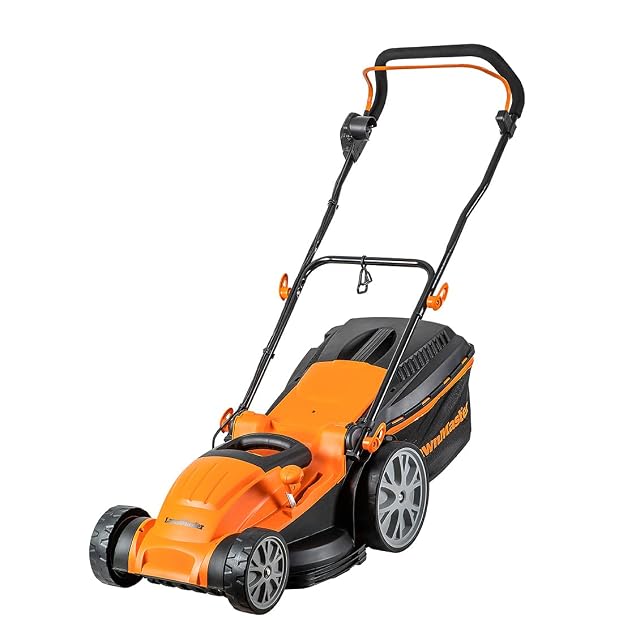
Lawnmaster MEB1840M-03

For : A large lawn near a socket, and particularly one that is usually cut a week later than it should be

Main strength : A motor that raises torque to hold blade speed when the grass thickens

Main limitation : No catcher volume published, on the widest machine here

Read the full review →

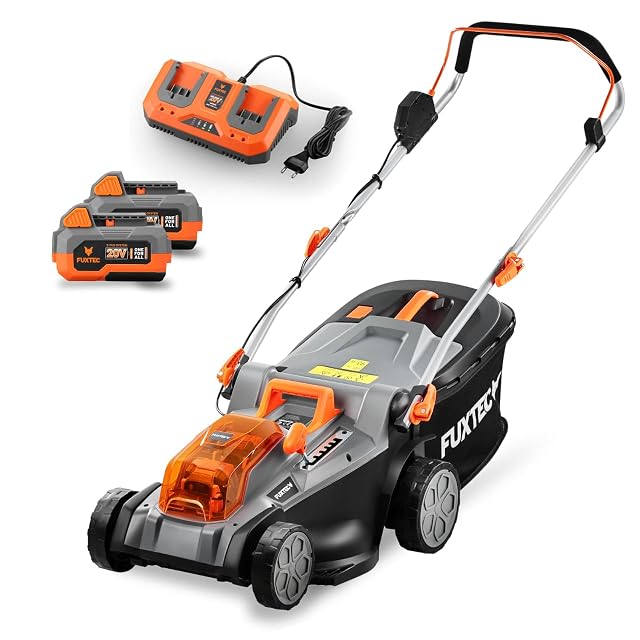
Fuxtec FX-E2RM43SET

For : A medium to large lawn where the whole job should finish in one session

Main strength : A twin charger, so both packs fill in one session rather than two

Main limitation : No weight published, on a 43 cm machine carrying two packs

Read the full review →

WORX WG743E

For : A medium lawn with a lot of boundary, where the strip left for the shears is the annoyance

Main strength : A motor that raises power when the grass thickens and drops it when it does not

Main limitation : No cutting-height range, only the number of positions

Read the full review →

Useful comparisons

Head-to-heads already published between two models from this guide or this aisle.

How this guide is built

The models here come from the catalogue of this site. Specifications are those published by the manufacturer and on the Amazon product page; prices are what Keepa reported on the date below, and both move. The ranking uses declared specifications, the balance of stated strengths and limitations, and price. No product on this site has been physically tested, and nothing here claims otherwise.

Last checked on

The tool we use ourselves

Model settled? Then find out whether the figure next to it means anything at all.

A mower gets bought when the grass is already too long, which is the worst possible moment to weigh up a price: demand on this shelf climbs from March and drops away after July, so a price struck through in May tells you nothing whatever about what the same reference cost in October. UniverTrack keeps a week-by-week record for each retailer, so a cut price can be set against one somebody really paid rather than one composed for the banner — and it says when ordering is genuinely the moment.

Real price historyBuy-now alertsAI buying assistant
Try free for 14 days →
No commitment · Cancel in one click · 5 languages