Boundary wire
SHANHUI 250 m Kupfer-Begrenzungskabel
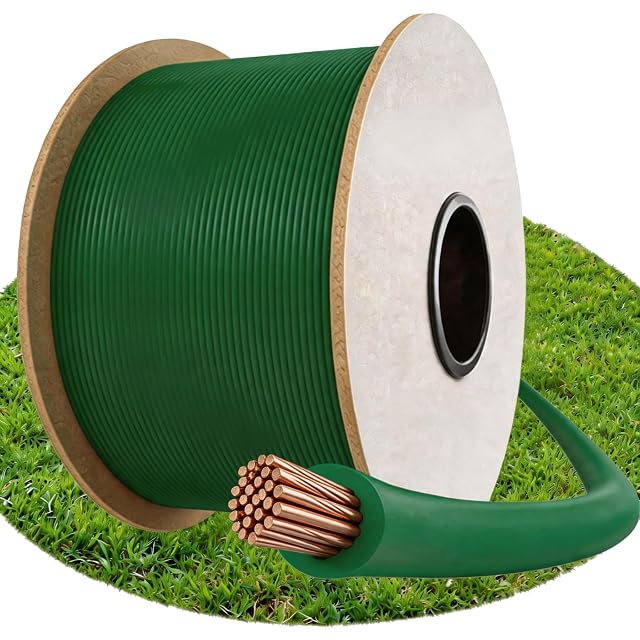
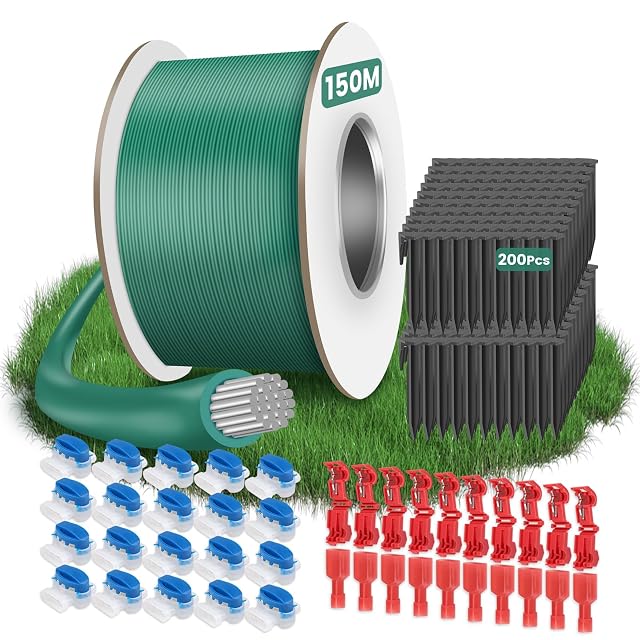
The longest run here — 250 m of 24-strand tinned copper-clad aluminium in LLDPE, with quick-connect clamps.
What the maker prints on its own page
A 2.7 mm core of tinned, copper-coated aluminium with 24 individual strands,
stated to give maximum conductivity and a stable magnetic field at the lawn
edge, so the robot detects the boundary precisely and never leaves the defined
area. Usable as a boundary, search and guide wire.
Fully compatible with ten named brands. The maker argues that, unlike
error-prone camera systems, a physical cable edge gives precise positioning even
in shade or poor light, and works as an invisible fence protecting beds, shrubs
and plants.
Available in four standard lengths — 25, 50, 150 and 250 m. Described as
extremely tensile and flexible, resisting being walked on, buried and mown
without tearing, with a paper spool for smooth, knot-free laying and T1
quick-connect clamps for fast wiring.
An LLDPE outer sheath, stated as UV-stable and resistant to rain, snow and
frost and to cracking and ageing, above ground or buried.
The argument for wire
Buried in the second feature line is the clearest statement on this site of why
anybody still lays a cable in 2026:
Unlike error-prone camera systems, the physical cable edge delivers precise
positioning even in shade or poor light.
That is correct and it is the whole case. A wire does not care about a canopy,
a shadow, a wet dusk or an overgrown bed edge. Every wire-free system on the
robot shelf depends on seeing or on a satellite signal, and both have weather.
What a wire has instead is a spade.
250 metres
The longest run here and the cheapest per metre by a wide margin.
It is also where the conductor material matters most. Copper-clad aluminium has
a higher resistance than copper at the same section, and the voltage lost along
a loop grows with its length. Nobody on this shelf publishes a resistance per
metre, so the honest position is that the difference exists and cannot be
quantified from these listings.
The garbled line
The third feature line reads, in substance, “after unpacking the complete
boundary system can be laid — additional parts needed”, which looks like a
negation lost in translation.
This page prints the sentence as published. Guessing at what a listing meant to
say is how a site starts inventing specifications.
What the box does not hold
Pegs. 250 metres of wire wants somewhere between 250 and 500 of them, and they
are a separate purchase — which at this price per metre still leaves the total
below most of this shelf.
Availability
From 29 € to 41 €, that being the spread across the German, French, Italian and Spanish Amazon stores on the day of the survey.
Beyond the euro zone, the British Amazon store prices it in its own currency, which the spread above sets aside.
Listed and unsold: the American Amazon catalogue holds the reference with nobody behind it.
Taken from Keepa on the day this page was last revised; stock and prices move without notice.
Prices quoted in this text were read on 26 September 2026. The live price is at the top of the page.