The distinction this whole shelf depends on
Two different products are sold under the name “lawn edging”, and they do not do
the same job.
A bed border stands above the soil. Its purpose is separation: it keeps bark
mulch in, gravel out, and rhizomes from travelling. You can see it, and it is a
design element.
A mowing edge is set flush with the lawn. Its purpose is that a mower wheel can
run along it, so the blade reaches right to the boundary and there is nothing left
to trim.
Those are opposite requirements. A barrier has to stand proud; a mowing edge has to
be level.
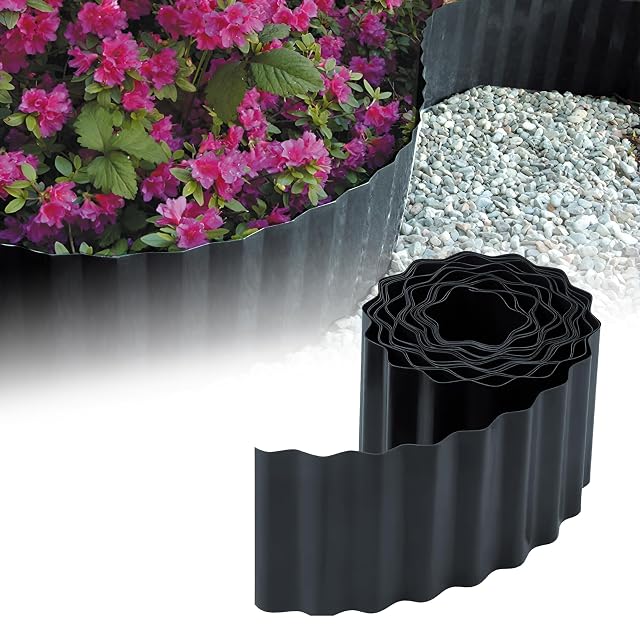
This is the first kind, and at 20 cm it is emphatically the first kind. Nothing
about it lets a mower reach the grass beside it, and a strip along its whole 9
metres will still need a trimmer.
Two products on this shelf are sold as mowing edges — one names robot mower
compatibility, the other states that mower wheels can run along it. Five, including
this one, are bed borders wearing the name.
What 20 cm is genuinely for
The tallest product on this shelf, and the height has one real use: stopping
roots.
The plants that ruin a border from the lawn side travel by rhizomes — couch
grass above all, plus ground elder, mint and bamboo. They run horizontally in the
top 10 to 15 cm of soil and come up on the other side of whatever is in the way.
A continuous barrier buried through that layer cuts them off. Nothing else on this
shelf is tall enough to do it properly: the metal edgings here are 11 to 18 cm, and
most of that has to stay above ground to be visible.
The condition is that it must be buried. Twenty centimetres standing on the
surface with two in the ground is a trip hazard that stops nothing.
And the corollary nobody mentions
A continuous plastic barrier also stops water and earthworms.
On free-draining soil that is irrelevant. On a heavy clay bed against a lawn, a
20 cm plastic wall buried to full depth can hold water on one side of it — and a
waterlogged bed edge is exactly where the grass thins and moss gets in, which is
what this site’s moss killer shelf spends its time on.
Nothing on this shelf is perforated. Corten and galvanised edging has the same
property; it is simply less often buried deep enough to matter.
What goes unpublished
No thickness. That is the specification of any edging, and it is what decides
whether it holds a curve or ripples. Two metal products on this shelf publish theirs
— 0.7 mm galvanised and 0.6 mm Corten — and it is the figure to compare
them on.
No fixing method. The listing says installation is simple and quick, three times
in different words, and never says how it is held. Products on this shelf variously
supply ground anchors, earth clips with cutting teeth, colour-coded pins,
or rely on being hammered in.
A plastic edging with nothing holding it works loose: frost lifts it, a mower
catches it, and it ends up leaning.
Five feature lines saying one thing
The listing publishes five bullet points, and between them they contain: flexible,
weather-resistant, easy to install, suitable for beds and paths, and adaptable to
curves or straight runs — each repeated across several of the five with different
adjectives.
No thickness. No fixing. No UV rating. No temperature range.
That last one is worth naming, because plastic edging’s real failure mode is
cold. It goes brittle below a few degrees, and the moment it breaks is when
somebody catches it with a mower in March.
The wavy profile
The “wave” in the name is a corrugation along the top.
It serves two purposes and one of them is structural. Decoratively it softens a hard
line. Structurally, a corrugation stiffens a thin sheet against buckling — the same
reason the flat-backed water tank on this site’s rain barrel shelf is dimpled.
For a plastic edging at an unpublished thickness, that stiffening is probably doing
real work.
The price, stated plainly
About 1.11 € per metre at the German price recorded here.
Across this shelf: galvanised steel at about 3.10 €, Corten at 3.83 €,
4.70 €, 5.00 € and 6.32 €, and recycled rubber at about 15.00 € per
metre.
A factor of 13.5 between the two ends, for a product that occupies the same line
on the ground.
What the money buys, further up the shelf, is: steel that holds a shape rather than
following the ground, a folded safe top edge, published thickness, supplied anchors,
and in one case a third-party flexibility certificate. Whether a bed edge needs any
of that is a fair question, and 9 metres for the price of a bag of compost is a
defensible answer.
Availability
Around 10 €, read at the German Amazon store on the day of the survey.
Beyond the euro zone, the American and British Amazon stores price it in their own currencies, which the spread above sets aside.
More than 1.6× the cheapest country at the French, Italian and Spanish Amazon stores; a gap of that size normally means forwarded stock rather than a seller on the ground, so the spread above leaves it out.
Taken from Keepa on the day this page was last revised; stock and prices move without notice.
Prices quoted in this text were read on 26 September 2026. The live price is at the top of the page.