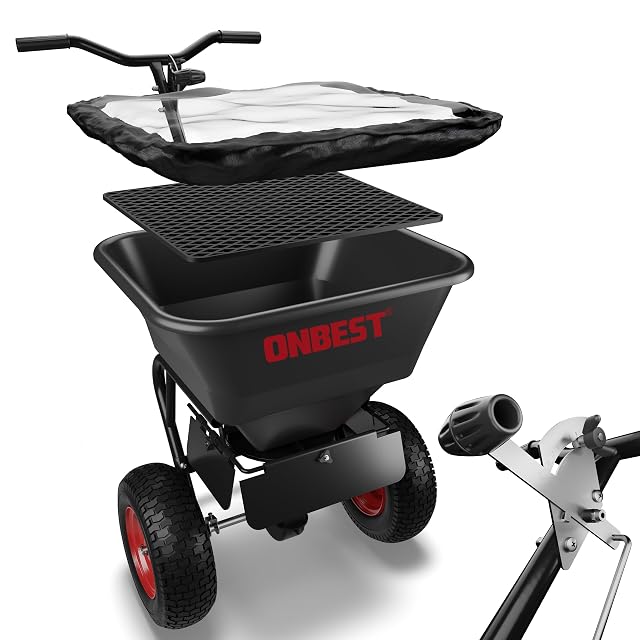
Forty-one centimetres, and fifteen litres
The combination is the reason this is on the shelf.
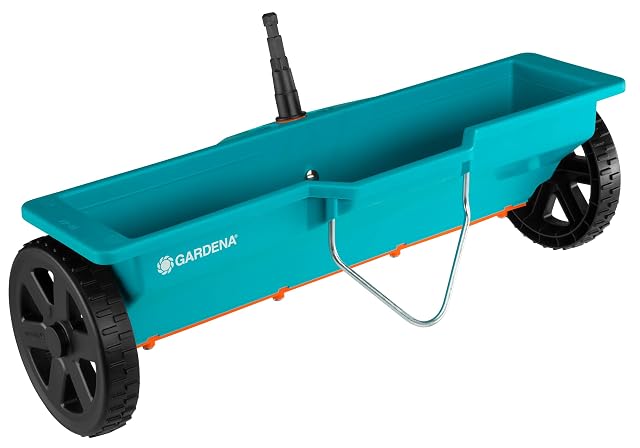
The other drop spreader here is 40 cm and does not publish a hopper capacity at
all — and arrives without a handle.
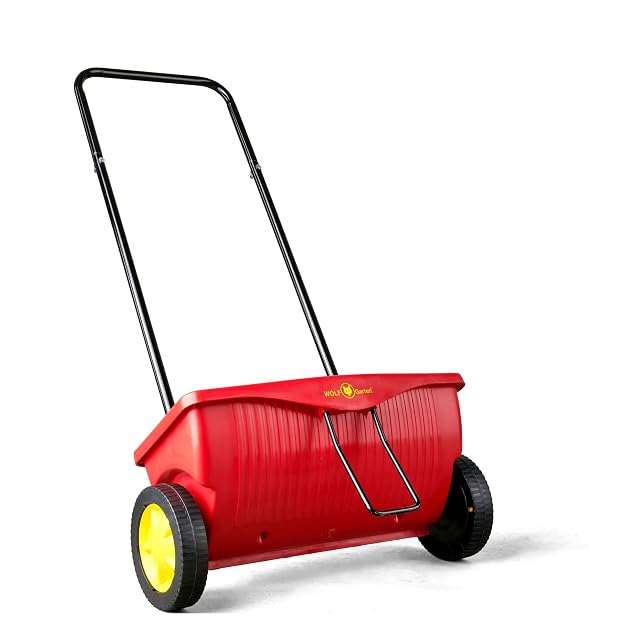
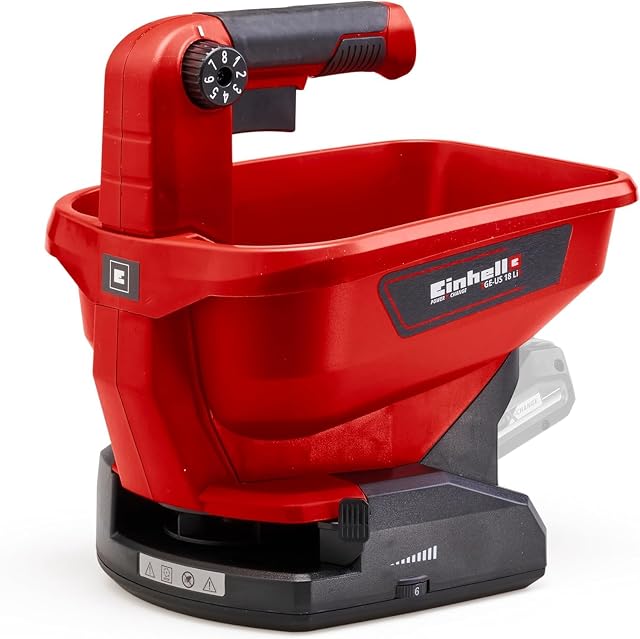
The handheld battery spreaders here hold 3.3 and 4 litres. The broadcast
walk-behinds hold 12 and 45.
So this is the accurate pattern with real capacity behind it, complete in the
box.
Why the narrow pattern is the accurate one
A drop spreader opens a slot along the bottom of the hopper and material
falls straight down between the wheels. What it treats is exactly its own width,
at the same rate all the way across, with a hard edge on each side.
A broadcast spreader throws material outward off a spinning or oscillating
plate. It covers two to five metres a pass — and the cone it throws is denser
near the middle than at the edges.
That means passes have to overlap, by roughly the right amount, or the lawn
records the error.
Too little overlap leaves a pale strip where neither pass reached full rate. Too
much leaves a dark strip where two cones stacked, and with a nitrogen feed a
double dose scorches.
Neither appears on the day. Both appear about ten days later, as stripes, and
then they stay for weeks.
A drop spreader’s failure mode is a missed strip, which is visible
immediately and can be walked again.
Fifteen litres, and what it means in passes
At 41 cm wide, covering 200 m² means roughly 500 metres of walking.
A hopper that runs dry a third of the way through means doing that with two trips
back to the bag, a scoop, and a guess about where you stopped.
Fifteen litres of granular lawn feed is a meaningful quantity — enough for a
typical domestic lawn in one fill at normal rates.
The winter job
Named in the listing as its second life: salt, sand and grit for snow and ice.
It is a real argument for the machine, because a spreader is otherwise used twice
a year. Used for grit as well, it earns its shed space.
And it sharpens the one maintenance rule this whole shelf shares.
Fertiliser is a salt. De-icing grit is a salt. Both draw moisture out of the
air, both set into a solid cake in a hopper, and both corrode steel and seize
mechanisms.
A spreader that has been used for either and put away loaded does not work next
season. The other drop spreader on this shelf makes a point of being washable
with a hose, and that is the correct habit for this one too: empty it, rinse it,
dry it, then put it away.
What goes unpublished
No metering detail whatsoever.
The listing says the spreader is usable for seed, fertiliser, sand and
everything else, and adjustable — and gives no settings, no scale, and no
indication of what a setting delivers.
That is the gap across almost all of this shelf. A lawn feed is applied at
something like 20 to 40 g/m² and grass seed at 20 to 30 g/m², and the difference
between those and a wrong setting is a scorched lawn or a wasted bag.
One spreader on this shelf maps its numbered settings to material — fine seed,
medium fertiliser, coarse salt — and it is the only one that acknowledges those
three flow differently.
Everything else here, including this, leaves the calibration to trial on a path.
Availability
From 37 € to 50 €, that being the spread across the German and Italian Amazon stores on the day of the survey.
Beyond the euro zone, the American and British Amazon stores price it in their own currencies, which the spread above sets aside.
Nothing came back from the French and Spanish Amazon stores at all; the buy button there runs a search rather than opening an empty page.
Taken from Keepa on the day this page was last revised; stock and prices move without notice.
Prices quoted in this text were read on 26 September 2026. The live price is at the top of the page.