Skip to content

Robot mowers that need no perimeter wire

Every robot here navigates without a buried wire, which removes a day of work and a permanent fault line from the lawn. What replaces it is a positioning system, and the systems fail in different ways: satellites lose accuracy under trees, cameras need light, and LiDAR needs a shape to recognise. This guide is sorted by the two figures that decide whether a given garden suits a robot at all — the slope limit and the narrowest passage.

What the wire was for, and what it cost

A traditional robot mower works inside a perimeter wire pegged or buried just inside the edge of the lawn. The mower detects the field around it and turns away.

It works, reliably, and it costs three things:

A day. Laying a wire round a garden with beds, trees and a path across it is a real job, and it has to be done accurately because the wire is the boundary.

A permanent fault line. A wire cut by a spade, a scarifier or a mole is a robot that stops working and gives almost no clue where the break is.

Flexibility. Moving a bed means moving the wire.

Every robot on this page removes all three. What it puts in their place is a positioning system, and those fail differently.

The three systems, and how each one breaks

Satellite positioning with a reference station. Two of these use it, one of them backed up by a visual system specifically for weak-signal areas. It is precise in the open — centimetre accuracy is the point of a reference station — and it degrades where the sky is obstructed. A garden with a mature canopy, a high wall or a narrow passage between buildings is exactly where it struggles, which is why one maker publishes a visual fallback and the other does not.

Cameras with on-board recognition. Three of these navigate by vision, one with three cameras, one with an HDR camera and ultrasound, one with a full-HD camera whose model is stated to update over the air. Vision needs light and it needs to recognise what it sees. It does not care about tree cover, and it is the only system on this page that is claimed to improve after purchase.

LiDAR. One of these uses 3D LiDAR with vision, and it publishes the only accuracy figure in the group: it follows an edge within 5 cm. LiDAR measures distance directly by timing a light pulse, which means it works in the dark and does not depend on recognising anything.

None of the six publishes a mapping accuracy figure except that one edge distance, which is why it is worth reading.

The slope limit, which is the figure to check first

Across these six the published figures are 50 per cent, 45 per cent, 45 per cent and 45 per cent — and two publish nothing at all.

Forty-five per cent is about 24 degrees. Fifty per cent is 26.

That is the commonest reason a robot mower goes back. A bank steeper than the stated figure means wheels that spin, a machine that beaches sideways, and a strip of lawn that is never cut — and a robot that keeps trying is a robot that wears a bare patch at the bottom of the slope.

Measure the steepest part, not the average. A lawn that runs gently down and then drops the last two metres to a patio is a 45 per cent lawn at the bottom.

One of these also publishes a 3 cm obstacle clearance, which is the related figure: a lawn edge, a tree root or the lip of a path is what stops a robot on the flat.

The passage width, which is the figure people discover afterwards

Two of these publish one: 55 cm and 60 cm.

It exists because a garden is rarely one lawn. It is a front and a back, or a main lawn and a strip behind the shed, connected by a gap — between a fence and a wall, down the side of a path, through a gate.

A robot that cannot fit through the gap will never cut what is on the other side of it, and no amount of mapping fixes that. It is a tape-measure question and it takes thirty seconds.

The area figures, and how to read them

3 000 m² on one. 600 m² on two. 500 m², 190 mm of cut on another, and 100 m² and 150 m² at the small end of the shelf.

Those are the makers’ own figures and they assume the robot runs on a schedule that suits the lawn. A robot is not a mower that cuts a lawn in one go; it is a machine that removes two or three millimetres a day and never lets the grass get long.

Which is also why the cutting height range matters more than it looks. Three of these publish one — 30 to 100 mm, 30 to 80 mm in 10 mm steps, and 20 to 60 mm — and a robot whose range stops at 60 mm cannot keep a lawn at the height that shades out weeds and survives a dry August.

And the thing a wire-free robot still cannot do

Cut the edge.

Every robot on this page turns away from a boundary, and the last few centimetres against a wall, a fence or a bed stay longer than the rest. One of them claims to follow an edge within 5 cm, which is the best figure here and is not zero.

The answer is on two other shelves of this site: a mowing edge that the machine can run over rather than turn away from, or a pair of hand shears with a rotating head for the strip against the wall. On a robot-mown lawn, one of those two is not optional.
The short list, and the reasoning behind its order

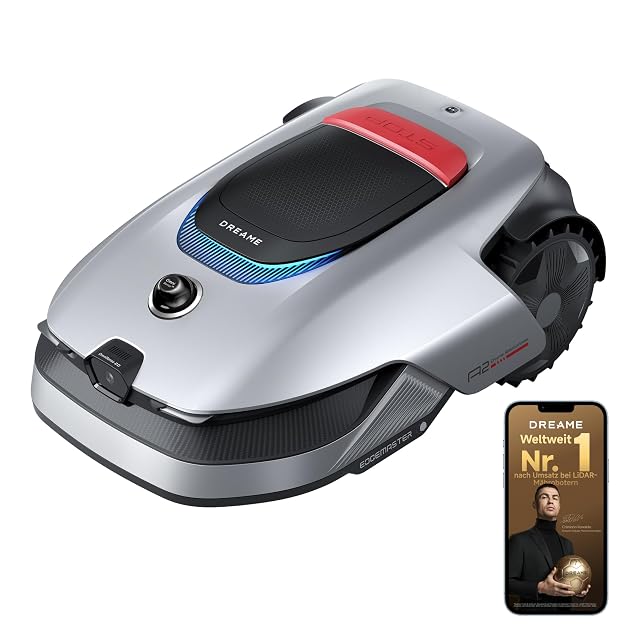
  1. dreame A2 1200

    3D + HDR camera, mapping to 3 000 m², 50 % slope, under 55 dB

    Long-range 3D scanning with an HDR camera, an extending cutting head for edges, a 26.5° slope and a camera that patrols the garden.

    Best for: A large garden with slopes and a lot of edge, for an owner comfortable with an app and a camera

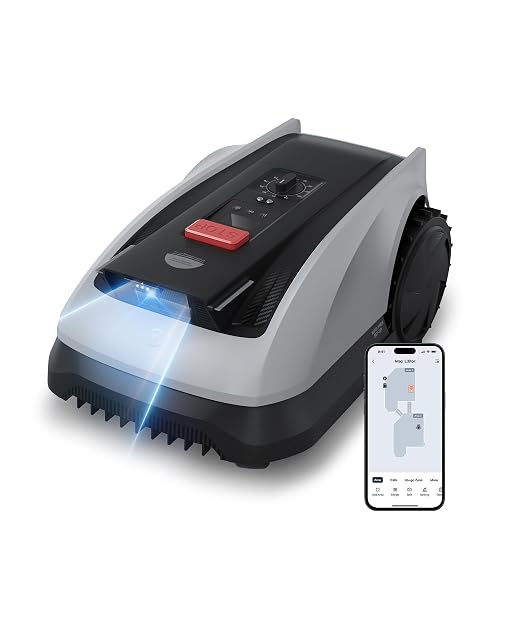
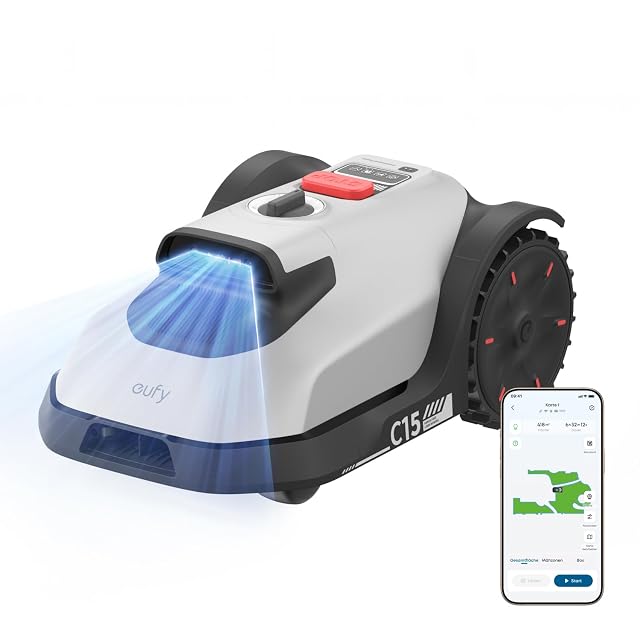
  2. eufy C15

    Vision, 500 m², 60 cm passages, 300+ obstacles, 58 dB stated

    Camera navigation with animal detection, 60 cm passages, edge riding, and a stated 58 dB — with no indication of which decibel it is.

    Best for: A medium garden with wildlife in it, where the machine will be scheduled and forgotten

What this guide tends to leave open

What actually replaces the wire?

Three different things across these six. Satellite positioning with a reference station, which is precise in the open and degrades under a canopy. Cameras with on-board recognition, which work anywhere there is light. And LiDAR, which measures distance directly and does not care about light at all. One of these publishes an edge accuracy figure — within 5 cm.

Which figure matters most?

The slope limit, because it is the commonest reason a robot is returned. The published figures here run from 45 per cent on three machines to 50 per cent on one, and 45 per cent is about 24 degrees. A bank steeper than the stated figure means wheels that spin and a strip that never gets cut.

Why does passage width appear in the specifications?

Because a garden is not one lawn, it is several connected by gaps — between a shed and a fence, down the side of a path. A robot that cannot get through the gap will never cut what is beyond it. Two of these publish a figure: 55 cm and 60 cm.

Do wire-free robots really map the garden themselves?

They build a map on a first guided or automatic run and then store it, and every one of these six is editable in an app afterwards — no-go zones around a pond or a bed, and separate schedules per area. What none of them publishes is a mapping accuracy figure, which is why the edge-distance claim on one of them is worth reading.

Why each one, and for whom

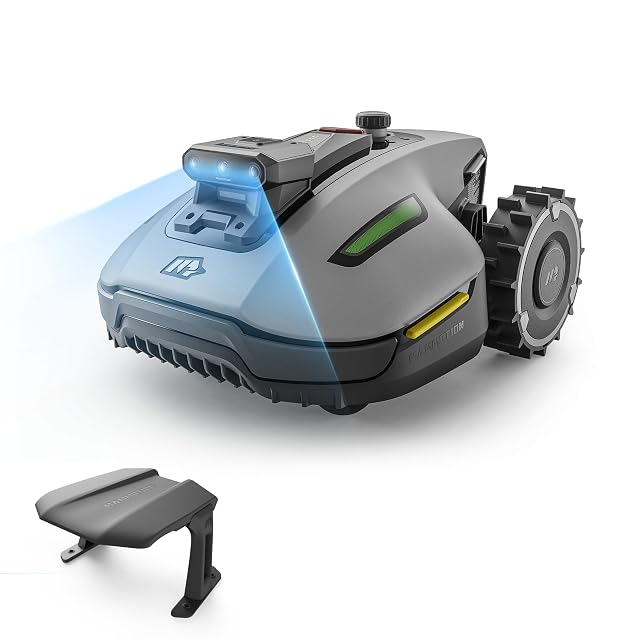
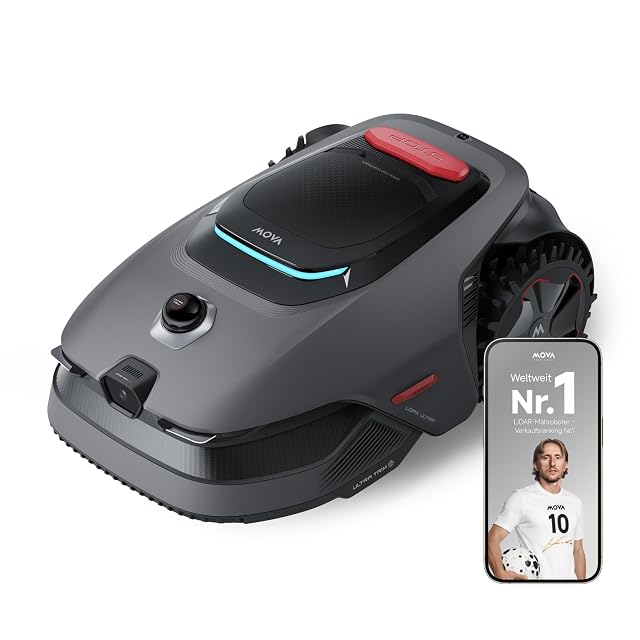
MOVA MXXM4100

For : A large, complicated garden with slopes, narrow links and a lot of hard edge

Main strength : The widest cutting-height range on the shelf, 3 to 10 cm

Main limitation : The stated area appears only in the model name, not as a published figure

Read the full review →

dreame MXXA8203

For : A large garden with slopes and a lot of edge, for an owner comfortable with an app and a camera

Main strength : The longest sensing range stated on this shelf, at 70 metres

Main limitation : The decibel figure does not say whether it is sound power or sound pressure

Read the full review →

ECOVACS O600 RTK

For : An open garden of moderate size with slopes and narrow links between areas

Main strength : A visual fallback stated for weak-signal areas, which is where RTK alone fails

Main limitation : A reference station is part of an RTK installation and its siting is a real constraint

Read the full review →

Mammotion YMVS3

For : A garden of several small linked areas with narrow gaps between them

Main strength : A published cutting width and a published cutting system — five free-swinging razors

Main limitation : No charge time and no weight

Read the full review →

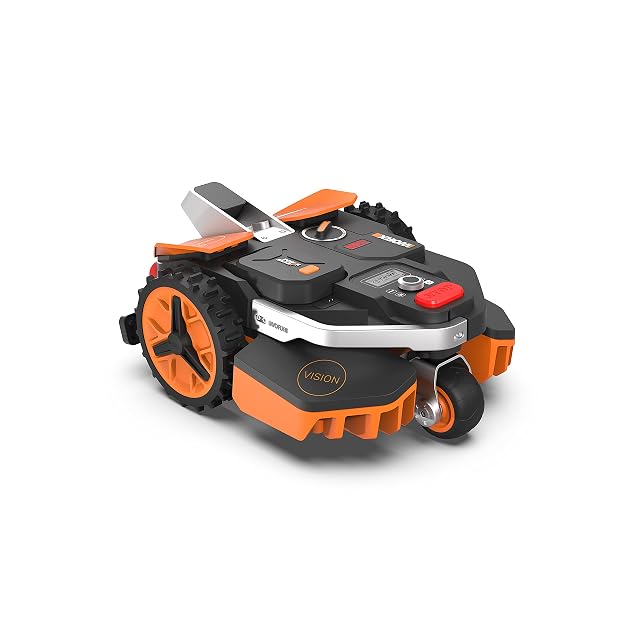
WORX WR206E.1

For : A garden of two or three linked lawns where nothing should be buried or bolted down

Main strength : The simplest installation on the shelf: a dock, and nothing else to place

Main limitation : No cutting height range, no slope figure, no battery — an unusually thin specification

Read the full review →

eufy T280B

For : A medium garden with wildlife in it, where the machine will be scheduled and forgotten

Main strength : A noise figure at all, which only one other robot here publishes

Main limitation : The decibel figure does not say whether it is sound power or sound pressure

Read the full review →

Useful comparisons

Head-to-heads already published between two models from this guide or this aisle.

How this guide is built

The models here come from the catalogue of this site. Specifications are those published by the manufacturer and on the Amazon product page; prices are what Keepa reported on the date below, and both move. The ranking uses declared specifications, the balance of stated strengths and limitations, and price. No product on this site has been physically tested, and nothing here claims otherwise.

Last checked on

The tool we use ourselves

Model settled? Then find out whether the figure next to it means anything at all.

A mower gets bought when the grass is already too long, which is the worst possible moment to weigh up a price: demand on this shelf climbs from March and drops away after July, so a price struck through in May tells you nothing whatever about what the same reference cost in October. UniverTrack keeps a week-by-week record for each retailer, so a cut price can be set against one somebody really paid rather than one composed for the banner — and it says when ordering is genuinely the moment.

Real price historyBuy-now alertsAI buying assistant
Try free for 14 days →
No commitment · Cancel in one click · 5 languages