Skip to content

Preparing ground for a new lawn

Tillers are sold on width and depth, and for a lawn the depth figures are almost all more than is wanted. Grass germinates in the top centimetre and roots in the top fifteen; a machine that goes to 33 cm is a vegetable-bed tool being used on a seedbed. These six run from 30 to 85 cm wide and 200 to 330 mm deep, and the guide is which end of each range a lawn actually needs.

The depth figures are mostly more than a lawn wants

Across these six: 200 mm, 205 mm, 220 mm, 220 mm, 240 mm and 330 mm.

And a lawn needs the bottom of that range.

Grass germinates in the top centimetre. Seed needs soil contact and light and must not be buried, which is why this site’s seed shelf keeps returning to the same point: seed sown too deep does not come up.

Grass roots in the top fifteen centimetres. Deeper on a good soil, and far deeper for drought tolerance in a fescue mix — but the working zone that a machine can usefully prepare is the first 15 to 20.

So a tiller reaching 330 mm is not doing a better job on a seedbed. It is doing a vegetable bed job, which is a different depth for a different reason.

What the tiller is actually for on a lawn

Three things, and none of them is turning soil over.

Breaking a compacted surface. Made-up ground, a builder’s finish, a former path, the strip where a skip stood. That soil is compressed and grass will not root into it, and a tiller is the fastest way to open it.

Mixing a dressing in rather than laying it on. This is the important one. This site’s lawn soil shelf carries graded washed sand at 0.4 to 1.4 mm and 0.3 to 1.5 mm, and substrate with a starter feed — and sand laid on a clay soil does nothing, while sand mixed in to 150 mm changes how it drains. A tiller is how the second happens.

Levelling. Tilled ground can be raked and rolled flat. Untilled ground can only be raked.

And the one job it is the wrong tool for

An existing lawn.

A tiller destroys turf, which is the point. Overseeding a lawn that is already there is a scarifier’s job — open the surface, sow into the gaps, top-dress lightly. A tiller on an established lawn is starting again.

That distinction is worth stating because the two machines look alike from a distance and one of them is a renovation tool while the other is a demolition tool.

Electric or petrol, and the figure that decides

Across these six: four mains machines at 750 W, 1050 W, 1500 W and 1500 W, covering 30 cm to 45 cm wide; and two petrol at 3 kW / 4.08 PS and 5.5 PS, covering 60 cm to 85 cm.

For a lawn seedbed the mains machines are the answer, and the reason is not power.

It is weight and handling. One of the mains machines publishes 11 kg, which is a tool carried to the bed in one hand. A petrol tiller at 60 to 85 cm wide is a machine to be walked, turned and wrestled, and a garden being prepared for a lawn is usually a garden with a fence round it and a narrow gate.

And width is not a virtue here. A 30 cm tiller gets between a bed and a path; a 60 cm one does not. On a lawn-sized area the narrow machine takes more passes and gets into the corners, which is exactly the trade this site’s mower shelves make in the same direction.

The petrol machines earn their place on genuinely rough ground — clearing a paddock, breaking an unused plot — and one of them publishes something the others do not: forward and reverse, with widths of 36, 57 and 85 cm. Reverse on a tiller is a real convenience, because a tiller that has dug itself in has no other way out.

The specifications worth reading past width and depth

Blade count. Across these six: 4, 16, 24, 24 and 24, with one machine publishing none. More blades work the soil finer in one pass; fewer dig rather than pulverise. Four blades on a 30 cm machine is a different tool from 24 on a 45 cm one.

Rotation speed. Only two publish one, both at 400 min⁻¹. This is the figure that describes the work — faster tines break soil finer and throw stones harder — and four of these six omit it.

The anti-jam clutch. One publishes one, with a guard plate and a 205 mm blade diameter. That is the feature to want on made-up ground, and the mechanism is straightforward: a 1500 W motor driving 24 blades into soil containing a brick has to yield somewhere, and a clutch decides whether that is the drive or the gearbox.

The safety switches. One machine publishes a two-point safety switch and a strain relief, and another a protection switch against unintended starting. On a tool whose working parts are spinning steel at ankle height, and whose cable runs behind it, both are the right things to engineer.

Folding handles and transport wheels. Three publish a folding handle, and two publish transport wheels — one folding, one manually adjustable. A tiller has to be moved and stored, and a machine that folds is a machine that fits behind a shed door.

The order the work goes in

One: clear and kill. Anything green has to go, and perennial weeds have to be dealt with before the soil is disturbed — tilling a patch of couch grass multiplies it, because every rhizome fragment is a new plant.

Two: till. Two passes at right angles, to 150 to 200 mm, and no deeper on a lawn.

Three: rake and remove. Stones, roots, debris. This is the step that decides what the lawn looks like in three years, because everything left in is something a mower will find.

Four: firm it. Not roll it flat — firm it, by treading or with a light roller. Tilled soil is full of air pockets, and a seedbed that has not been consolidated settles unevenly afterwards and the lawn goes lumpy. This site’s lawn roller shelf covers the tool and the one caution that matters: heavy rolling on wet clay compacts the root zone, which is what a tiller was just used to undo.

Five: rake level, sow, and keep it damp. The seed shelf publishes rates of 20 to 30 g/m² and germination thresholds of 8 and 10 °C — and the condition that decides everything is that a germinating seedbed must not dry out once.
The short list, and the reasoning behind its order

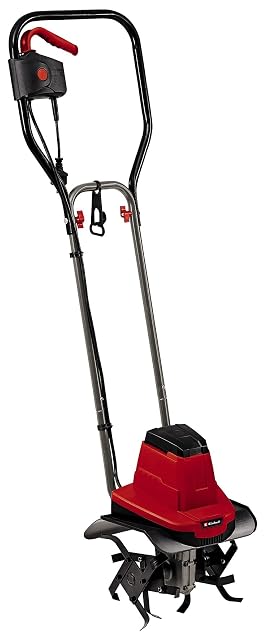
  1. Einhell GC-RT 7530

    750 W, 30 cm wide, 200 mm deep, 4 blades, folding handle

    Four blades on 30 cm at 750 W, with a folding handle, a two-point safety switch and a strain relief — the smallest tiller here.

    Best for: Flower beds and vegetable plots already in cultivation, rather than ground being broken

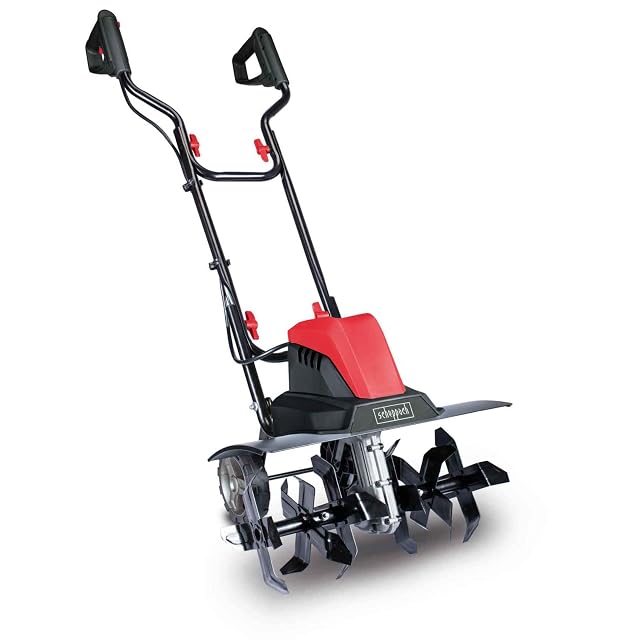
  2. Scheppach MTE460

    1500 W, 450 mm wide, 220 mm deep, 24 blades, 400 rpm

    1500 W and twenty-four blades at 400 rpm across 450 mm, 220 mm deep, with an instant start and a folding handle.

    Best for: A large bed or vegetable plot, and a buyer who wants to check the price against another country

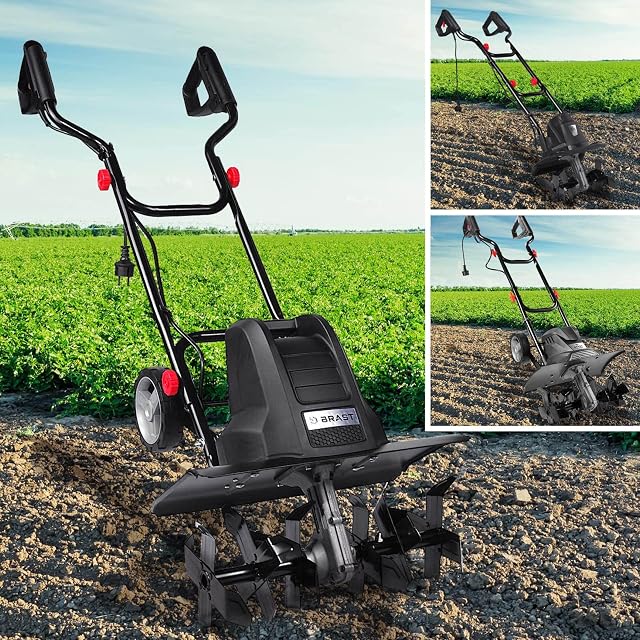
  3. BRAST BRE-AF 1500

    1500 W, 450 mm wide, 220 mm deep, 24 blades, 11 kg, 400 rpm

    The only tiller here with a weight, a speed and an anti-jam clutch: 11 kg, 400 rpm, 24 blades on 450 mm.

    Best for: A large vegetable plot worked every year, by somebody who expects to own the machine for a decade

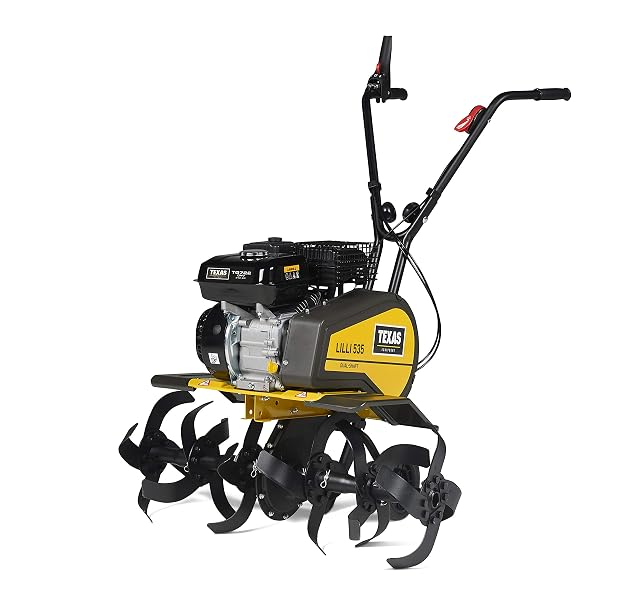
  4. Texas Lilli 535TG

    212 cm³, 5.5 PS, 36/57/85 cm, 33 cm deep, forward and reverse

    A variable 36, 57 or 85 cm width, 33 cm deep, with a separate gearbox for reverse and attachments available for ploughing and ridging.

    Best for: A large vegetable plot or smallholding worked seriously, where the machine will earn its price

What this guide tends to leave open

How deep does a lawn seedbed need to be tilled?

Fifteen to twenty centimetres is ample. Grass germinates in the top centimetre and the root zone is the top fifteen, so the job is breaking a compacted surface and mixing in a top dressing — not turning soil over. Four of these publish 200 to 220 mm, which is the right range; two go to 240 and 330 mm, which is deeper than a seedbed needs.

Electric or petrol for a lawn?

Electric, almost always. The four mains machines here are 750 to 1500 W at 30 to 45 cm, which breaks a domestic seedbed comfortably, and one publishes 11 kg — light enough to carry to the bed. The two petrol machines are 3 kW / 4.08 PS and 5.5 PS at 60 to 85 cm, which is ground-clearing equipment.

Do I need a tiller at all to sow a lawn?

On soil that is already open, no — a rake and a roller will do. A tiller earns its place on ground that is compacted, on a builder’s leftovers, and where a top dressing has to be mixed in rather than laid on. On an existing lawn being overseeded, a tiller is the wrong tool entirely; that is a scarifier’s job.

What is the anti-jam clutch for?

For the brick. A motor driving twenty-four blades into ground that contains a buried stone has to give way somewhere, and a clutch decides whether that is the soil or the gearbox. One of these six publishes one, along with a guard plate, and on made-up ground it is the feature worth paying for.

Why each one, and for whom

Einhell 3431050

For : Flower beds and vegetable plots already in cultivation, rather than ground being broken

Main strength : The lowest power and the narrowest width here, which on a small bed is the right pairing

Main limitation : Four blades on 30 cm is the sparsest arrangement on this shelf

Read the full review →

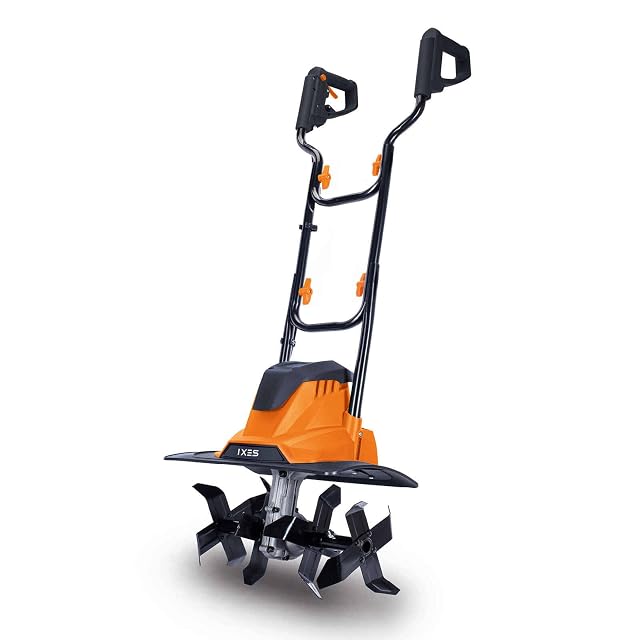
IXES 39123139978

For : Beds and vegetable plots that are worked every season and need a fine tilth

Main strength : Sixteen blades on 360 mm — a close spacing that works soil finely

Main limitation : No transport wheels stated

Read the full review →

Scheppach MTE460

For : A large bed or vegetable plot, and a buyer who wants to check the price against another country

Main strength : A published tine speed, which only one other machine here gives

Main limitation : No transport wheels stated, on a 450 mm machine

Read the full review →

BRAST 1004118001

For : A large vegetable plot worked every year, by somebody who expects to own the machine for a decade

Main strength : The only machine here with a weight, a tine diameter and a working speed

Main limitation : The listing covers four models at once, so width and wattage depend on the variant

Read the full review →

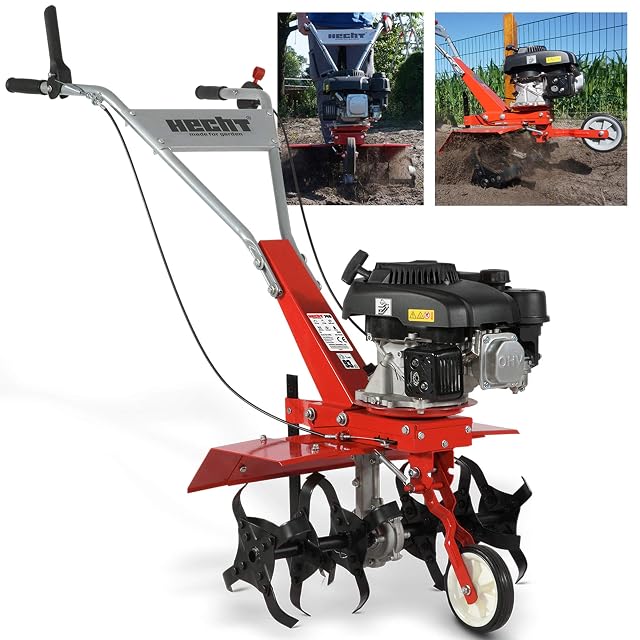
Hecht 8595614903882

For : Breaking or turning a large plot once or twice a year, away from any socket

Main strength : The widest tine assembly here except one, and the deepest bar two

Main limitation : Twenty-four blades across 60 cm is wide spacing — coarser work than the narrow machines

Read the full review →

Texas 90061118

For : A large vegetable plot or smallholding worked seriously, where the machine will earn its price

Main strength : A reverse gear on its own gearbox — unique on this site

Main limitation : The attachments are all extra: the carton contains the machine and the tine unit only

Read the full review →

Useful comparisons

Head-to-heads already published between two models from this guide or this aisle.

How this guide is built

The models here come from the catalogue of this site. Specifications are those published by the manufacturer and on the Amazon product page; prices are what Keepa reported on the date below, and both move. The ranking uses declared specifications, the balance of stated strengths and limitations, and price. No product on this site has been physically tested, and nothing here claims otherwise.

Last checked on

The tool we use ourselves

Model settled? Then find out whether the figure next to it means anything at all.

A mower gets bought when the grass is already too long, which is the worst possible moment to weigh up a price: demand on this shelf climbs from March and drops away after July, so a price struck through in May tells you nothing whatever about what the same reference cost in October. UniverTrack keeps a week-by-week record for each retailer, so a cut price can be set against one somebody really paid rather than one composed for the banner — and it says when ordering is genuinely the moment.

Real price historyBuy-now alertsAI buying assistant
Try free for 14 days →
No commitment · Cancel in one click · 5 languages